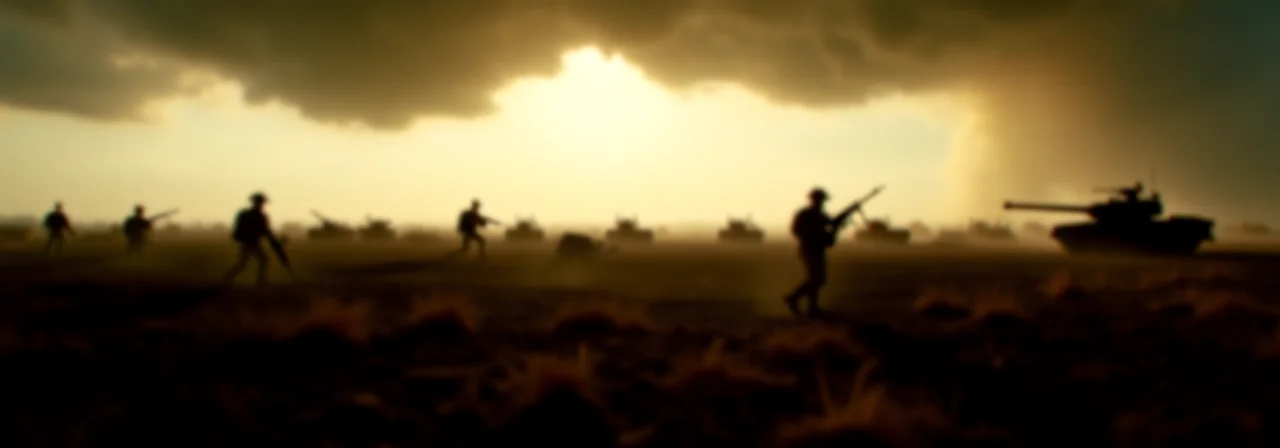
At 3:47pm GMT on a Wednesday, every weapon on Earth stops working. Simultaneously. Without warning.
Guns won't fire. The trigger pulls, the hammer falls, the primer doesn't ignite. Missiles sit inert on their rails. Warheads become expensive paperweights. Grenades are just lumps of metal with a pin in them. Every bomb, mine, torpedo, and artillery shell on the planet becomes as dangerous as a football.
The nuclear arsenals of nine nations, roughly 12,100 warheads as of 2024, are suddenly just very expensive containers of heavy metal. The Trident submarine off the coast of Scotland is now a very quiet underwater hotel.
The first hour
Nobody notices immediately. Most weapons aren't being fired at 3:47pm on a Wednesday. The overwhelming majority are sitting in armouries, warehouses, silos, and holsters being not used.
The exceptions are the active conflict zones. Soldiers in eastern Ukraine pull triggers and nothing happens. Both sides. Simultaneously. The confusion is total. Rifles are checked, cleared, rechecked, and tried again. Nothing. Magazines are swapped. Bolts are cycled. Different weapons are tried. None of them work.
Within the first hour, every active firefight on the planet stops. Not because anyone agreed to stop, but because the tools stopped cooperating.
What counts as a weapon?
This is the question that determines everything. If only purpose-built weapons stop working, that's one scenario. If anything used as a weapon stops working, that's a completely different world.
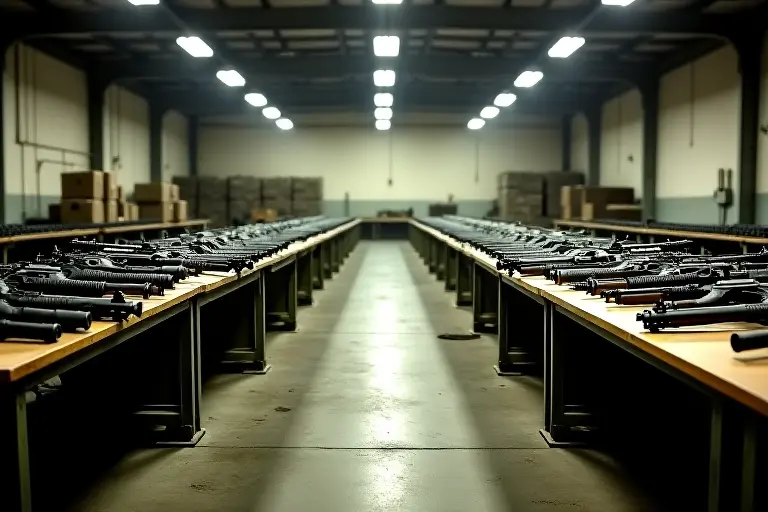
Let's go with the narrower definition. Objects designed and manufactured as weapons stop functioning. Guns, explosives, bladed weapons manufactured for combat (military knives, swords, bayonets), chemical weapons, biological weapons, nuclear weapons. All inert.
Kitchen knives still cut. Baseball bats still swing. A rock is still a rock. Fists, as mentioned, still work.
This matters because violence doesn't need weapons. It's just more efficient with them.
The military crisis
Every standing army on Earth is instantly reduced to a group of very fit people in matching outfits. The United States military, with an active force of 1.3 million and a defence budget of $886 billion in 2024, now commands an organisation whose primary assets don't function.
Aircraft carriers still float and move. Fighter jets still fly. Tanks still drive. But none of them can shoot anything. An F-35 without working missiles or guns is a very fast, very expensive commuter plane. A tank without a functioning cannon is a bulldozer with pretensions.
The chain of command would initially treat this as a technical failure. Something in the supply chain. A batch of bad ammunition. But when reports come in from every base, every branch, every country simultaneously, the realisation dawns that this is something else entirely.
Nuclear powers would panic the most. The doctrine of mutually assured destruction relies on the credible threat that your weapons work. If they don't, the entire strategic framework of the post-1945 world order evaporates in an afternoon.
Crime changes, not stops
In the UK, where firearms are already rare in civilian hands, the immediate impact on street crime is minimal. Most violent crime here involves knives, and kitchen knives still work because they're not manufactured as weapons. Stanley knives, screwdrivers, bottles. None of these were designed as weapons, so they're unaffected.
In the United States, where there are an estimated 393 million civilian-owned firearms (more guns than people), the shift is seismic. Armed robbery becomes unarmed robbery overnight. Mass shootings become mass... shoving? The gun isn't a deterrent any more. It's not a tool. It's a metal paperweight shaped like a gun.
Home invasion dynamics change completely. The homeowner's shotgun doesn't work. But neither does the intruder's pistol. Physical size and numbers become the decisive factors again, which is exactly how violence worked for most of human history.
Domestic violence, which rarely involves purpose-built weapons anyway, continues largely unaffected. This is a grim but important point. The most common forms of violence against people rely on hands, feet, and household objects. Disabling manufactured weapons doesn't touch this.
Police forces are suddenly unarmed
Armed police in the UK lose their Glock 17s and MP5s. They still have batons, handcuffs, PAVA spray, and Tasers (do Tasers count as weapons? They're manufactured as weapons. Let's say they're out too).
American police, who carry firearms as standard, are reduced to the same toolkit that British bobbies use. This is either terrifying or reassuring depending on your perspective and postcode.
The immediate effect on policing is that confrontations become physical. Officers trained primarily in firearm use find themselves in situations that require hand-to-hand skills they may not have practised since the academy. Meanwhile, criminals who relied on firearms for intimidation discover they now need to be physically imposing, which is a higher barrier to entry than buying a gun.
International relations reset overnight
Wars that were being fought stop. Not permanently, but the pause is real. You can't run an artillery bombardment with shells that won't explode. You can't enforce a naval blockade when your deck guns are ornamental.
But wars don't stop because the desire to fight stops. They stop because the tools break. And people are extremely creative about finding new tools.
Within days, militaries would begin repurposing non-weapon technology for combat. Vehicles become battering rams. Drones designed for surveillance are loaded with rocks. Aircraft designed for transport are used to drop heavy objects from altitude. Gravity still works. A crate of bricks dropped from a cargo plane is not a manufactured weapon. It's logistics with malicious intent.
Cyberwarfare becomes the primary strategic tool immediately. You can't shoot a server, but you could never shoot a server anyway. Hacking infrastructure, disabling power grids, disrupting communications: none of this requires a weapon as traditionally defined. Nations with strong cyber capabilities find themselves holding the only cards that still work.
The arms industry collapses
The global arms trade is worth approximately $130 billion annually. Every company in that supply chain, from Lockheed Martin to the smallest ammunition manufacturer, is suddenly producing objects that don't function. Share prices crater. Hundreds of thousands of jobs disappear.
But manufacturing doesn't stop. It pivots. If guns don't work, someone will build something that does. Compressed air launchers. Electromagnetic railguns (wait, do those count as weapons? They're designed as weapons. Inert). Crossbows might still work if they're recreational models repurposed, but military crossbows wouldn't.
The legal definition of "weapon" becomes the most litigated question in human history. Patent lawyers become the most important people in the military-industrial complex. If you can design something that hurts people but is technically classified as an agricultural tool, you've got a defence contract.
Does peace follow?
No. Not really. Peace requires more than the absence of weapons. It requires the absence of the desire to harm, or at least sufficient systems to manage that desire. Remove weapons and you remove efficiency. You don't remove intent.
The Rwandan genocide of 1994 killed approximately 800,000 people in 100 days. The primary weapons were machetes and clubs. Purpose-built military weapons played a role, but the scale of killing was achieved with tools that, in our scenario, would still function perfectly.
Humans have been killing each other since long before we had weapons. We used rocks. Sticks. Hands. The first purpose-built weapons are roughly 400,000 years old. The first evidence of interpersonal violence is older than that. Violence is not a technology problem. It's a human problem. And no Wednesday afternoon miracle fixes that, no matter how many triggers stop pulling.