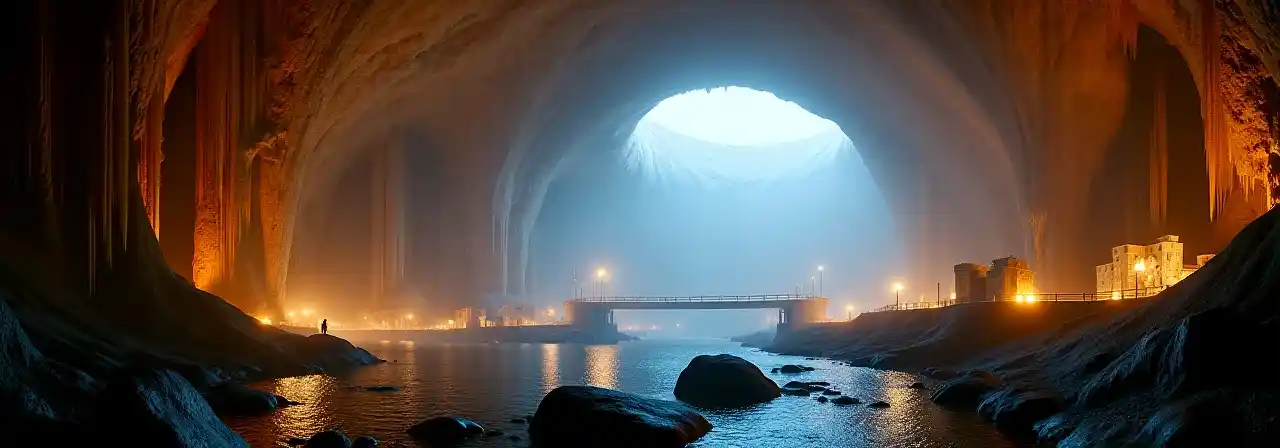
Humans have been living underground, intermittently, for thousands of years. The underground city of Derinkuyu in Cappadocia, Turkey, extends roughly 60 metres below the surface and could shelter 20,000 people. The residents carved it out of soft volcanic rock as protection against invaders. It worked. But they always came back up.
What if we didn't?
What if the entire human population moved permanently below ground: homes, cities, industry, agriculture, everything? The surface abandoned. Eight billion people living their entire lives without ever seeing the sky.
Why would we do this?
The obvious triggers are catastrophic: nuclear war rendering the surface uninhabitable, runaway climate change pushing temperatures beyond survivable limits, an asteroid impact throwing enough debris into the atmosphere to block sunlight for decades. The surface becomes hostile, and underground is the only option.
But there are less dramatic reasons too. Underground construction eliminates weather damage (no hurricanes, no flooding from above, no wind load on structures). It provides natural insulation (below about 10 metres, ground temperature in the UK sits at a steady 10-12°C year-round regardless of surface conditions). It frees the entire surface for rewilding or agriculture. On paper, there are arguments for it. On paper.
Digging the cities
The engineering is the easy part, relatively speaking. We already build deep. London's Crossrail tunnels run 40 metres below ground. Finland's Onkalo nuclear waste repository goes 450 metres down. Mining operations routinely work at depths of 2-3 kilometres. The TauTona gold mine in South Africa reaches 3.9 kilometres below the surface, where the rock temperature hits 60°C and requires industrial refrigeration to make the environment survivable.
An underground city doesn't need to go that deep. Fifty to a hundred metres would suffice for most purposes, well below the frost line and surface instability, well above the temperatures that require active cooling. At that depth, the rock is stable, predictable, and boring in the geological sense. Good boring.
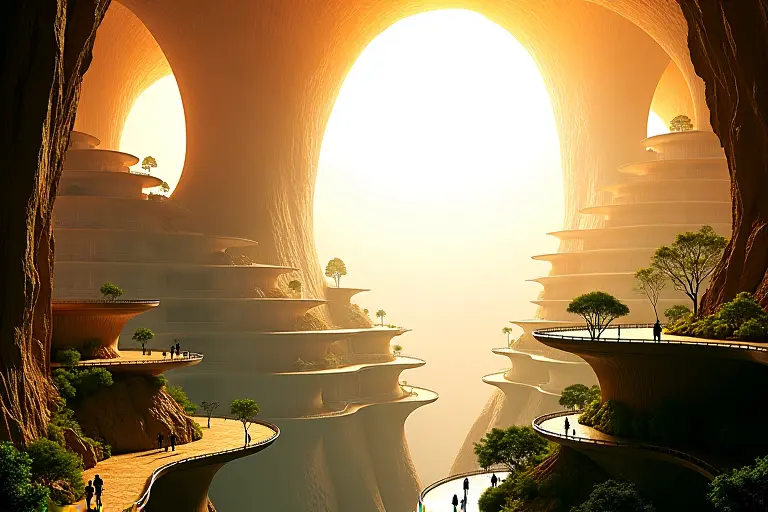
The problem is scale. Housing 8 billion people underground means excavating a volume that makes every mine in human history look like a pothole. You'd need interconnected cavern networks spanning thousands of square kilometres per major population centre. The spoil alone (all that excavated rock) would reshape the surface landscape into mountain ranges of rubble.
Air and light
Ventilation comes first. Humans consume about 550 litres of oxygen per day each. Multiply by 8 billion and you need industrial-scale air circulation systems drawing from the surface, filtering, conditioning, and distributing breathable atmosphere through every corridor, room, and public space. The system can never fail. A power cut on the surface means dead lights and cold radiators. A power cut underground means dead people.
Lighting is the next challenge and the one that would define the psychology of underground life more than anything else. Full-spectrum LED arrays can simulate daylight. Modern grow lamps already produce light in the wavelength ranges that plants need and human circadian rhythms expect. But simulation isn't the same as the real thing, and everyone who's worked in a windowless office for eight hours knows this instinctively. That vague, creeping unease you feel in a room with no natural light? Scale it to a lifetime.
Circadian disruption would be universal. Without genuine sunrise and sunset, without the gradual shift of light temperature through the day, human sleep patterns drift. Artificial lighting on timers helps, but research on submarine crews (who spend months in artificial light) shows persistent sleep disturbance, mood changes, and cognitive effects even with carefully managed light schedules. Submarines deploy for six months. We're talking about forever.
Growing food in the dark
No sunlight means no conventional agriculture. Every calorie has to come from either hydroponics (growing plants in nutrient solutions under artificial light) or fungiculture (growing edible fungi, which don't need light at all). Both are viable. Neither is cheap in energy terms.
Hydroponic systems under LED lighting can produce yields per square metre that match or exceed traditional farming, but the electricity consumption is enormous. A single hectare of indoor lettuce production uses roughly 1,100 MWh per year. Scale that to feed billions and you need an energy infrastructure that makes the current global grid look quaint.
Mushrooms become the staple food. They grow in the dark, they grow fast, they grow on waste material. Oyster mushrooms, shiitake, button mushrooms, all thrive underground. The diet shifts permanently toward fungi, hydroponically grown greens, and whatever protein can be produced without sunlight (insect farming, cultured meat, possibly algae in bioreactors). Beef becomes a memory. Wheat fields become mythology.
The vitamin D crisis

Sunlight on human skin produces vitamin D. Without it, you get rickets in children, osteomalacia in adults, and a general increase in immune dysfunction, depression, and cardiovascular risk. The recommended daily dose is 10 micrograms, and most people in the UK already don't get enough because our weather is rubbish and we spend too much time indoors.
Underground, nobody gets any. Supplementation becomes mandatory. Vitamin D pills distributed with the same seriousness as water purification. UV lamp stations in public areas where people queue for their daily dose of artificial sunlight, standing under buzzing panels like tanning beds in a shopping centre, except the queue is everyone and the alternative is skeletal disease.
Vitamin D would acquire a strange cultural status. The most valuable supplement. Possibly the basis for trade or rationing. A black market in high-dose tablets seems inevitable.
Mental health and the missing horizon
Humans evolved on open savannahs. We're wired for long sight lines, wide skies, distant horizons. Our stress response calibrates itself partly through exposure to open space. Stick a person in a confined environment for long enough and you get predictable psychological effects: anxiety, irritability, difficulty concentrating, claustrophobia even in people who never had it before.
The most common psychological complaint among long-term space station crew isn't fear or loneliness. It's the absence of nature. Astronauts on the ISS spend disproportionate amounts of free time looking out the cupola window at Earth. They crave the sight of open land, water, and sky.
Underground, there's no window to look out of. The longest view you ever get is the far end of a corridor. Parks are caverns with artificial turf and LED sky panels. Children grow up without ever experiencing weather, without ever feeling rain on their face, without ever seeing a cloud.
The first generation might cope. They'd remember the surface. They'd have context for their loss. The second generation, born underground, wouldn't mourn what they never had. Or maybe they would. There's evidence that certain environmental preferences are partially innate, not just learned. A child who has never seen a tree might still feel something missing when staring at a rock ceiling. Or maybe not. Nobody knows, because nobody has ever tried.
Would we come back up?
If the surface were habitable, yes. Eventually and inevitably. No regulation, no cultural norm, no government mandate would permanently keep billions of people in artificial caverns when open sky exists above their heads. Someone would dig upward, step outside, feel actual wind, and never come back down. Others would follow. The underground cities would slowly empty, becoming the ruins that a future generation explores with torches and wonder, asking themselves why anyone ever chose to live this way.
If the surface were genuinely lethal, though, the underground becomes permanent. Generations born below ground would adapt. Their culture would have no concept of weather, seasons, horizon, or sunset except as inherited stories. And those stories would fade, the way all oral traditions do, until the surface becomes something between legend and irrelevance.