For people living above the Arctic Circle, this isn't hypothetical. Every summer, the sun stays up for weeks or months. Tromsø in northern Norway gets continuous daylight from late May to late July. Residents cope with blackout curtains, melatonin supplements, and a cultural acceptance that sleep schedules become approximate.
But that's a small population adapted over generations to an extreme latitude. Now apply permanent daylight to the entire planet. The sun is up everywhere, all the time, forever. No night. No dusk. No twilight.
The obvious mechanism would be to stop Earth's rotation so the same hemisphere always faces the sun. But that introduces tidal forces, atmospheric collapse on the dark side, and a host of other complications. Let's keep it simpler. Imagine the sun is just always above the horizon everywhere, somehow. Physics-breaking, yes. But the biological and social consequences are interesting enough to justify the cheat.
Sleep falls apart within days
The human circadian rhythm runs on a roughly 24-hour cycle regulated primarily by light. When light hits your retina, it signals the suprachiasmatic nucleus in your hypothalamus to suppress melatonin production, which keeps you awake. When the light fades, melatonin rises and you get drowsy. This system evolved over hundreds of millions of years. It is not optional.
Remove the dark half of the cycle and your body loses its primary timing signal. The internal clock still runs, because it's genetically encoded, but without the daily reset of sunset it drifts. Most people's free-running circadian rhythm is slightly longer than 24 hours, about 24 hours and 11 minutes on average. Without daylight cues to pull it back, your sleep-wake cycle slides forward, roughly ten minutes each day.
Within a month, half the population is sleeping during what used to be afternoon. Within three months, nobody's schedule aligns with anyone else's. Offices, schools, and hospitals can't function because there's no shared agreement about when "daytime" is. The entire social contract of synchronised activity dissolves.
The effects on health are severe. Chronic sleep disruption is linked to increased rates of cardiovascular disease, diabetes, obesity, depression, and impaired immune function. Night shift workers, who experience a milder version of this disruption, have a 40 per cent higher risk of heart disease than day workers. Permanent daylight inflicts this on everyone.
Agriculture burns
Plants need light. They also need darkness. Photoperiodism is the biological mechanism by which plants measure day length to time their growth, flowering, and dormancy. Short-day plants like rice, soybeans, and chrysanthemums flower when nights are long. Long-day plants like wheat, barley, and lettuce flower when days exceed a threshold. Eliminate night entirely and the signalling breaks.
Rice, which feeds roughly half the world's population, requires a period of darkness to trigger flowering. Without it, the plants grow vegetatively forever, producing leaves and stems but no grain. No grain, no harvest. No harvest, no food for 3.5 billion people.
Wheat does better in long days but still needs some dark period. Permanent light causes many crop species to enter a state of continuous photosynthesis that sounds beneficial but isn't. The plant produces sugars faster than it can use or store them, leading to photooxidative damage, where excess light energy destroys chlorophyll and cell membranes. Leaves bleach white and die.
Continuous light also means continuous transpiration. Plants lose water through their stomata when photosynthesising. Normally, stomata close at night, reducing water loss. Without night, they stay open. Soil dries faster. Irrigation demand rises. In regions that depend on rainfall rather than irrigation, crops wilt.
Temperature climbs
Earth's average surface temperature is about 15 degrees Celsius. This is the equilibrium between energy received from the sun during the day and energy radiated back into space at night. Remove the night side and you double the solar energy input without changing the radiation output proportionally.
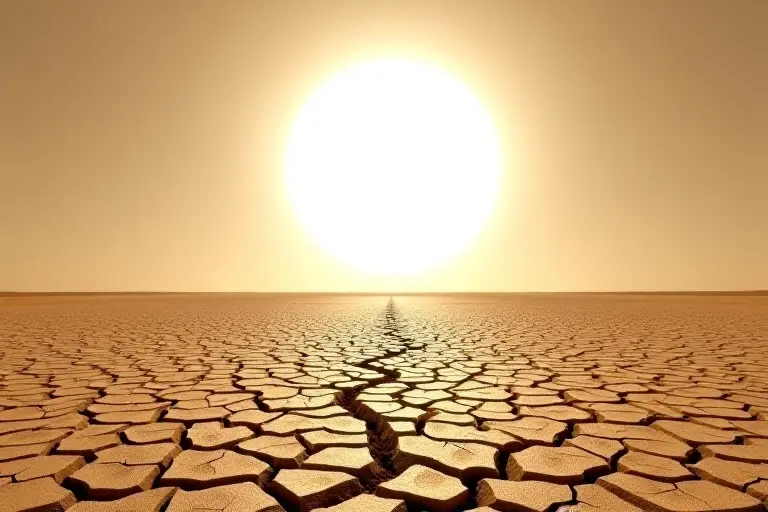
The temperature rise wouldn't be instant, but it would be relentless. Oceans act as thermal buffers, absorbing enormous quantities of heat before the air temperature catches up. But they'd absorb heat continuously without a nightly cool-down period. Within weeks, daytime temperatures in temperate regions would push into the high thirties. Tropical regions would become lethally hot. The wet-bulb temperature threshold for human survival is 35 degrees Celsius. Above that, your body cannot cool itself through sweating regardless of hydration, and you die of hyperthermia within hours.
Parts of the Persian Gulf and South Asia already approach this limit during heatwaves. Permanent sunlight would push them well past it. These regions would become uninhabitable. Not uncomfortable. Uninhabitable.
Nocturnal ecosystems collapse
Roughly 30 per cent of vertebrate species are nocturnal. Owls, bats, most rodents, many primates, most cats, nearly all amphibians. They evolved to exploit the dark half of the day. Their eyes, ears, and behaviour are adapted to low-light conditions. Permanent daylight doesn't just inconvenience them. It destroys their entire ecological niche.
Bats, which eat between 600 and 1,200 mosquitoes per hour, would be unable to hunt. Without bats, insect populations explode. The mosquito-borne disease burden rises. Pollination of night-flowering plants, many of which depend on bats and moths, collapses.
Owls can't hunt in bright light, not effectively. Rodent populations, normally controlled by nocturnal predators, surge. Rodents eat crops, stored grain, seeds. The agricultural damage compounds with the photoperiodism failures already devastating food production.
Coral reefs, which spawn at night in response to moonlight cues, stop reproducing. Marine invertebrates that migrate vertically in the ocean (rising to feed near the surface at night and descending during the day) no longer have a trigger. This vertical migration is the largest daily movement of biomass on Earth. It stops.
Human culture dissolves
Night is culturally load-bearing. It structures rest, intimacy, entertainment, reflection. Restaurants, theatres, pubs, cinemas: all built around the assumption that there's an evening. Shift work, bedtime routines, the concept of "staying up late," the romance of stargazing, fireworks, candlelight, the entire aesthetic vocabulary of night.
Gone. All of it. Not banned or restricted. Just made meaningless by the permanent presence of the sun.
Religion takes a hit. Many faiths structure observance around sunrise, sunset, or the lunar cycle. Islam's daily prayers are timed by the sun's position. Ramadan fasting runs from dawn to dusk. If dusk never comes, the fast never ends. Judaism marks the Sabbath from sunset Friday to sunset Saturday. No sunset, no marker. Christianity's Easter date depends on the lunar calendar. No visible moon means no visible cycle to anchor it.
These are solvable problems. Artificial timekeeping can substitute for celestial cues. But the spiritual and emotional weight of sunrise and sunset, built into human culture for tens of thousands of years, doesn't transfer to an alarm on your phone.
You'd miss the dark
People who've spent extended time in the Arctic summer describe an oppressive quality to continuous daylight. It's not the brightness that wears you down, though that contributes. It's the flatness. Without the daily rhythm of light and dark, time loses its texture. Every hour looks the same. Three in the afternoon is indistinguishable from three in the morning. The psychological effect is disorienting in a way that's hard to convey until you've experienced it.
We think of darkness as the absence of something. As a deficit. As the thing we're afraid of. But darkness is when the brain consolidates memories. When the body repairs tissue. When melatonin triggers immune responses. When the mind wanders without visual input demanding attention. Darkness is not dead time. It's half the operating cycle of every biological system on the planet.
Remove it and you don't get twice the productivity. You get a world running on half its operating system, burning out, overheating, and slowly going mad under a sun that never gives anyone permission to stop.