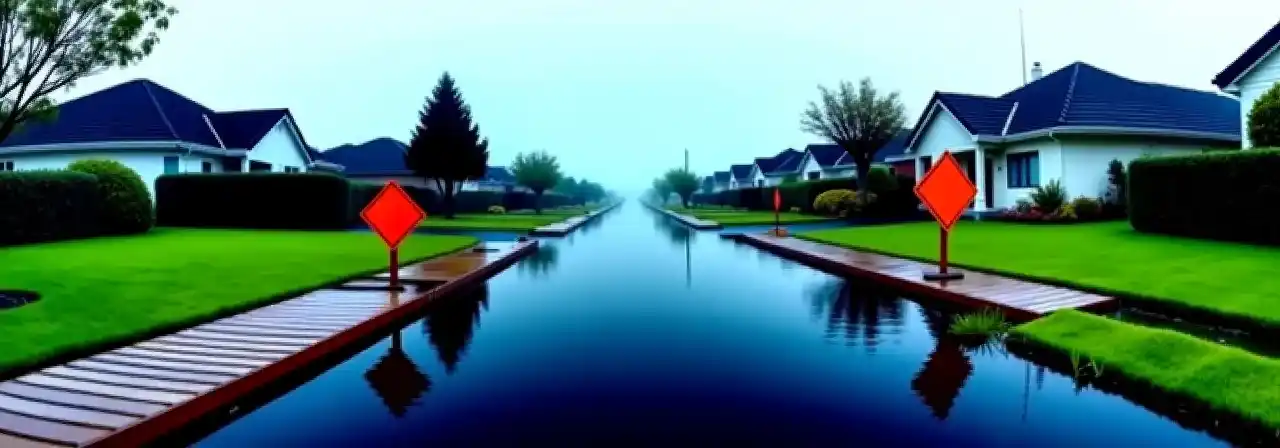
When I was about eight years old, I was absolutely convinced that quicksand would be a major problem in my adult life. Films, cartoons, and adventure novels all suggested that stepping in quicksand was roughly as likely as getting stuck in traffic. It seemed like something you'd encounter once a month at least.
Turns out quicksand is rare, shallow, and not particularly dangerous. Most natural quicksand is only a few feet deep. You don't sink completely. You bob at about waist level because the human body is less dense than quicksand, and the real risk is exposure or tidal drowning, not being swallowed whole. The childhood fear was overblown.
So let's vindicate the fear. Let's make every unpaved surface on Earth potential quicksand.
What quicksand actually is
Quicksand forms when water saturates loose granular material, usually sand or silt, reducing the friction between particles until the surface can't support weight. It behaves as a solid until disturbed. Step on it and your weight creates a pressure change that liquefies the material beneath your feet. The ground gives way.
Real quicksand has a viscosity roughly four times that of regular sand when disturbed. It's a non-Newtonian fluid, which means its behaviour changes depending on how you interact with it. Move slowly and it resists gently. Thrash around and it firms up, trapping you more effectively. The instinct to struggle is exactly wrong.
In our scenario, this property applies to any soil, sand, dirt, grass, mud, or natural ground surface. Anywhere you step that isn't paved, built, or covered with a solid material might liquefy under your feet. Not every step. Not predictably. But the possibility is always there.
Cities become islands
The first consequence is obvious. Paved surfaces become the only safe ground. Roads, pavements, car parks, building floors, anything with a solid constructed surface remains reliable. Everything else is suspect.
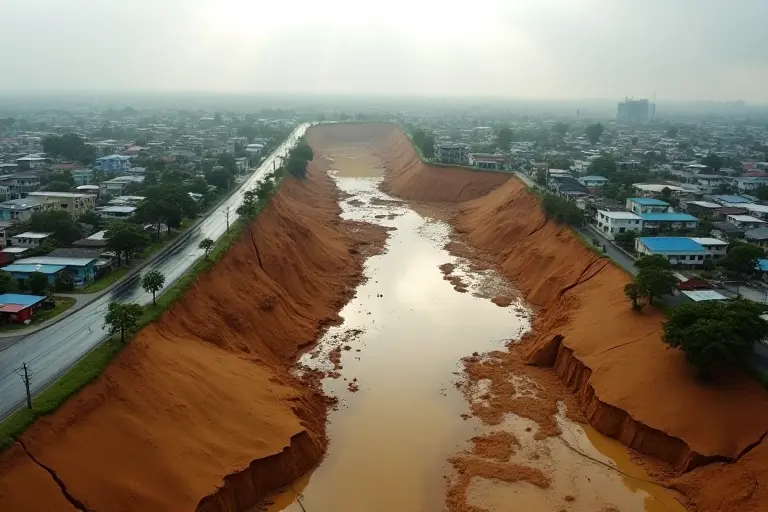
Cities, which are mostly paved already, become the safest places on Earth. Rural areas become dangerous. The countryside, currently a place people go to relax, becomes a place people avoid. Hiking is over. Camping is suicidal. A walk across a field requires the same risk assessment as crossing a minefield.
Property values invert. Rural cottages become worthless. Urban flats become priceless. The village green is now a death trap. The population density of cities increases massively as people abandon the countryside for the safety of concrete and tarmac.
Infrastructure breaks
Roads exist because the ground beneath them is stable. In a world where that ground can liquefy unpredictably, road foundations fail. Not all at once, but over time. A road built on soil that occasionally liquefies doesn't stay flat. It cracks, sags, and eventually collapses into the softened material beneath it.
The response is deeper foundations. Pilings driven down to bedrock, like building a bridge but for every road. Existing road networks become unsustainably expensive to maintain. The M1 motorway stretches 306 kilometres from London to Leeds. Rebuilding it on deep foundations would cost more than the original construction by an order of magnitude.
Railways face the same problem. The tracks need stable ground. Existing rail networks built on ballast and soil subgrade become unreliable. Trains derail when the ground softens mid-journey. The solution is elevated rail, essentially building the entire network as a series of bridges. Japan's Shinkansen bullet train network is partly elevated already, which gives it an unexpected advantage.
Pipelines, cable routes, buried utilities: all compromised. Everything underground is now sitting in potentially unstable material. Water mains fracture. Gas pipes shift. Fibre optic cables snap. The hidden infrastructure that modern life depends on, all of it built on the assumption that soil stays still, starts failing.
Agriculture is finished
Farms require unpaved land. Tractors require firm ground. Crops require stable soil. In a world where any soil might liquefy under weight, mechanised agriculture is impossible. A combine harvester weighing 15 tonnes is going straight through any surface prone to liquefaction.
Hand farming on light feet might work in some areas, some of the time. But the unpredictability is the killer. You can't invest a growing season into a crop if there's a meaningful chance the field will swallow your harvest before you can collect it. The economics of farming collapse.
The world turns to hydroponics, vertical farming, and greenhouse agriculture. Food production moves indoors, onto controlled surfaces. This technology exists now but operates at a fraction of the scale needed to feed eight billion people. The transition period would involve famine on a global scale. Countries with the wealth to build indoor farming infrastructure survive. Countries without it don't.
Animals adapt (and don't)
Wild animals face a new selection pressure. Heavy animals are disadvantaged. Elephants, which exert ground pressure of about 6 kg/cm² per foot, would trigger liquefaction constantly. Their habitat shrinks to areas of exposed bedrock. Most don't make it.
Light animals fare better. Birds are unaffected, obviously. Small mammals that distribute weight across four paws might manage on surfaces that would swallow a human. Insects carry on as normal. The ecology of the natural world shifts toward lighter, faster, more arboreal species. Trees, assuming they can root in bedrock or in stabilised ground, become even more valuable as habitat because the canopy is the only reliable surface.
Dogs, weighing on average 10 to 30 kilograms and distributing weight across four paws, are at lower risk than humans but not immune. Dog walking becomes a paved-surface-only activity. Parks with grass are fenced off. The concept of letting your dog run free in a meadow belongs to the old world.
The psychology of unsafe ground
We take the ground for granted in a way that is so complete we don't even recognise it as trust. You step forward and assume the ground will hold. You've done this every day of your life. You have never, not once, seriously considered the possibility that your next step might be your last.
Remove that certainty and something fundamental breaks in the human psyche. Anxiety disorders spike. Agoraphobia, already the fear of being in situations where escape is difficult, now has a literal physical basis. Open spaces are genuinely dangerous. Unpaved ground is genuinely unstable. The fear is rational, which makes it harder to treat.
Children grow up afraid of grass. A generation raised entirely on pavements and indoor surfaces develops a deep, instinctive aversion to natural ground. "Playing outside" means playing on concrete. The relationship between humans and the natural landscape, already strained, severs completely.
The childhood version of me, the one who thought quicksand was everywhere, would feel grimly satisfied.