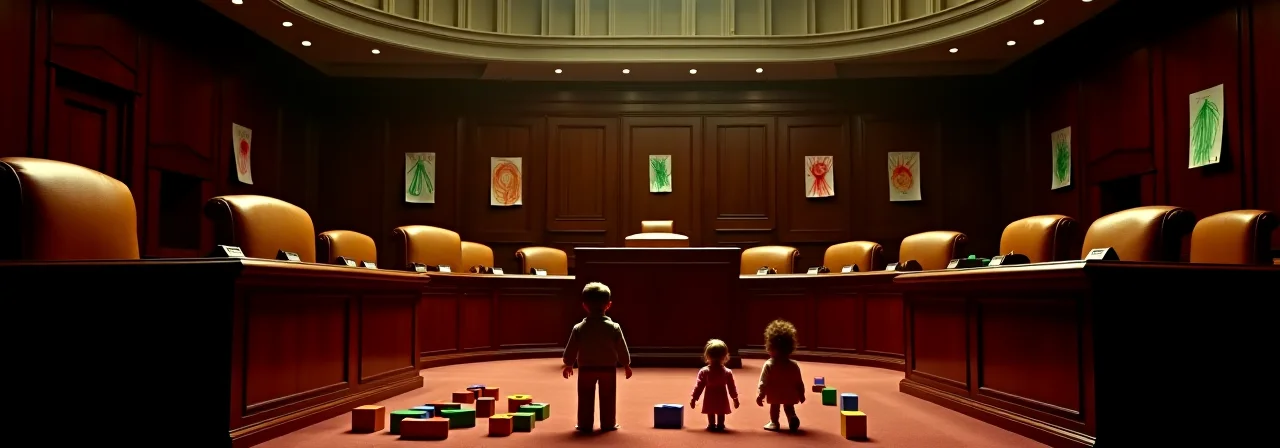
The average age of a UK Member of Parliament is 51. The average age of a child who confidently announces "that's not fair" when confronted with any minor inconvenience is about six. I'm starting to think the six-year-old might have a clearer sense of justice.
Imagine tomorrow morning, every government official in the world is replaced by a child between the ages of seven and twelve. Same institutions, same buildings, same civil service infrastructure. But the people making decisions haven't finished primary school yet.
It would be chaos. Obviously. But here's the thing that keeps nagging at me: some of it would genuinely work better.
The first cabinet meeting
Picture the scene. Twelve children in oversized suits, sitting around the Cabinet table in Downing Street. One of them has already nicked the biscuits. Two are arguing about who gets the big chair. The Secretary of State for Education has declared homework illegal and is getting a standing ovation from the backbenches.
The first law passed would be predictable. Bedtime: abolished. Every child in the country is now legally entitled to stay up as late as they want. This sounds like anarchy, but within a fortnight most of them would be voluntarily going to bed at a reasonable hour because they're shattered. The free market of sleep deprivation would sort itself out faster than any legislation ever could.
Ice cream gets reclassified as a staple food. Subsidised by the Treasury. Free school meals now include a Cornetto.

But then something odd happens. Once the novelty wears off (give it a week), some of these kids would start asking questions that adult politicians learned to stop asking decades ago.
The questions nobody asks any more
"Why are there homeless people when there are empty buildings?"
A child would ask this within the first hour. And the terrifying part is that the answer involves about forty layers of property law, planning regulation, housing policy, and economic theory that exist partly to justify the fact that yes, there are homeless people and empty buildings, and no, apparently we can't just put the people in the buildings.
A child wouldn't accept that answer. They'd say "but why not" until somebody either fixed it or admitted the real reason, which is that we've decided some problems aren't worth solving because solving them would inconvenience people who own property.
Children have an infuriating talent for cutting through complexity to the moral question underneath. Adults call this naivety. Sometimes it is. Sometimes it's the most honest thing in the room.
Defence and diplomacy
The UK's annual defence budget is roughly £55 billion. A child Prime Minister would look at that number and immediately redirect most of it toward trampolines, water parks, and a national network of tree houses. The Royal Navy gets repurposed for dolphin watching expeditions.
International diplomacy becomes simultaneously simpler and more volatile. Trade disputes get resolved by rock-paper-scissors. NATO summits last twenty minutes because nobody can sit still longer than that. The UN Security Council vetoes are replaced by a "no takebacks" rule.
But here's where it gets interesting. Children are terrible at long-term strategy but remarkably good at de-escalation when they actually have to sit in the same room as their opponent. Adults can maintain grudges across decades, across generations, hardening them into ideology. A nine-year-old might be furious at another nine-year-old at lunchtime and best friends by the afternoon.
Wars might actually become less likely. Not because children understand peace, but because they lack the patience for sustained hostility. You can't maintain a military campaign when half your generals have wandered off to look at a dog.
The economy breaks immediately
Children have no concept of monetary policy. A child Chancellor would look at the national debt (currently over £2.7 trillion) and say "just print more money." Which, to be fair, is functionally what quantitative easing is, but dressed up in language that makes it sound deliberate rather than desperate.
The Bank of England's base rate would be set by however many fingers the child governor felt like holding up that morning. Interest rates: vibes-based. The pound would collapse within hours. International markets would panic. Your mortgage would become either very cheap or very expensive depending on the mood of a ten-year-old.
Taxation policy would be brutal in its simplicity. "Rich people have too much money. Take some of it." No loopholes, no offshore structures, no creative accounting. Just a child pointing at a billionaire and saying "share."
This would obviously destroy sophisticated financial systems that took centuries to build. It would also address wealth inequality faster than any policy white paper ever published.
Healthcare, education, and the stuff that matters
A child Health Secretary would have one priority: make hospitals less scary. This is honestly not a bad starting point. Paediatric wards are already designed this way, with bright colours, play areas, and staff who explain things in plain language. The adult wards are beige corridors with confusing signage and the persistent smell of institutional soup. A child would fix the soup first.
Mental health services would get properly funded, because children take sadness seriously. They haven't yet learned the adult skill of telling someone who's struggling to "just get on with it." When a child sees someone crying, their instinct is to help. When an adult sees someone crying on the tube, their instinct is to look at their phone.
Education policy would be transformed overnight. PE five days a week. Art and music treated as seriously as maths. Tests abolished. Teachers paid whatever they want (the child Education Secretary has no idea what a normal salary is and assumes a million pounds sounds about right). This would bankrupt the education budget in a quarter, but teacher recruitment problems would vanish overnight.
Where it falls apart completely
Infrastructure. Children cannot plan infrastructure. They have no concept of "five-year project timeline" or "environmental impact assessment." A child Transport Secretary would commission a roller coaster from London to Edinburgh and see no reason why it couldn't open by Thursday.
The legal system would collapse. Children's sense of justice is binary: fair or not fair. There's no room for mitigating circumstances, legal precedent, or the distinction between civil and criminal law. Punishment would be wildly inconsistent. Stealing a sweet: life in prison. Arson: ten minutes on the naughty step.
Foreign policy would be conducted entirely through the medium of playground alliances. Countries would be friends or enemies based on whether their child leader was invited to the right birthday party. Nuclear codes would need to be hidden somewhere no child would look, which is probably inside a book of long division.
The uncomfortable comparison
The real point of this thought experiment isn't that children would be good at governing. They wouldn't. They'd be terrible at it in ways that are immediate, obvious, and spectacular.
But adults are terrible at it in ways that are slow, hidden, and dressed up in respectability. Children would crash the economy in a week. Adults took the better part of a century to build an economic system that crashes itself every decade or so and somehow calls this a feature.
Children would make policy based on emotion and instinct. Adults make policy based on focus groups, polling data, and whatever will get them re-elected, then pretend this is rational governance.
I'm not saying we should hand the country to a bunch of Year 5 students. I'm saying that the next time a politician gives a forty-minute speech saying nothing at all, you might catch yourself thinking: at least a child would have been honest about wanting longer playtime.