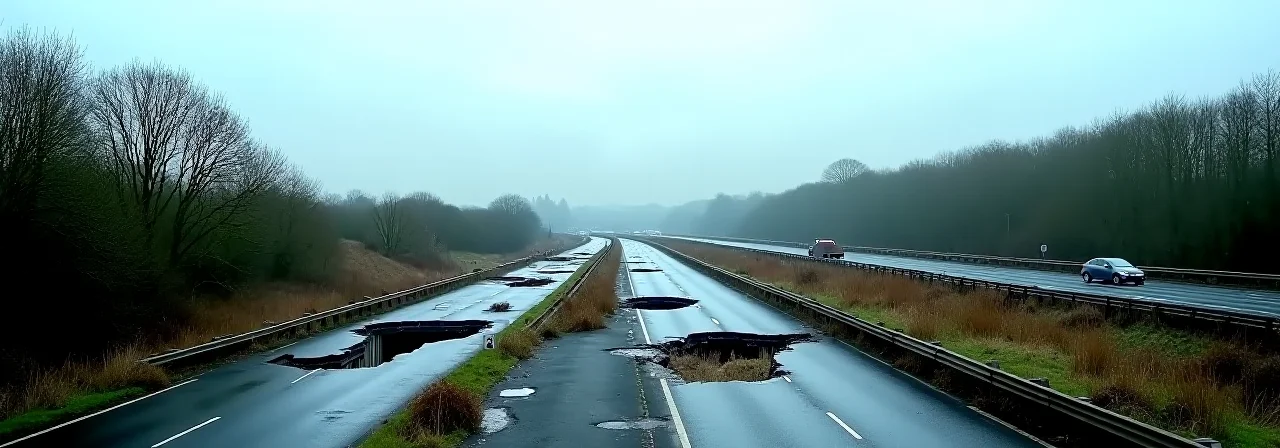
Nobody likes paying taxes. This is one of the few genuinely universal human sentiments, right up there with "the other queue is always faster" and "the USB goes in the wrong way round the first time." Whether you lean left or right, whether you think the government spends too much or not enough, the moment HMRC takes a chunk out of your payslip you feel it. That's your money, going to fund things you may or may not agree with, and you had no say in the transaction.
So let's give you a say. Taxes are now voluntary. You choose whether to pay them, how much to pay, and what to fund. Nobody goes to prison for not paying. There's no penalty at all.
What happens next is predictable, immediate, and catastrophic.
The first month
Tax revenue collapses. Not by 10 or 20 percent. By something closer to 80.
This isn't cynicism; it's observed behaviour. In countries where tax compliance depends heavily on voluntary participation rather than enforcement, compliance drops sharply. The IRS estimates that the US "tax gap" (the difference between what's owed and what's actually paid) was $688 billion in tax year 2021, and that's with penalties, audits, and the threat of prosecution. Remove all enforcement and the gap becomes a canyon.
Most people aren't selfish. But most people are subject to the free-rider problem. If you know that roads, hospitals, and schools will exist whether or not you personally pay, the rational economic choice is to let everyone else fund them while you keep your money. Each individual thinks "my contribution is tiny, the system won't miss it." Multiply that by 30 million taxpayers and the system collapses.
Roads
The UK government spent approximately £12.3 billion on transport in 2023-24. That covers road maintenance, rail subsidies, local transport grants, and infrastructure projects. Make taxes voluntary and most of that vanishes.
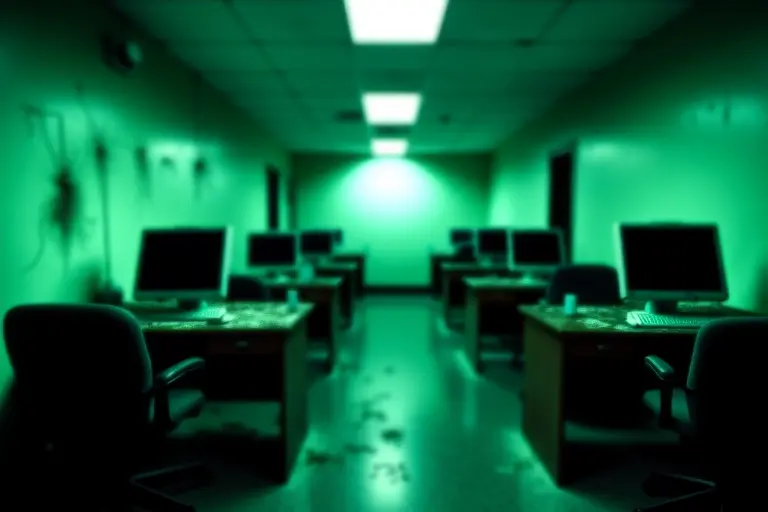
Road maintenance is the first thing to go, because it's unglamorous and nobody thinks about it until there's a pothole the size of a bathtub on their commute. Councils already struggle to fill potholes with full funding (the RAC reported 26,000 pothole-related breakdowns in 2023 alone). Remove 80% of the budget and the road network deteriorates from "a bit rough" to "genuinely dangerous" within two years.
Motorways would survive longest because they carry the most traffic and attract the most complaints. The B-road connecting two villages in Shropshire? Abandoned within eighteen months. Rural communities become isolated. Property values outside cities drop. The gap between urban and rural Britain, already wide, becomes a gulf.
The NHS
NHS England's budget for 2023-24 was around £165 billion. That's roughly £2,500 per person per year. In a voluntary system, some people would continue paying because they use the NHS regularly, they have chronic conditions, or they believe in public healthcare on principle. Others would calculate that they're young, healthy, and haven't seen a GP in three years, and conclude that £2,500 is a lot of money for a service they're not using.
The problem is that healthcare costs are concentrated. A small percentage of patients consume a large percentage of the budget. The 5% most expensive NHS patients account for roughly 50% of total spending. Voluntary contributions from the healthy majority won't cover the costs of the sick minority, because the healthy majority is exactly the group with the least incentive to pay.
Hospitals start closing. Not all at once, but one by one, starting with the ones in areas where voluntary contributions are lowest. A&E departments in affluent areas survive longer because wealthier residents are more likely to pay (they have more disposable income and more to lose if local services disappear). A&E departments in deprived areas, where residents have less money to contribute voluntarily, close first. Healthcare access becomes directly proportional to local wealth, which is exactly the system the NHS was created to prevent in 1948.
Schools
The UK spent about £114 billion on education in 2023-24. Voluntary funding would follow a similar pattern to healthcare: parents with children in school would pay, parents without school-age children mostly wouldn't, and childless adults would see no reason to fund other people's children's education.
Private schools already operate on voluntary payment (tuition fees) and they work fine. But they work fine because they serve a self-selecting population of families who can afford £15,000-£45,000 a year per child. State schools serve everyone, including families who can't afford £45 a year, let alone £45,000.
The schools that close first would be in the poorest areas, where families have the least ability to contribute and the community has the lowest aggregate wealth. Children in wealthy postcodes continue to receive funded education. Children in deprived postcodes don't. Within a generation, educational inequality becomes absolute rather than relative.
The guilt economy
Here is the strange part. Some services would survive on guilt alone.
The fire service, for instance. Nobody wants to be the person who didn't contribute to the fire service and then watches their neighbour's house burn down. The social pressure is too immediate, too visible, too personal. Your house catches fire, the fire engine comes, and everyone on the street knows whether you paid or not.
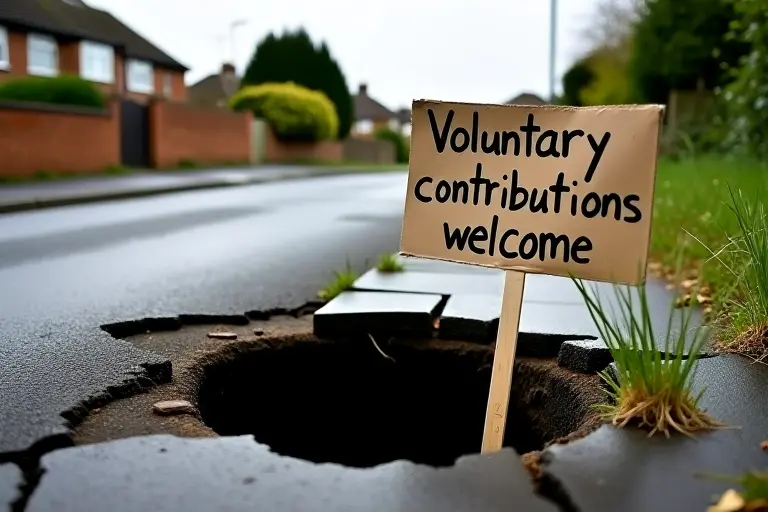
Libraries would die. Parks would die. Street lighting would become patchy. Bin collection would become a postcode lottery. These are services that everyone uses but nobody thinks about until they're gone, and by the time people notice they're gone, there's no funding mechanism to bring them back.
The military would be interesting. Defence spending is £54.2 billion (2024-25), and it protects everyone equally regardless of contribution. This is the purest possible free-rider scenario. Why pay for the army when it defends you whether you pay or not? But the flip side is that national security has a strong emotional pull. Charities that support veterans already raise significant voluntary money. The question is whether patriotic sentiment can replace compulsory taxation. History suggests it can't, not at the scale required to maintain a modern military.
Peer pressure as policy
In the absence of legal obligation, social pressure becomes the enforcement mechanism. Your tax contributions would need to be public, because without visibility there's no pressure. Some transparency advocate would propose a public register. You'd be able to look up what your neighbours paid.
This sounds dystopian. It is dystopian. But it's also the only mechanism that keeps voluntary taxation even partially functional. Denmark, which has one of the highest voluntary tax compliance rates in the world, also has a culture of social cohesion and mutual obligation that took centuries to develop. You can't manufacture that overnight. And even Denmark collects taxes through mandatory withholding, not the honour system.
In Britain, the public register would become a weapon. Neighbours shaming neighbours. Local Facebook groups posting lists of non-contributors. "These five houses on Elm Street didn't pay for street lighting last year." The social fabric doesn't hold together under that kind of strain. It tears.
The endpoint
Within five years, voluntary taxation produces a two-tier country. Areas with concentrated wealth maintain functioning services through voluntary contributions, effectively becoming self-funded enclaves. Areas without that wealth lose everything: roads, schools, hospitals, police, fire services. The geographic inequality that already exists in Britain accelerates to breaking point.
At some point, someone stands up in parliament and proposes making taxes mandatory again. The vote would be nearly unanimous. Because every MP would have spent the last five years watching their constituency fall apart and fielding phone calls from furious constituents demanding to know why the roads haven't been fixed, the school has closed, and the bins haven't been collected in a month.
Compulsory taxation exists because voluntary cooperation doesn't scale. It works in a village. It works among friends. It doesn't work when 67 million people need to fund a shared infrastructure that costs hundreds of billions of pounds a year. The maths is against it, the psychology is against it, and every historical experiment with voluntary public funding has ended the same way: with somebody making it compulsory again.