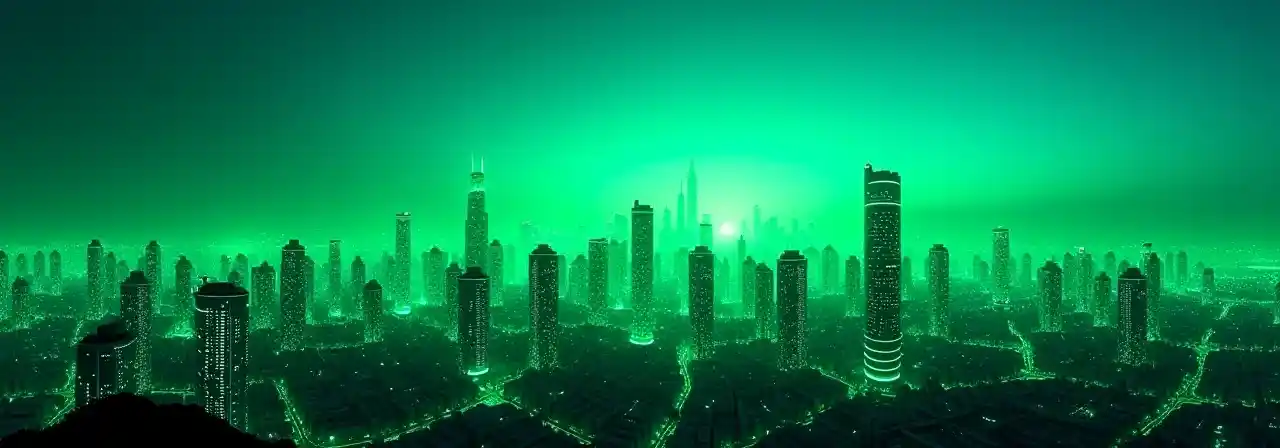
A mature oak tree produces roughly 100 kilograms of oxygen per year and absorbs about 22 kilograms of carbon dioxide. Impressive for a tree. Useless for powering a city. Photosynthesis, for all its elegance, converts sunlight to chemical energy at an efficiency of about 1-2%. A standard solar panel manages 20%. Biology lost that race decades ago.
But what if it hadn't? What if we could engineer buildings whose exterior surfaces photosynthesised at efficiencies high enough to replace conventional power generation? Walls, roofs, window glazing, all of it converting sunlight and CO2 into usable energy and breathable oxygen. Every building a power station. Every skyscraper a vertical forest that actually earns its name.
The engineering
For this to work, we need photosynthetic surfaces operating at roughly 15-20% efficiency, comparable to current solar panels but with the added trick of carbon absorption. Real research is heading in this direction, slowly. Bio-photovoltaics, which use cyanobacteria or algae to generate electricity from photosynthesis, exist in laboratories. A team at Cambridge published work in 2022 demonstrating a system using Synechocystis cyanobacteria that powered a small microprocessor for over six months using nothing but ambient light and water.
Scaling that from a microprocessor to a building is an engineering challenge roughly equivalent to going from a paper aeroplane to a 747. But let's assume it's solved. Some combination of synthetic biology and material science produces a coating, a living paint if you like, that can be applied to any exterior surface. It photosynthesises. It generates electricity. It absorbs CO2. And it repairs itself the way biological systems do, filling in cracks and damage without human intervention.
A 30-storey office building in London has roughly 15,000 square metres of exterior surface area. At 15% photosynthetic efficiency and average UK solar irradiance of about 100-120 watts per square metre, that building generates somewhere around 200-250 kilowatts during peak daylight. Enough to power the lighting and ventilation, probably. Not enough for the server rooms and lifts. Not yet.
What changes immediately

The grid relationship inverts. Buildings stop being consumers and become producers, at least during daylight hours. Every structure with a south-facing wall is generating electricity. Terraced houses. Warehouses. Multi-storey car parks. Garden sheds, even, though a shed's contribution is modest.
Office buildings, which currently consume enormous amounts of energy during the day when the sun is shining, would generate their own. The timing is convenient. Commercial energy demand peaks during business hours. Photosynthetic output peaks during business hours. For the first time, the biggest energy consumers become partially self-sufficient at the exact hours they're consuming most.
Night-time is still a problem. Photosynthesis requires light. Without storage, the buildings go dark and draw from the grid like before. But battery technology is advancing fast enough that a building generating surplus during the day could store enough for overnight basics. The grid becomes a backup, not a lifeline.
Cities start breathing
This is the part that excites me more than the electricity. A photosynthetic building doesn't just generate power. It inhales CO2 and exhales oxygen. At scale, a photosynthetic city is a carbon sink.
London has approximately 3.5 million buildings. If every exterior surface photosynthesised, the combined carbon absorption would be staggering. Current estimates for urban CO2 concentration in London hover around 420-450 parts per million, slightly above the global average. A fully photosynthetic city could draw that down measurably within years.
Air quality in city centres improves. Not just CO2 but particulate matter, as the biological surfaces trap dust and fine particles the way living walls already do. Walking through central London in summer, you'd notice the difference. The air would feel cleaner. It would taste different. Cities have a smell, a mixture of exhaust, hot tarmac and food, and photosynthetic buildings would soften it.
Shade would work differently too. A building wall that photosynthesises produces oxygen and moisture. Stand next to it on a hot day and the microclimate is cooler and fresher than standing next to concrete. The urban heat island effect, where cities run several degrees hotter than surrounding countryside, would diminish.
Architecture transforms
If your building's exterior is a power source, you want as much of it as possible. Smooth glass towers are efficient to build but terrible at maximising surface area. Photosynthetic architecture would favour texture, folds, ridges, overhangs and setbacks that increase the total exterior surface exposed to light.
Buildings would start looking organic. Not as a design affectation (we've had that already; it produced some ugly blobs in the 2000s) but as a functional requirement. A corrugated facade has more surface area than a flat one. A stepped pyramid has more exposed wall than a box. Architects would study leaf venation patterns and coral structures for inspiration, because nature already solved the problem of maximising surface area for light capture.
Colour would change. Photosynthetic surfaces would likely be green, or at least greenish, depending on the organisms used. Chlorophyll is green for a reason: it absorbs red and blue light most efficiently. Cities would take on a verdant tint. Glass-and-steel skylines replaced by something that looks, from a distance, like a forest growing vertically.
Some architects would hate this. The clean lines of modernism, the crystalline purity of a glass tower catching the sunrise, don't work when every surface needs to be a photosynthetic substrate. Others would thrive. The constraint would produce genuinely new forms. The best architecture often comes from working within limits, not from unlimited freedom.
Power plants close
Not immediately, and not all of them. But the economics shift fast. If every building in a city generates even 30% of its own electricity and absorbs carbon while doing it, the business case for fossil fuel power stations collapses. They're already struggling against wind and solar. Add photosynthetic buildings to the mix and natural gas plants become stranded assets within a decade.
Nuclear power stations survive longer. They provide baseload power for night-time demand, heavy industry, and the gap between what buildings generate and what they consume. But even nuclear faces pressure as building-level generation plus storage improves year on year.
The national grid doesn't disappear. It becomes a balancing mechanism, redistributing surplus from sunny areas to cloudy ones, from commercial districts (generating during the day, quiet at night) to residential areas (generating less, consuming more in the evening). Grid operators become traders, not providers.
The maintenance question
Biological systems need care. A photosynthetic building surface isn't concrete that you can ignore for forty years. It's alive. It needs water. It's susceptible to disease, contamination, environmental stress. A harsh winter might kill the surface organisms on north-facing walls. A pollution spike might poison them. Bird droppings would block photosynthesis the way they block solar panels, except the biological surface underneath might also get infected.
Building maintenance becomes horticulture. Facilities managers need biology degrees. Window cleaners become the most important workers in the energy sector, because a dirty photosynthetic surface is a dead one. The job market shifts in strange directions. Microbiologists and ecologists find themselves in higher demand than electrical engineers.
Insurance gets complicated. Your building is a power plant and a living organism. If the photosynthetic layer dies and your energy output drops to zero, is that a building defect, crop failure, or an act of God? Underwriters would need entirely new categories.
What it doesn't fix
Photosynthetic buildings don't solve energy poverty. Affluent areas with large, well-maintained buildings in sunny locations generate surplus. Cramped terraced streets in northern towns with small windows and overcast skies generate a fraction. The energy inequality between a photosynthetic penthouse in Barcelona and a photosynthetic bedsit in Dundee would be enormous.
Transport, heating, heavy industry: these still need energy that buildings alone can't provide. A photosynthetic office block in Manchester can power its own lights. It cannot smelt steel.
But as a piece of the puzzle, it's a good one. Every building quietly breathing, absorbing carbon, generating power, repairing itself. A city that photosynthesises is a city that works with its climate instead of against it. We already have a word for organisms that do this. We call them plants. We've just never tried to make our buildings behave like them.