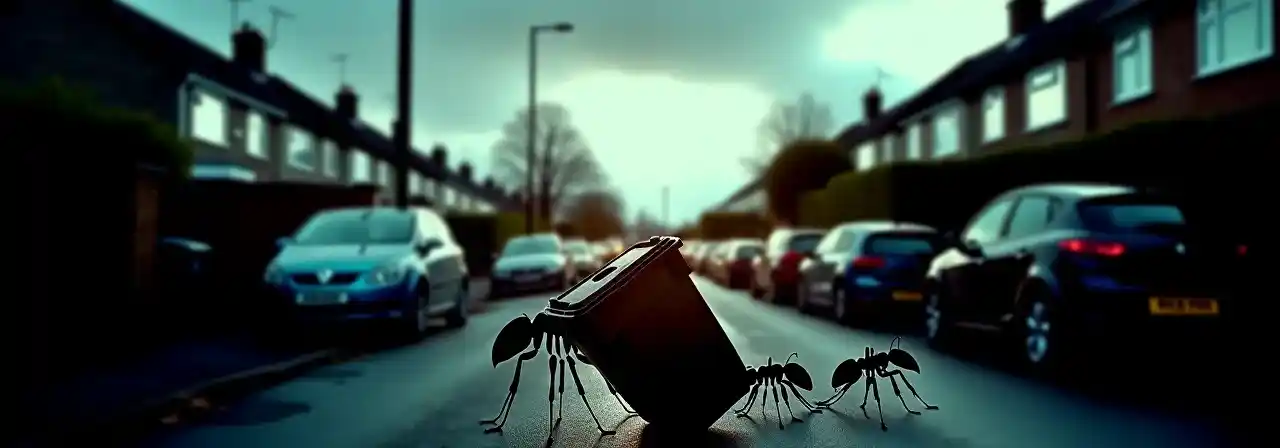
There are approximately 20 quadrillion ants on Earth. That's 20,000,000,000,000,000. About 2.5 million for every human. At their current size, a single ant weighs between 1 and 2 milligrams. At dog size, let's say Labrador-sized, each one would weigh around 30 kilograms.
The total ant biomass would go from roughly 80 million tonnes to something in the region of 600 trillion tonnes. For context, the entire biomass of all mammals on Earth, humans included, is about 170 million tonnes.
We'd be outnumbered, outweighed, and outmatched before anyone had time to panic.
The square-cube problem
Before I get to the apocalypse, there's a physics problem to deal with. When you scale an insect up to dog size, its body mass increases by the cube of the scaling factor while its leg cross-section only increases by the square. The legs can't support the weight. The ant collapses under its own mass.
This is why there are no insect-sized elephants and no elephant-sized insects. Scaling doesn't work linearly.
But this is a thought experiment, so let's be generous. Assume the ants scale proportionally in strength as well. Their exoskeleton thickens. Their muscles grow to match. They can move and function at dog size with the same relative capability they have at ant size.
This is where it gets frightening.
Strength that doesn't make sense
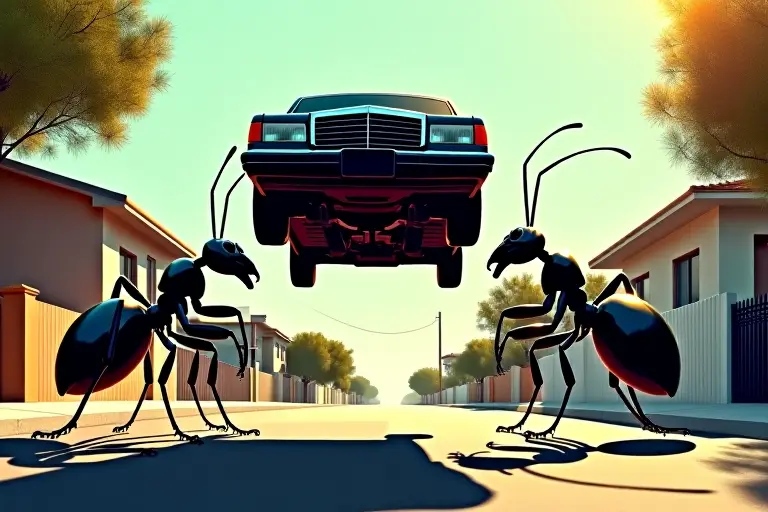
An ant can carry 10 to 50 times its own body weight. At 30 kilograms, that means a single ant could carry 300 to 1,500 kilograms. One ant could lift a grand piano. A small group could flip a car.
Their mandibles, scaled up, would be able to shear through wood, thin metal, and bone without difficulty. An ant's bite force relative to its size is extraordinary. At Labrador scale, those jaws would cut through a human femur the way garden shears go through a rose stem.
And they're fast. An ant moves at about 300 body lengths per second at top speed. Scale that up to a Labrador-sized body and you're looking at something that can sprint at roughly 50 km/h. That's faster than Usain Bolt's top speed. Faster than most people can cycle.
You cannot outrun a giant ant. You probably can't outrun five million of them.
The colony mind
Individual ants aren't particularly clever. A lone ant wanders semi-randomly, bumping into things, following simple chemical rules. But a colony is something else entirely. Ant colonies solve logistical problems that would trouble a decent operations manager. They find the shortest route to food sources. They allocate workers to tasks based on demand. They wage coordinated wars against rival colonies with flanking manoeuvres and siege tactics.
Leafcutter ants run underground fungus farms that they've been cultivating for 60 million years. They cut specific leaves, process them, feed them to their fungus crop, weed out competing moulds, and manage waste disposal. It's agriculture. They invented it about 59.99 million years before we did.
Scale this up to dog size and a leafcutter colony doesn't farm fungus. It farms whatever it wants. A colony of 8 million dog-sized leafcutters could clear an entire forest in days, process the wood into mulch, and grow food on it. They'd strip-mine landscapes with a speed that would make the most aggressive logging operation look restrained.
What happens to cities
Army ants already form living bridges and rafts out of their own bodies. At dog size, a column of army ants could bridge a river by linking together. They could form living walls, living ladders, living siege towers. The structural possibilities of thousands of 30-kilogram creatures locking their bodies together are genuinely hard to overstate.
Buildings wouldn't stop them. Ants are exceptional climbers. A dog-sized ant could scale a brick wall as easily as a normal ant scales a kitchen counter. They'd be on the roofs within minutes. Through the windows. Through the walls, if they decided to chew.
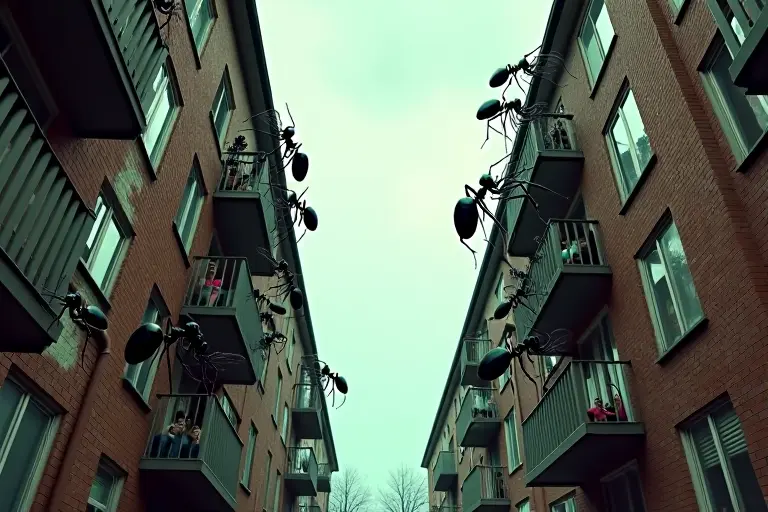
An ant colony's first priority is food, and a modern city is a concentrated food source. Supermarkets, warehouses, restaurants, kitchens full of stored calories. A raiding column of giant ants hitting a Tesco distribution centre would strip it in hours and carry the contents back to their nest in an organised relay chain stretching miles.
Highways would become ant trails. Those chemical pheromone paths they lay? At dog scale, the pheromone output would be overpowering. You'd smell an ant highway from half a mile away. A thick, acrid chemical trail marking the route from nest to food source. And good luck driving on a road covered in 30-kilogram ants marching in formation.
Military response
We'd try, obviously. Guns work against individual ants at this scale. A Labrador-sized insect is a big target and its exoskeleton, even scaled up, probably wouldn't stop a rifle round.
But you're not fighting individual ants. You're fighting colonies of millions. Kill a thousand and the colony barely registers the loss. Ant colonies absorb casualties as a running cost. They don't retreat from losses. They don't mourn. They replace the dead with new workers from the brood and keep coming.
Chemical weapons might work against specific colonies. Poison bait is how we deal with ants now, and the principle scales. But there are an estimated 20 quadrillion ants in over 20,000 species on every continent except Antarctica. You're not fighting one colony. You're fighting all of them, simultaneously, everywhere.
Nuclear weapons would work locally. But you'd be nuking your own cities to destroy ant nests underneath them, and the radiation wouldn't bother the ants much. Insects are roughly 10 to 20 times more resistant to radiation than mammals. Cockroaches get the publicity, but ants handle radiation better than we do too.
Who wins
Ants. Comprehensively.
We have technology, but we're 8 billion individuals who struggle to coordinate a response to a slowly developing climate crisis. Ants are 20 quadrillion organisms that coordinate instinctively, sacrifice individually without hesitation, and reproduce at a rate that makes our best efforts look glacial. A queen ant lays up to 300,000 eggs per day. The maths is not in our favour.
Humanity's best hope would be to retreat to environments ants can't easily reach. Deep ocean platforms, perhaps. Arctic stations. Space, if we were already there. The surface of every temperate and tropical landmass would belong to them within a year. Maybe less.
I keep ant traps in my kitchen. Little plastic boxes with borax paste inside. I watch the ants file in, one by one, and carry the poison back to their nest. It feels like a minor victory. I'd feel differently if they were looking me in the eye while they did it.