
You wake up on a Monday and there it is. A number, floating just above your eyebrows, perfectly legible from about three metres away. Clear black digits on your actual skin, like a tattoo you never asked for. It reads your exact age in years, and it updates on your birthday.
Everyone has one. Every human on the planet, including newborns. Baby comes out: 0.
You can't cover it. Hats, fringes, foundation, bandanas, elaborate headbands: nothing works. The number shows through everything. It's not a projection or a glow. It's just there, readable, permanent and impossible to obscure.
Dating changes overnight
Every dating app in existence becomes a different product. You can't subtract five years on your profile when anyone who meets you can see the real figure at a glance. The entire architecture of mild dishonesty that dating depends on collapses in an afternoon.
Tinder already has an age filter. This renders it unnecessary. People who listed themselves as 29 for the last six years suddenly have a visible 35 and some explaining to do.
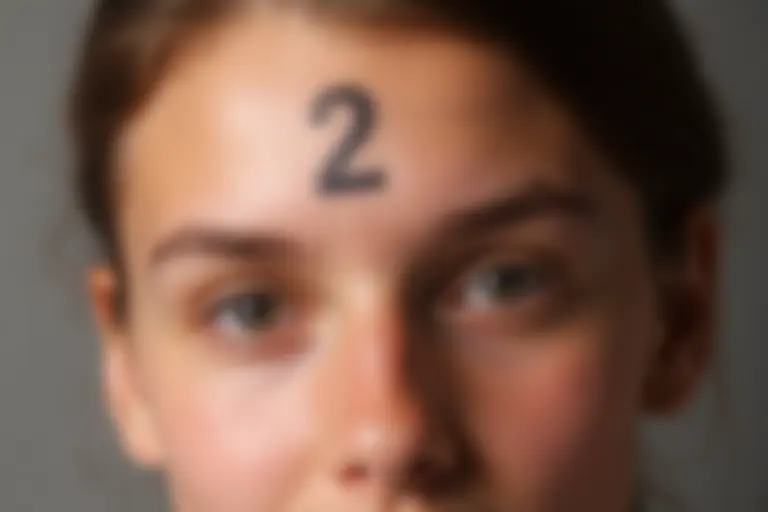
But it cuts both ways. You can't assume someone's older than they are either. The 45-year-old who looks 30 gets quietly resented. The 30-year-old who looks 50 gets quiet sympathy. Everyone knows which direction the gap runs.
Age-gap couples can't fly under the radar any more. Walking through a restaurant with a 24 and a 52 on display invites a level of public scrutiny that most people wouldn't tolerate. Some couples wouldn't survive it. Others would wear it like a badge. Either way, it's no longer ambiguous.
Nightclub bouncers become redundant
At least for age-checking purposes. Every bar, off-licence and pub in the country can verify your age from across the room. Fake IDs are worthless. Challenge 25 policies become Challenge Glance-At-Their-Head.
This sounds convenient until you realise the 16-year-old buying their first pint was relying on ambiguity. The entire rite of passage of trying to get served while underage vanishes. Adolescence loses one of its formative shared experiences. I'm not saying underage drinking is good. I'm saying the shared anxiety of standing at a bar hoping the barmaid doesn't ask is a cultural institution, and it's gone.
Casinos, age-restricted films, energy drink purchases at supermarkets: all simplified. The checkout worker doesn't need to press "customer appears over 25" on the till. They can read your forehead.
The workplace gets uncomfortable
Age discrimination is already illegal in most developed countries. It happens anyway, quietly, in hiring decisions made behind closed doors. Now imagine every candidate walking into an interview with their age stamped on their face.
You can't un-know it. The interviewer sees 58 before they see your CV. Or 23. Both carry assumptions, and those assumptions now have zero friction. There's no polite dance of not asking. The information is involuntarily broadcast.
Ageism in the workplace gets worse, not better. You might think transparency helps, but discrimination thrives on snap judgements, and a visible number speeds those up. A 2019 AARP study found that 61% of workers over 45 had seen or experienced age discrimination. That number wouldn't shrink when the basis for discrimination is literally written on your face.
Skincare becomes the new status symbol
Here's where the vanity economy pivots hard.
When everyone can see your exact age, the gap between how old you are and how old you look becomes the only game in town. A 50-year-old who looks 35 isn't just ageing well. They're winning. And everyone watching knows exactly how much they're winning by, because the number is right there for comparison.
The skincare industry, currently worth about $180 billion globally, would probably double. Not because people want to hide their age (they can't) but because the only remaining flex is looking younger than the number says you are. Retinol becomes a status symbol. Sunscreen becomes a moral imperative. Botox bookings go through the roof.
The flip side: looking older than your number becomes a source of genuine distress. If your forehead says 30 but your face says 45, every stranger you pass is doing the maths.
Children and teenagers
Kids wouldn't mind much at first. Children are already sorted by age constantly. School years, sports teams, height restrictions at theme parks. A number on the forehead is just a more efficient version of what already happens.
But teenagers? Teenagers would be horrified. Being 13 when everyone around you is 14 matters enormously at that age. Being 15 in a group of 17-year-olds is social currency or social death depending on context. The number removes any ability to fudge it.
The "mature for their age" kid loses their advantage. The late bloomer can't hide behind confidence any more. Adolescent social hierarchies, already brutal, gain a publicly visible ranking metric.
Aging becomes a spectator sport
Celebrities already face absurd scrutiny about their age. This cranks it to a level that would be funny if it weren't so grim. Every red carpet photo includes a clearly visible number. Magazine covers can't be airbrushed to remove it. The "she's 50 and looks amazing" headline becomes "she's 50, it says so right there, and yes she does look good, that's the whole article."
Politicians, too. Voters already worry about candidates being too old. Now there's a number displayed during every debate, every press conference, every handshake at a factory visit. The discourse around Biden's age in 2024 was already consuming. Imagine if the number 81 had been floating above his forehead the entire time.
Monarchs, Supreme Court justices, religious leaders. Every institution that skews elderly gets a constant visual reminder of exactly how elderly.
What you'd actually cover up
Hats become purely decorative, since they can't hide the number. But I think forehead fashion would explode anyway. Not to conceal, but to frame. Decorative borders around your number. Temporary tattoos that complement it. Custom fonts if the universe allowed it (it doesn't, the number is what it is, but people would try).
Some people would be proud. Ninety-year-olds with high numbers would get respect or awe. "She's 94!" whispered in supermarket aisles. Centenarians become minor celebrities just by walking down the street.
Others would dread each birthday, not for getting older, but for the public increment. Watching your number tick from 39 to 40 while standing in a queue at Tesco is a particular kind of existential humiliation that nobody asked for.
The number you can't negotiate with
The strangest thing about all of this isn't the social consequences. It's the honesty.
We spend enormous energy managing how old we appear. Clothes, posture, hair dye, fitness, surgery, the careful omission of graduation years on LinkedIn. All of that becomes irrelevant, not because you stop caring, but because the definitive answer is always visible.
You can't argue with arithmetic. And your forehead has receipts.