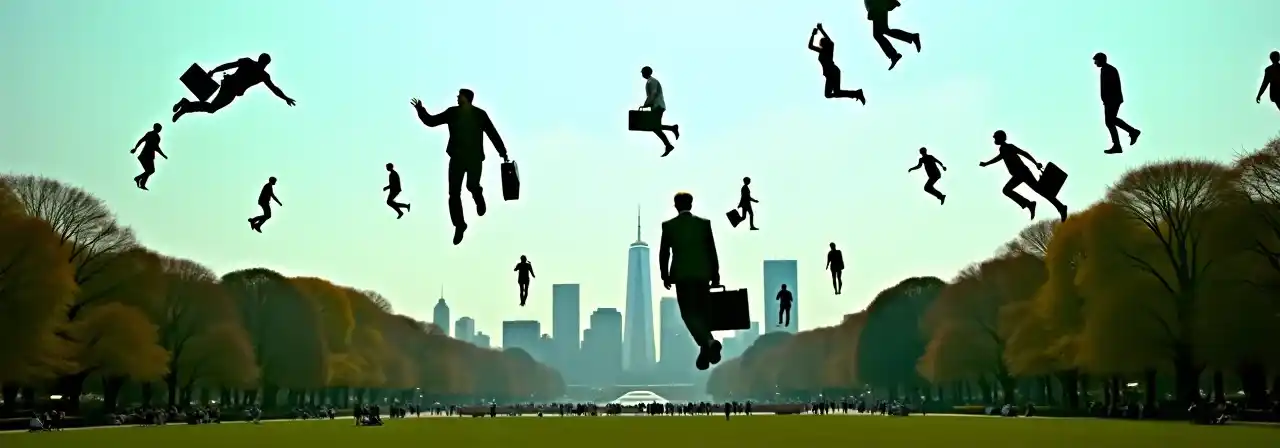
No wings. No jetpack. No running start. You just think "up" and you go up. Everyone can do it. Everyone has always been able to do it, since the first human stood upright and thought, "I wonder what's above those trees."
Top speed: about 60 km/h, roughly the same as a car in a residential zone. Maximum altitude: let's say 3,000 metres, above which the air gets too thin to breathe comfortably. It takes effort, like jogging. An hour of flight burns about the same calories as an hour of running. You can hover, but it's tiring, like treading water.
No one is soaring effortlessly. You're working for it. But you are flying.
Commuting gets worse, somehow
You'd think personal flight would fix commuting. No more traffic jams, no more packed trains, no more waiting at bus stops in the rain. Just launch yourself from your front garden and land in the office car park twenty minutes later.
Except 9 million people live in London, and if even a third of them take to the air at 8am, you've got 3 million humans moving through the same airspace at various speeds and altitudes, with no lanes, no signals, and no training beyond "I've been doing this since I was four."

Mid-air collisions would be the leading cause of injury within the first week. Two people flying toward each other at 60 km/h produces a combined closing speed of 120 km/h. That's a motorway-speed car crash, except neither of you is wearing a seatbelt, there are no airbags, and you're 200 metres above concrete.
Governments would regulate almost immediately. Flight corridors. Altitude bands: northbound traffic at 500 metres, southbound at 600, local traffic below 300. Speed limits. No-fly zones around airports, hospitals, and government buildings. A licence to fly above 1,000 metres, requiring a test and annual renewal. Within a decade, the freedom of personal flight would be wrapped in as much bureaucracy as driving is today.
People would complain about it constantly. "Remember when you could just fly wherever you wanted?" Yes. That week killed 40,000 people.
The umbrella question
When everyone can fly, the ground below becomes a very different place. People flying overhead means things falling from overhead. Phones, keys, loose change, shopping bags, and, inevitably, the contents of people's stomachs when they fly too soon after eating.
Walking beneath a busy flight corridor would be like walking under a flock of seagulls, except the seagulls weigh 80 kilograms and are carrying backpacks.
Umbrellas would become essential outdoor equipment regardless of weather. Reinforced umbrellas. Hard-shell umbrellas rated for impact protection. There would be an entire market segment: "flight-rated personal canopy, tested to withstand a dropped iPhone from 400 metres." Insurance companies would require them.
Ground-level cafes with outdoor seating would need overhead netting. Parks would install canopy structures. The entire concept of "outdoor space" would be redefined to include vertical threat assessment.
Architecture flips upside down
If people can fly, the ground floor stops being the most valuable part of a building. Penthouse apartments are already premium, but in this world, every floor above ground level has direct outdoor access. Why take the lift when you can fly to your window?
Buildings would sprout balconies, landing platforms, and external doorways at every level. The ground-floor entrance becomes a service entrance for deliveries and people too tired to fly. Stairwells become emergency infrastructure rather than daily-use. Lifts still exist for carrying heavy objects, but humans mostly don't use them.
Fences become pointless. Gates, walls, security perimeters: useless unless they extend upward to 3,000 metres, and even then you just fly over the neighbouring building and come in from the other side. Prisons would need to be fully enclosed. Gated communities would need literal domes.
Ground-floor retail would suffer. Why land at street level to browse shops when the better ones are on the fourteenth floor with a view? Shopping centres would reorganise vertically, with premium retail at altitude and bargain shops at ground level. The phrase "upmarket" would become embarrassingly literal.
Sport changes completely
Football doesn't work if the goalkeeper can fly. Tennis doesn't work if both players can reach any point above the court. Basketball becomes absurd. Any sport designed around the physical limitations of ground-bound humans either dies or transforms into something unrecognisable.
New sports would emerge. Three-dimensional tag at altitude. Aerial racing through obstacle courses. Formation flying competitions. Contact sports where the objective is to force your opponent to the ground (landing counts as a point against you). The Olympics would need an entirely new category, and the events would be spectacular.
Swimming remains unchanged, because water doesn't care if you can fly. Swimmers would become the elite athletes of this world: the only people still competing against gravity in the traditional way.
Crime and warfare
Burglary becomes almost impossible to prevent. Any window above the second floor, previously accessible only by ladder, is now a potential entry point for anyone willing to fly up to it. Home security would focus on window locks and shatter-proof glass rather than door locks and ground-floor sensors. Alarm systems would need 360-degree coverage at every level.
Police chases would move into three dimensions. A foot pursuit already strains most officers' fitness. An aerial pursuit at 60 km/h, with the suspect able to change altitude, reverse direction, and dive between buildings, would be nearly impossible without technology assistance. Drones tracking suspects from above. AI-predicted flight paths. Net launchers.
Warfare would change less than you'd think. Soldiers who can fly at 60 km/h are slower than helicopters (250+ km/h) and far more visible. A flying human is an easy target for anyone with a rifle. Military flight would be limited to short tactical movements: clearing walls, reaching elevated positions, rapid retreat. You wouldn't fly into battle. You'd fly around the edges of it.
The class divide goes vertical
Rich people would live high. Literally. When anyone can fly, altitude becomes the new gated community. Wealthy neighbourhoods would build upward, with residences and amenities at 500+ metres accessed exclusively by flight. Street-level living would be for people too exhausted from physical labour to fly home after work.
Because flight is effort, physical fitness determines how high you can comfortably live. Wealthy people with desk jobs and personal trainers can maintain the fitness needed for high-altitude living. Manual labourers who've spent their energy at work can't. The vertical divide mirrors the economic one with uncomfortable precision.
Children would fly before they could walk properly. Toddlers launching themselves off furniture and drifting toward the ceiling, parents frantically grabbing ankles. Child-proofing a house would require ceiling nets, window locks rated for small determined humans, and a completely new vocabulary of warnings. "Don't fly in the house" would be shouted more often than "don't run in the house" ever was.
You'd still queue at the post office, though. Some things are beyond the reach of even the most liberating evolutionary upgrade.