
At 3:17am GMT on a Tuesday, every internet-connected device on Earth stops connecting. Routers flash red. Servers go unreachable. Undersea cables, satellite links, fibre backbones, mobile data: all dead. Not a regional outage. Not a DNS failure. The entire global internet, gone.
It's not coming back for a year.
The first hour
Most people don't notice immediately. It's the middle of the night in Europe. Early evening in the Americas. But within minutes, the people who are awake start hitting refresh. Then restarting their routers. Then checking their phones. Then looking out the window to see if the world has ended.
It hasn't. But their version of it has.
Emergency services in most developed nations run over internet protocol. The UK's Emergency Services Network, which replaced the old radio system, relies on 4G/5G data connections. In the US, many 911 dispatch centres route calls through VoIP systems. These don't all fail instantly (some have radio fallbacks), but the coordination layer between ambulances, hospitals, fire stations, and police disintegrates. Response times lengthen. People die that first night from delayed ambulances.
Day one: the money vanishes
The global financial system stops.
This isn't hyperbole. The SWIFT network, which processes roughly 45 million financial messages per day between 11,000 institutions in over 200 countries, is an internet-dependent system. Stock exchanges, which now execute trades in microseconds via electronic networks, cannot function. ATMs, which verify card transactions against remote bank servers, go offline. Contactless payments, online banking, payroll systems: all gone.
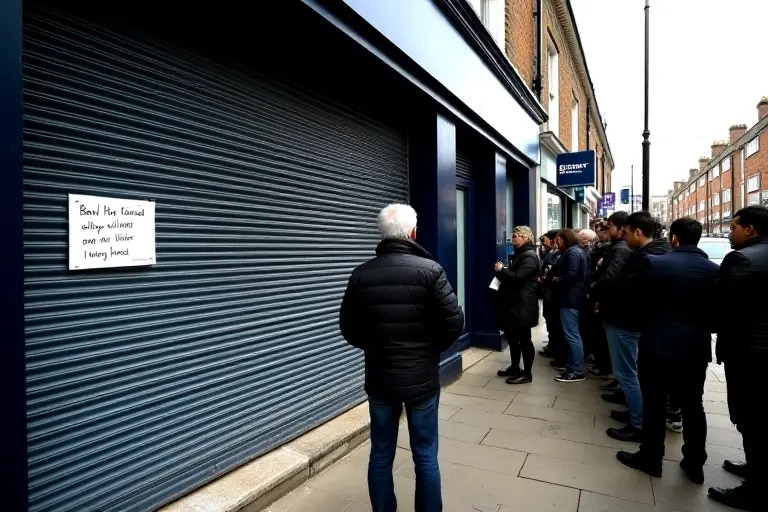
Physical cash becomes the only working currency by lunchtime. Most people don't carry much. A 2023 UK Finance report found that only 14% of UK payments were made in cash. The rest were electronic. If you have forty quid in your wallet, that's your money until the banks figure out how to process transactions manually.
They will figure it out. Banks existed before the internet. Ledgers, paper cheques, in-person verification. But the infrastructure for manual banking has been dismantled over decades. Branches have closed. Staff have been retrained for digital systems. Rebuilding analogue banking capacity takes weeks at minimum, and during those weeks, the economy runs on whatever cash people happen to have and whatever bartering arrangements they can cobble together.
Day three: supply chains snap
Modern logistics runs on real-time data. A container ship approaching Felixstowe doesn't just arrive and unload. Its manifest was transmitted electronically. Its berth was allocated by software. The lorries waiting to collect its cargo were dispatched by route-planning algorithms fed by live traffic data. Customs clearance happens through digital portals.
Without the internet, none of this coordination works. Ships arrive at ports that don't know they're coming. Warehouses can't check inventory. Supermarkets can't reorder stock. The just-in-time supply chain, which keeps most UK supermarkets stocked with only about three days of food at any given moment, falls apart spectacularly.
By day three, shelves are bare. Not because food doesn't exist (farms are still farming, factories still have stock) but because nobody can coordinate getting it from where it is to where it's needed. The bottleneck isn't production. It's information.
Week one: governments scramble
Every government on Earth faces the same problem simultaneously: how do you run a 21st-century nation without its central nervous system?
Tax collection stops. Most nations now collect taxes through digital filing systems. The UK's HMRC processed 97% of self-assessment returns online in 2024. Benefits payments, which are administered electronically, can't be disbursed. Government communications with citizens relied on websites, email, and social media. The only remaining broadcast infrastructure is radio, television, and the postal system.
Radio becomes important again almost immediately. The BBC World Service, which still maintains shortwave transmitters, becomes the primary source of reliable information for much of the world. Countries that maintained analogue broadcast infrastructure as a redundancy measure cope better than those that went fully digital. Japan, which kept its public address system (the same one that warns of earthquakes and tsunamis), has a functioning information network. Countries that were entirely dependent on mobile push notifications do not.
Month one: the social rewiring
After the initial panic and the economic chaos, something strange happens. People adapt. Not comfortably, not happily, but they adapt.

Newspapers, the ones still operating (many had already become digital-only), start printing extra editions. Their circulation numbers spike. Local notice boards become information hubs. Community centres and libraries, the ones that haven't been closed by austerity cuts, become gathering points. People queue for news the way their grandparents did.
Social relationships change. Without social media, group chats, or video calls, friendships revert to proximity. You socialise with people you can physically reach. Long-distance relationships, already difficult, become near-impossible. International friendships enter suspended animation.
The mental health effects are contradictory. Anxiety spikes from the economic uncertainty and loss of communication. But studies of past digital detox experiments suggest that after an initial withdrawal period, many people report improved sleep, reduced comparison anxiety, and a strange sense of calm. The constant low-level stress of being permanently reachable and perpetually updated on global disasters simply stops.
Month three: the parallel economy
Humans are good at building systems. By month three, analogue workarounds are appearing everywhere.
Local currencies emerge in communities where cash is scarce. Barter networks formalise. Someone in every neighbourhood becomes the person who knows things: a walking search engine built on social connections and memory. Classified ads reappear in newspapers. Job seekers turn up in person with printed CVs. Answerphones and landlines, for those who still have them, become precious infrastructure.
Industries that were already offline-capable (agriculture, construction, manual trades) recover faster than knowledge work. A plumber can still fix a pipe without the internet. A cloud software engineer cannot cloud anything.
Education lurches backward. Schools that had moved to digital textbooks, online assignments, and cloud-based learning management systems have to improvise with photocopied handouts and chalk. Universities can't access journal databases. PhD students lose years of work stored on cloud servers they can't reach. Libraries, physical ones with actual books on shelves, become the most important institutions in any town.
Month six: who benefits?
Not many, but some.
Local businesses that never fully digitised pick up customers. Independent bookshops, record shops, physical retailers of all kinds see foot traffic they haven't had in a decade. Local journalism, which was being slowly strangled by the loss of advertising revenue to Google and Facebook, suddenly has no digital competition. Communities that maintained strong offline social infrastructure (churches, pubs, sports clubs, allotment societies) weather the disruption better than atomised urban populations.
And there's a darker benefit. Cybercrime stops. No ransomware, no phishing, no data breaches, no state-sponsored hacking, no online fraud. The estimated global cost of cybercrime in 2025 was projected at over $10 trillion annually. That number drops to zero. A hollow victory given the broader economic collapse, but a data point worth sitting with.
Day 366: it comes back
On the first anniversary, the internet returns as suddenly as it left. Servers reconnect. Data flows. The digital world snaps back into existence.
But the humans using it have changed.
Some people rush back online immediately. They check a year's worth of emails. They scroll through a year's worth of social media posts. They find that the internet, in their absence, continued to exist in cached, archived form: a snapshot of a world that moved on without their participation.
Others hesitate. They'd grown accustomed to something. Not the hardship, certainly not the economic destruction, but the quiet. The reduced pace. The smaller world that they could see and touch. Some of them will go back online reluctantly, and some won't go back at all.
Which tells you something about our relationship with this technology. We built it because we needed it. We'd suffer enormously without it. But we also suspect, in a way we don't often say out loud, that it's taken something from us that we can't quite name.