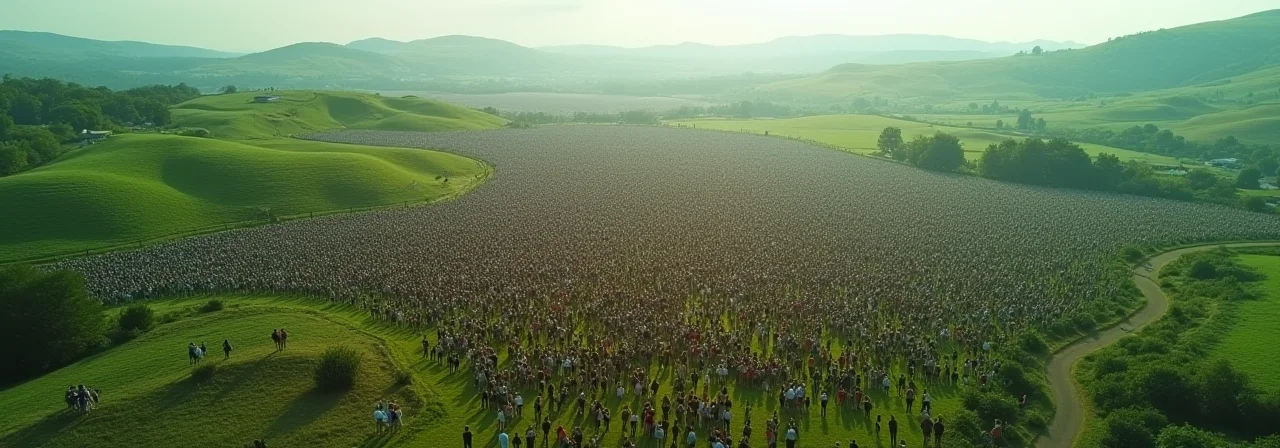
It's the most asked hypothetical in physics classrooms worldwide. A teacher mentions Newton's Third Law, and someone's hand shoots up: "But what if everyone on Earth jumped at the same time?"
I've always loved this question because the interesting answer isn't the physics. It's the logistics.
The physics (disappointing)
Let's get this out of the way. Earth's mass is approximately 5.97 × 10²⁴ kilograms. The combined mass of all 8 billion humans is roughly 560 billion kilograms, or 5.6 × 10¹¹ kg.
That's a ratio of about 10 trillion to one. The Earth outweighs humanity by a factor of 10,000,000,000,000.
When you jump, you push the Earth away from you with equal force (Newton's Third Law). Given the mass ratio, the Earth moves approximately 0.00000000001 millimetres. Less than the width of a single hydrogen atom. Undetectable by any instrument ever built.
Eight billion simultaneous jumps? Still less than the width of an atom. Multiplying nothing perceptible by 8 billion still gives you nothing perceptible.
The Earth wouldn't notice.
But that's the boring answer
The question assumes we can get everyone to the same place, or at least coordinate the timing. What actually happens if 8 billion people tried to jump simultaneously?
The gathering problem
If we need everyone in one place for maximum effect (all pushing the same direction), where do we put them? Standing shoulder-to-shoulder, humans occupy about 0.5 square metres each. Eight billion people would fill roughly 4,000 square kilometres. That's about the size of Devon.
Now you have the entire human population crammed into Devon. No food distribution system. No sanitation. No shelter. People on the edges are hundreds of kilometres from the centre. Communication to coordinate the jump is functionally impossible for anyone without line-of-sight to a screen or speaker.
Devon, for what it's worth, has about 800,000 residents normally. They'd be slightly overwhelmed.
The seismic signature
If all 8 billion did manage to jump in unison, the landing would register on seismographs. Not because of Earth's displacement, but because of the localised surface impact. Eight billion people landing simultaneously generates a pulse equivalent to roughly a magnitude 4-5 earthquake, localised entirely beneath Devon.
Windows in nearby buildings would crack. Car alarms would trigger across southern England. Geologists in Bristol would have a very confusing afternoon.
The real disaster: trying to leave
The jump takes 0.5 seconds. The event itself is utterly anticlimactic. But now 8 billion people, crammed together with no infrastructure, need to go home.
This is where people die.
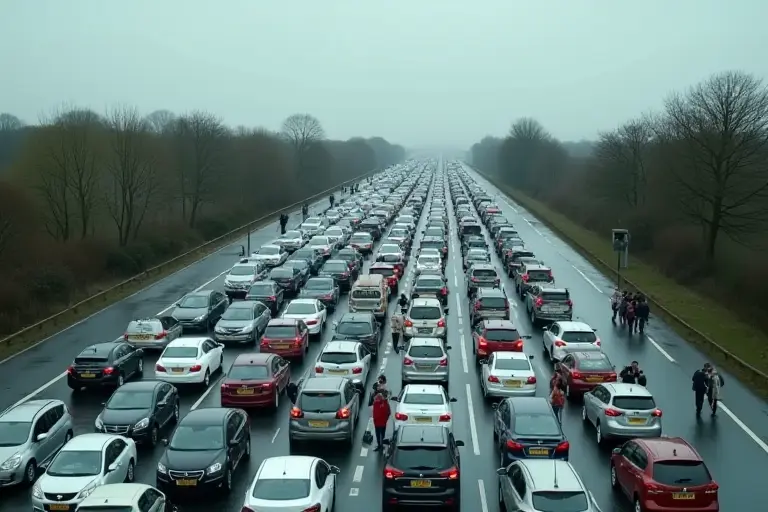
There is no transport system on Earth designed for this. Roads in every direction are instantly gridlocked beyond repair. People on foot form crush zones at every bottleneck: bridges, tunnels, narrow roads between hills, motorway on-ramps.
Historical crowd disasters have killed hundreds at densities far lower than this. The Hajj crush in 2015 killed over 2,000 people in a crowd of two million. Scale that to 8 billion in 4,000 km² and the death toll from the dispersal would likely reach tens of millions. Possibly more.
The jump itself? Nothing. Getting home afterwards? One of the worst disasters in human history.
The better classroom answer
Next time someone asks this in a physics lesson, the honest answer isn't "the Earth doesn't move." That's technically correct but boring.
The better answer is: "How are you getting everyone to Devon, and how are you getting them home alive?"
The physics of the jump is a one-line calculation. The logistics of the gathering would be the subject of every PhD thesis written for the next century.