
There are 195 countries in the world, separated by roughly 250,000 kilometres of international borders. Some are fences. Some are walls. Some are rivers, mountain ranges, or lines drawn on a map by colonial administrators who never visited the places they were dividing. A few are genuinely invisible: walk from Belgium into the Netherlands on the wrong street in Baarle-Hertog and you cross a national boundary that runs through people's living rooms.
Now erase them all. Every border, every checkpoint, every visa requirement, every immigration control. Eight billion people, free to move anywhere on Earth.
What happens next depends almost entirely on who you ask.
The economics
Economists have studied open borders more than you'd expect, and their conclusions are startling. A 2011 paper by Michael Clemens at the Center for Global Development estimated that eliminating barriers to migration could roughly double world GDP. Not by a few per cent. Double. The reasoning is straightforward: a Guatemalan farm worker doing identical work earns about a tenth of what the same worker earns doing the same job in the United States. That gap isn't caused by skill differences. It's caused by the border.
Move the worker and the gap closes. Multiply that by the hundreds of millions of people currently prevented from moving to where their labour is most productive, and you get gains measured in tens of trillions of dollars per year. On paper, open borders are the single biggest poverty-reduction policy available to humanity.
On paper.
In practice, the transition would be agony.
The first six months
Not everyone moves. This is the first misconception to correct. Surveys consistently show that most people prefer to stay where they were born, near their family, speaking their language, eating their food. A 2018 Gallup World Poll found that about 750 million adults worldwide wanted to migrate permanently. That's roughly 15% of the global adult population.
750 million is still a lot of people.

The movement wouldn't happen overnight. People need money to move, information about destinations, and a reason to leave that outweighs the cost of going. But within months, millions would be on the move. The main flows would be predictable: sub-Saharan Africa to Europe, Central America to North America, South Asia to the Gulf states and Western Europe, Southeast Asia to Australia and Japan.
These are the same migration routes that exist now, just without the friction. Remove the border controls and you remove the bottleneck. The trickle becomes a flood, at least initially.
Who wins
Young countries with shrinking workforces would benefit enormously. Japan's population is declining by about 700,000 people per year. Its economy is desperate for workers in construction, elder care, agriculture, and logistics. Open borders solve Japan's demographic crisis in a decade. The same goes for South Korea, much of Eastern Europe, and increasingly Germany and Italy.
Employers everywhere win. Labour shortages vanish. The cost of hiring drops. Industries that currently depend on immigration workarounds (seasonal agricultural visas, skilled worker programmes, guest worker schemes with expiration dates) simply hire whoever shows up. Construction booms. Infrastructure projects that stalled for lack of workers start moving.
Migrants themselves win most of all. The Guatemalan farm worker now earning US wages sends money home, invests in education, starts a business. The multiplier effects are real and documented. Remittances to low-income countries already exceed foreign aid by a factor of three. Open borders would accelerate this massively.
Who loses
Low-skilled workers in wealthy countries. This is the part that open-borders advocates sometimes gloss over, and it's the part that matters most politically.
If you're a construction labourer in Birmingham earning £14 an hour, and suddenly there's no barrier preventing workers from Dhaka, Lagos, or Bucharest from competing for your job, your wages face downward pressure. Not because the immigrant workers are worse. Because there are more of them, and the labour market is now global.
Economists argue about the magnitude. Some studies suggest the wage effects on native workers are small and temporary. Others find they're significant and lasting, particularly for workers without qualifications. What nobody disputes is that the perception of competition is real and politically explosive, even when the measured effect is modest.
Housing markets in popular destinations would break. London already has a housing crisis with net migration of about 250,000 per year. Open borders could multiply that figure several times over. Where do people live? Rents in desirable cities would spike. Homelessness would increase before construction caught up, if construction caught up at all.
Public services buckle. Schools need more teachers. Hospitals need more beds. Roads need more capacity. All of this can be built, but not instantly, and the gap between arrival and infrastructure expansion would be painful.
Countries that empty
This is the part that gets discussed least. Open borders don't just change where people arrive. They change where people leave.
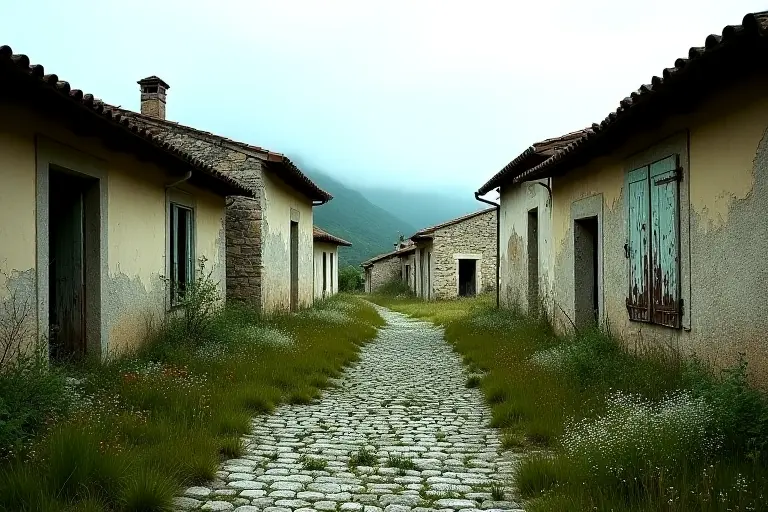
Small countries with poor governance, limited economies, and educated populations would haemorrhage people. Why would a doctor stay in a country where she earns $400 a month when she can earn $8,000 doing the same work somewhere else? Brain drain is already a serious problem for developing nations under current restrictions. Remove those restrictions and it accelerates catastrophically.
Moldova, which has already lost a third of its population to emigration since 1991, might lose another third. Parts of sub-Saharan Africa, Central Asia, and the Caribbean would see their youngest and most skilled people leave within a generation. The people who remain are the oldest, the poorest, and the least mobile. Tax bases collapse. Services deteriorate. The country enters a downward spiral that open borders were supposed to fix.
This is the central paradox. Open borders help individual migrants enormously. They may help the receiving countries. But they can devastate the countries people leave. Global wealth increases on aggregate, but the distribution is uneven and the losers are the ones least equipped to cope.
Culture and identity
I'm going to be honest: this section is where most reasonable discussions fall apart, because the arguments slide very quickly from legitimate concerns about social cohesion into territory that's just xenophobia in academic clothing. But the legitimate concerns do exist.
Communities function on shared assumptions. Language, customs, social norms, expectations of behaviour in public spaces. When a neighbourhood changes rapidly, those assumptions break down. Long-term residents feel alienated in their own streets. Newcomers cluster together for mutual support, which makes integration slower, which makes alienation worse. This isn't theoretical. It happens in every city that experiences rapid demographic change, and pretending it doesn't helps nobody.
The question is whether this is a permanent problem or a transition cost. History suggests it's the latter. The Italian and Irish immigrants who arrived in American cities in the 1900s faced exactly these tensions. Within two generations, their descendants were indistinguishable from the general population. But "within two generations" means forty to sixty years of friction, resentment, and political conflict. That's a long time to ask people to be patient.
Would it last?
Probably not. At least not in its pure form.
The political backlash would be ferocious. Within a year of open borders, parties promising to restore controls would surge in every wealthy country. They'd win elections. Borders would go back up, probably harder than before, with the added resentment of "we tried it and it was chaos" fuelling a generation of restrictionist policy.
The more interesting question is whether a partial version could work. Freedom of movement within the EU has been running for decades, and while it generates plenty of political friction (see: Brexit), it has broadly increased prosperity across member states. Polish plumbers in London, Spanish nurses in Germany, Romanian software engineers in Dublin. The flows are real and, on balance, beneficial.
Scaling that model globally might be possible, in stages, over decades, with managed transitions and support for sending countries. It would be messy, politically difficult, and slower than anyone would like. But then, so was the EU. They started with six countries and a coal agreement in 1951. Seventy years later, 450 million people can live and work freely across 27 nations. It's not perfect. But it exists, and it broadly works, and nobody had to double world GDP overnight to get there.