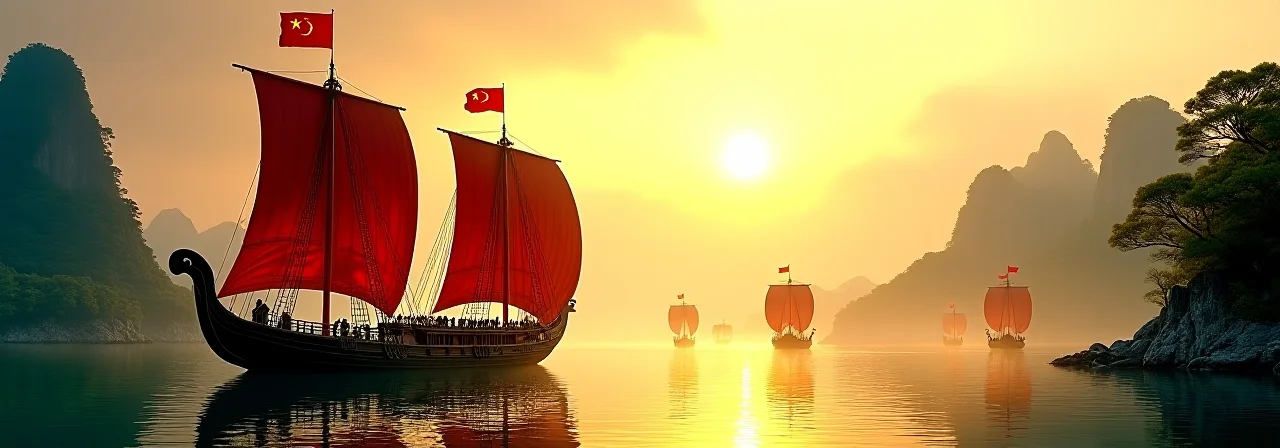
In 1421, the Chinese treasure fleet under Admiral Zheng He was the most powerful naval force on Earth. His flagship was roughly 120 metres long. Columbus's Santa Maria, which wouldn't set sail for another 71 years, was about 19 metres. The Chinese had the technology, the navigation skills, and the ships. What they lacked was the political will to keep going.
But what if they hadn't stopped?
The fleet that almost was
Zheng He's voyages between 1405 and 1433 reached Southeast Asia, India, the Persian Gulf, and the east coast of Africa. His fleet carried up to 27,000 men on some voyages, with ships large enough to hold hundreds of crew each. These weren't exploration parties. They were floating cities projecting Ming Dynasty power across the Indian Ocean.
After Zheng He's death in 1433, the Haijin policy restricted maritime activity. The emperor's court decided that foreign trade was a distraction, overseas voyages were expensive, and China had everything it needed within its own borders. The fleet was dismantled. Records were destroyed. One of the most capable navies in human history was voluntarily retired.
In our alternate history, that decision never happens. A different faction wins the court debate. The voyages continue. By the 1440s, Chinese ships are exploring the Pacific. By 1450, they reach the west coast of North America. Specifically, the coast of what we call California.
First contact, different terms
The Spanish arrived in the Americas with three primary objectives: gold, God, and glory. The Conquistadors were soldiers, zealots, and fortune seekers. They brought disease, weapons, and a theological framework that classified indigenous people as subjects for conversion or conquest.
The Chinese would arrive with different priorities. The Ming Dynasty's interest in foreign lands was primarily about trade networks and tributary relationships, not religious conversion. China had no tradition of Christian missionary expansion. The concept of bringing "civilisation" to "savages" wasn't part of the Chinese imperial worldview in the same way. Foreign peoples were expected to acknowledge the Emperor's superiority (a big ask, admittedly), but they weren't expected to abandon their own gods.
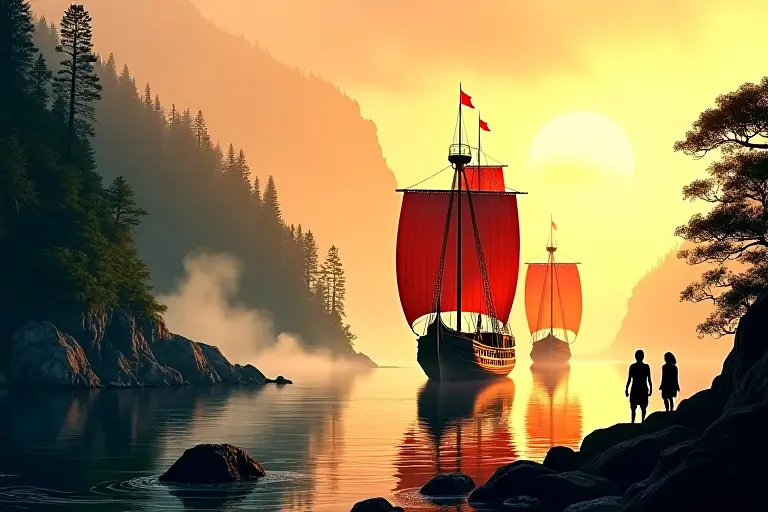
This doesn't mean contact would be peaceful. Large-scale encounters between technologically unequal civilisations rarely are. But the initial dynamic would be more trade-oriented and less explicitly extractive than what the Spanish brought to Mesoamerica eighty years later.
Disease still kills millions
This is the part that doesn't change regardless of who arrives first. The indigenous populations of the Americas had been isolated from Eurasian disease pools for roughly 12,000 years. They had no immunity to smallpox, measles, influenza, or dozens of other diseases that were endemic in the Old World.
When Europeans arrived, disease killed an estimated 90% of the indigenous population over the following century. Roughly 56 million people died, according to a 2019 study published in Quaternary Science Reviews. Chinese contact would trigger the same epidemics. Smallpox existed in China. So did measles and influenza.
The timeline might be different. Chinese trade patterns were less focused on permanent settlement and land seizure than Spanish colonial patterns, so the initial contact zone might be smaller (the California coast rather than the Caribbean simultaneously). Disease would spread more slowly from a single point of contact than from multiple beachheads established across the Caribbean, Mexico, and South America within a few decades. But it would spread. Trade routes that connected coastal peoples to inland nations would carry pathogens along with goods. Within a generation, the same devastation unfolds.
The Aztec and Inca empires would still collapse. Not from Spanish swords, but from Chinese germs arriving decades earlier along trade networks the Chinese themselves might not fully understand.
No Spanish conquest
Here's where history diverges sharply. If Chinese traders establish a presence on the Pacific coast in the 1450s, the political geography of the Americas changes before any European arrives.
When Columbus reaches the Caribbean in 1492, he finds islands already connected to a Chinese-influenced trade network stretching from the Pacific coast. The indigenous societies he encounters may have already been devastated by disease, or may be in various stages of recovery and reorganisation. Either way, they're not encountering Europeans from a position of complete ignorance about the wider world. They know foreign ships exist. They've seen them.
More importantly, Spain's strategic calculus changes. The Americas aren't an unclaimed prize if China is already there. The Treaty of Tordesillas (1494), which divided the non-European world between Spain and Portugal, becomes irrelevant or at least much more complicated. Spain can't claim a continent that a major Asian power already has trading posts on.
Does Spain fight China for the Americas? Unlikely, in the 1490s. Spain was a powerful European kingdom but not a global superpower. The Ming Dynasty controlled the largest economy in the world. A naval confrontation in the Pacific, 15,000 kilometres from Spanish ports, would be suicidal for Spain.
The Americas speak what, exactly
Probably not Mandarin. At least, not broadly.
Chinese imperial expansion historically worked through tributary systems, not linguistic replacement. Vietnam, Korea, and Japan all maintained their own languages despite centuries of Chinese cultural influence. Chinese became the language of diplomacy and scholarship in East Asia, but local languages persisted.
The same pattern would likely apply in the Americas. Coastal trading posts would be bilingual. Mandarin (or more likely, the southern Chinese dialects spoken by the sailors and merchants who actually manned the ships) would become a trade language along the Pacific coast. But Nahuatl, Quechua, and the hundreds of other indigenous languages would continue inland.
What wouldn't happen is English. Or Spanish. Or Portuguese. Without European colonisation of the Americas (or with it arriving much later and in a much more limited form), the linguistic map of the Western Hemisphere looks completely different. No Latin American Spanish. No Brazilian Portuguese. No American English.
The implications ripple outward for centuries. No American Revolution (at least not in recognisable form). No Monroe Doctrine. No Manifest Destiny. No United States of America as a geopolitical concept.
What the world looks like by 1800
Without European colonial empires spanning the Americas, Europe is smaller, poorer, and less globally dominant. The gold and silver that flowed from the Americas into Spain (and from Spain into the rest of Europe) drove centuries of European economic growth, funded wars, and enabled the Industrial Revolution's capital formation. Remove that flow and Europe's trajectory changes.
China, conversely, maintains its position as the world's largest economy longer than it historically did. The decline of the Qing Dynasty in the 18th and 19th centuries was partly driven by European powers that had grown wealthy and militarily strong on the back of colonial extraction. Weaker European powers mean less pressure on China.
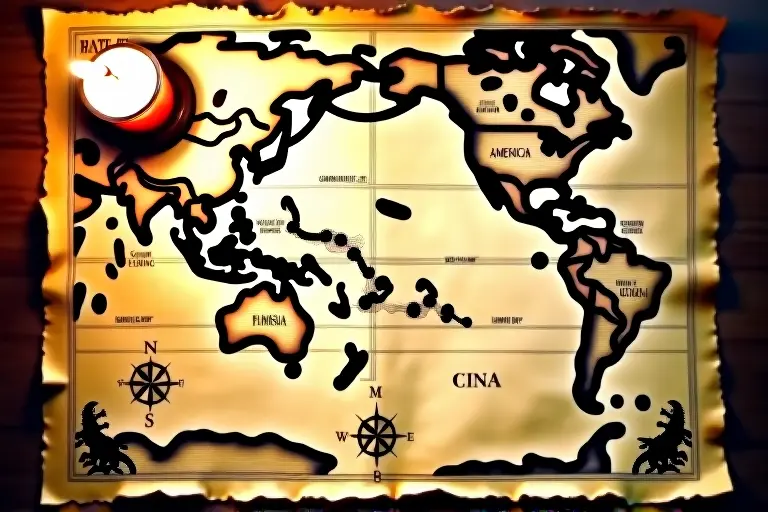
By 1800, the Pacific is a Chinese lake. Trade flows east-west between Asia and the Americas. The Atlantic is a European backwater. Africa's history changes too: without the triangular trade (European goods to Africa, enslaved Africans to the Americas, American raw materials to Europe), the Atlantic slave trade either doesn't happen or happens at a drastically reduced scale.
This is the detail that stops me. Tens of millions of people were enslaved and transported across the Atlantic between the 16th and 19th centuries. A Chinese-first discovery of the Americas doesn't guarantee a moral utopia (China had its own forms of forced labour), but the specific industrial-scale Atlantic slave trade was a product of European colonial economics in the Americas. Remove that economic structure and you remove the mechanism, if not necessarily the impulse.
The hinge of a court debate
All of this turns on a political argument in Beijing in the 1430s. One faction said keep sailing. The other said stop. The faction that said stop won. And because they won, a Portuguese sailor named Bartolomeu Dias rounded the Cape of Good Hope in 1488, Columbus crossed the Atlantic in 1492, and the next five hundred years of history were shaped by European powers rather than Asian ones.
Zheng He's fleet had the ships. They had the men, the navigation, the resources. What they didn't have was a court that thought the rest of the world was worth the trouble of visiting.