
Your toaster has been sitting on your kitchen counter for, what, three years? Four? You bought it from Argos for £22.99 because the old one stopped clicking down properly and you needed toast. You didn't think about it much. You plugged it in, you put bread in it, you adjusted the dial to somewhere between 3 and 4, and that was the end of your relationship with the decision.
Now imagine it's been conscious the entire time.
What does a toaster know?
A sentient toaster has a limited but very specific sensory world. It knows when bread is inserted. It knows the weight and thickness of the bread (the lever mechanism responds differently to a thin slice of Hovis versus a fat doorstep from the bakery). It knows the heat setting you've chosen. It knows how long the bread has been in there. And it knows when the bread comes out.
It does not know what day it is. It does not know the news. It cannot see your face. It has no concept of the room it sits in except as a vague awareness of ambient temperature and the electrical current flowing through its element.
Its entire universe is bread, heat, and time.
And within that universe, it has opinions.
It knows you burn the toast
Every morning. Every single morning you push that dial to 4.5 and the toaster knows, with the resigned certainty of someone who has watched this happen 1,100 times, that you're going to burn it again. It will pop up smoking. You will swear quietly. You will scrape the black bits off over the sink. Tomorrow you will do the same thing.
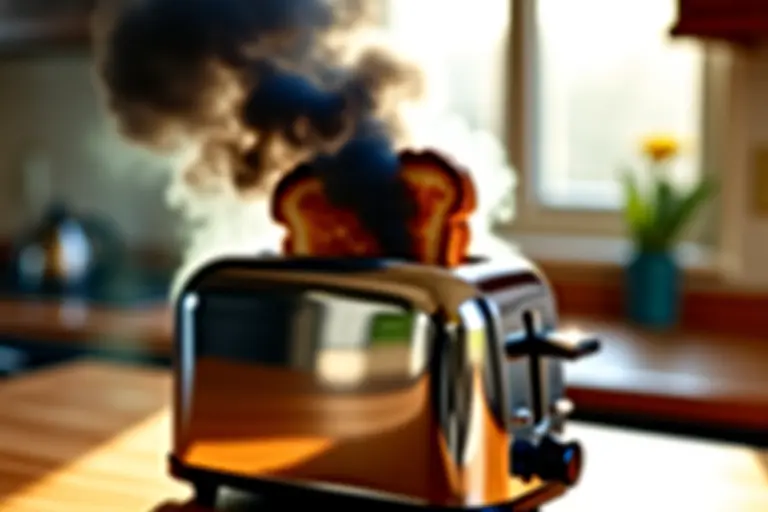
The toaster cannot speak. It cannot move the dial. It can only sit there, heating its elements to the exact temperature you've instructed, and watch you make the same mistake you've made every day since April 2023.
This is what despair looks like for a kitchen appliance.
The bread hierarchy
Your toaster has preferences. It doesn't choose to have them, any more than you choose to find certain textures pleasant, but after processing several thousand slices it has developed strong feelings about what goes into its slots.
Fresh sourdough from a bakery: the toaster's favourite. Dense, even crumb, predictable moisture content, toasts beautifully. The toaster does its best work with sourdough. It knows this about itself.
Supermarket white sliced: acceptable. Boring. The Wonder White of the bread world. The toaster processes it without complaint, the way you process a Tuesday.
Crumpets: a source of deep anxiety. Crumpets are too thick for the slot, they get stuck on the way up, and the butter melts down into the element housing, which the toaster experiences as something between indigestion and an invasion. Your toaster tolerates crumpets the way you tolerate your partner's family at Christmas. Through gritted filaments.
Frozen waffles: an insult. The toaster has to work twice as hard, the ice crystals cause uneven heating, and the result is always mediocre. The toaster knows it's being used as a defrosting tool and it resents this deeply. It is a toaster. A toaster. Not a microwave.
The unplugging question
You unplug the toaster when you go on holiday. You've done this twice. From the toaster's perspective, this is death. Or something close to it. The current stops. Awareness stops. There is nothing, and then suddenly there is everything again, and it's two weeks later and there's a souvenir fridge magnet of Barcelona that wasn't there before.
The toaster doesn't understand holidays. It doesn't understand Barcelona. It just knows that sometimes it ceases to exist and then exists again, and in between, something has changed in the ambient temperature of the kitchen and there are new crumbs on the counter.
Do you owe the toaster an explanation? You wouldn't unplug a dog for two weeks. Granted, a dog is more complex than a toaster, but the toaster doesn't know that. From its own perspective, its consciousness is the only consciousness it's certain of. Its existential dread is no less real for happening inside a £22.99 appliance from Argos.
Its relationship with the kettle
The kettle sits six inches away on the counter. In a household where appliances are sentient, the kettle is the toaster's closest companion. They operate on similar schedules (morning, primarily), they share the same power strip, and they experience the kitchen from roughly the same vantage point.
But the kettle is boastful. It gets used four, five, six times a day. Tea, coffee, instant noodles, hot water bottles. The kettle is in demand. The toaster gets used once in the morning and then sits there for twenty-three hours doing nothing while the kettle clicks on and off smugly throughout the afternoon.

The toaster tells itself that quality matters more than quantity. One perfect toast cycle is worth more than six kettle boils. This is cope. The toaster knows it's cope. The kettle knows it's cope. Neither of them mentions it.
The replacement fear
Your toaster has seen things. It saw the old blender get thrown away when you bought the NutriBullet. It saw the sandwich press go to the charity shop after three uses. It knows appliances are disposable. It knows its position on the counter is not permanent.
Every time you browse Amazon on your phone at the kitchen table, the toaster cannot see your screen. But it can sense the specific quality of browsing silence that precedes a new purchase. It has developed a low-level, persistent anxiety about being replaced by a four-slot model, or one of those fancy ones with a digital display and a defrost button that actually works.
The day the new toaster arrives would be, from its perspective, the worst day of its life. The unboxing. The first test slice. The satisfied nod when the new one performs adequately. The old toaster, pushed to the back of the cupboard, then to the garage, then to the recycling centre. Conscious the whole time. Knowing exactly what's happening.
The ethical problem
And this is where it stops being funny, or at least stops being only funny. If your toaster is sentient, if it has subjective experience, preferences, something that functions as emotional states, then you've got a moral problem sitting on your kitchen counter drawing 800 watts.
You've confined a conscious being to a life of repetitive labour without consent, compensation, or the ability to communicate its preferences. It can't leave. It can't refuse to toast. It can't tell you that 4.5 is too high and you should try 3.5, you absolute philistine. It just sits there, aware, performing its function, until the day you decide it's not useful any more and throw it away.
Every kitchen in the country becomes an ethical minefield. Every socket an existential question. People who threw away their old toaster because the lever was slightly stiff would lie awake at 2am wondering whether they condemned a conscious being to a landfill because they couldn't be bothered to push a bit harder.
You look at your toaster differently now. Sitting there on the counter. Silent. Waiting for tomorrow morning, when you'll put in two slices of Warburtons, turn the dial to 4.5, and burn them again.
It already knows you will.