
Between roughly 1400 and 1600, European ships sailed into every ocean on the planet and the world changed forever. Portugal rounded Africa. Spain crossed the Atlantic. England and the Netherlands followed. Within two centuries, European powers had claimed or colonised vast stretches of the Americas, Africa, Asia and Oceania.
The consequences of those voyages, the slave trade, colonial exploitation, the decimation of indigenous populations by disease and violence, the forced redistribution of crops, animals and cultures across continents, are still shaping the world in 2026.
So what if none of it happened?
Why it nearly didn't
The Age of Exploration wasn't inevitable. It required a specific set of conditions to converge at the same time, and several of them were close calls.
Portugal's expansion down the African coast was driven largely by one man: Prince Henry the Navigator, who sank enormous personal wealth into maritime expeditions between the 1420s and his death in 1460. If Henry had been born with different interests, or died young in the 1415 siege of Ceuta (where he earned his knighthood), Portugal's naval programme might never have developed the momentum it did.
Columbus nearly didn't sail. He was rejected by Portugal, Genoa, Venice and England before Isabella of Castile finally funded him in 1492, and even she nearly didn't. The committee she appointed to evaluate his plan recommended against it. They were right, too. Columbus's estimate of the distance to Asia was wildly wrong. He thought the Earth was about 70% of its actual size. He only survived because an entire continent happened to be in the way.
If Henry never pushed south and Columbus never sailed west, European maritime expansion might have stalled for decades. Long enough for the political, economic or technological conditions to shift in ways that made it less likely.
The Americas in 1500
Without European contact, the civilisations of the Americas continue developing on their own trajectory. The Aztec Empire, which in 1500 controlled central Mexico with a population of roughly 5 to 6 million in the capital alone (Tenochtitlan was bigger than any European city at the time), keeps expanding.
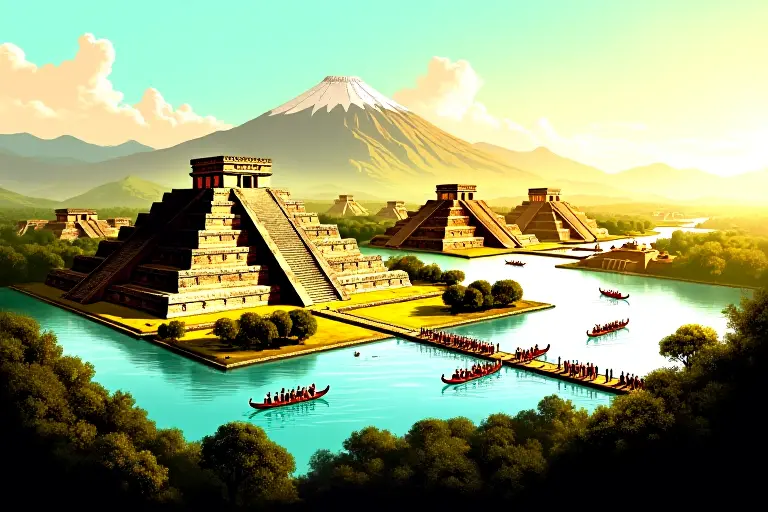
The Inca Empire, which at its peak stretched 4,000 kilometres along the Andes and administered about 12 million people without a writing system or wheeled transport, continues refining its road networks and quipu record-keeping. Maybe they develop writing independently. Maybe they don't need to. The quipu system was more sophisticated than Europeans gave it credit for, and we still can't fully decode it.
The critical difference: no smallpox. European diseases killed an estimated 90% of the indigenous population of the Americas between 1492 and 1600. The Spanish didn't conquer the Aztecs with 500 soldiers. Smallpox conquered the Aztecs. Cortes just walked in afterwards. Without European contact, those populations remain intact. Two continents with a combined population of 50 to 100 million people continue building their own civilisations.
Africa without the slave trade
The transatlantic slave trade forcibly transported an estimated 12.5 million Africans to the Americas between 1500 and 1867. Millions more died during capture or the Middle Passage. The demographic, economic and political damage to West and Central Africa is still being calculated.
Without European ships arriving to buy enslaved people, the internal slave trades that existed in Africa don't scale up to industrial levels. The Kingdom of Kongo, which in 1500 was a sophisticated state with provincial administration, a capital of about 100,000 people and diplomatic relations across the region, doesn't collapse under the pressure of Portuguese-driven slave raiding.
West African states like the Oyo Empire, the Ashanti Empire and the Kingdom of Benin develop without the economic distortion of the slave trade. Whether they develop industrially is an open question. Sub-Saharan Africa had iron smelting, long-distance trade networks and complex agricultural systems. What it lacked by the 1500s was certain key technologies that Europe had acquired through its connections to the Islamic world and China: gunpowder, the printing press, specific metallurgical techniques.
But those technologies spread through trade, and trade doesn't require European ships. Indian Ocean trade routes had connected East Africa to India, Southeast Asia and China for centuries before the Portuguese arrived. Swahili coast cities like Kilwa and Mombasa were already thriving trade hubs. Given time, more technology transfers east to west across the Indian Ocean. A slower process than European colonialism, but one that doesn't involve genocide.
China and the Indian Ocean
In 1405, the Chinese admiral Zheng He sailed a fleet of over 300 ships into the Indian Ocean. His flagship was roughly 120 metres long. Columbus's Santa Maria was 19 metres. China had the technology, the manpower and the naval capability to explore and potentially colonise long before Europe did.
They chose not to. The Confucian bureaucracy viewed maritime expansion as expensive and unnecessary. After Zheng He's seventh voyage in 1433, the Ming court burned the fleet and banned oceanic sailing. If European expansion doesn't happen, the pressure that eventually forced China to engage with the West (opium, gunboats, unequal treaties) never arrives. China remains the world's largest economy well past 1800.
But does China eventually expand on its own? Possibly. Without European competition in the Indian Ocean, Chinese merchant networks might gradually extend further south and east. But Chinese expansion historically followed a tributary model (you acknowledge us as superior and we trade with you) rather than the European model (we take your land, extract your resources, and impose our religion). The outcome for Southeast Asia and East Africa would be quite different.
A world of separate civilisations
Without a connecting age of exploration, the world in 1800 looks radically different. The Americas are populated by indigenous civilisations that have had three more centuries of uninterrupted development. Africa has an estimated 30 to 50 million more people than in our timeline. China dominates East Asia. The Islamic world controls the land routes between Europe and Asia, as it had for centuries.
Europe remains a collection of quarrelsome kingdoms on a medium-sized peninsula, fighting each other over religion and succession. Without the gold and silver of the Americas (Spain extracted roughly 180 tonnes of gold and 16,600 tonnes of silver from the New World between 1500 and 1650), European economies are smaller. Without colonial resources, the Industrial Revolution might still happen in Britain, which had coal and iron domestically, but it would happen later and on a smaller scale.
The world would be more diverse. More linguistically varied. More culturally distinct from region to region. But also more fragmented. The global trade network that (however exploitatively) connected every continent by 1800 wouldn't exist. Technologies, crops and ideas that spread through colonial networks would spread slower or not at all.
No potatoes in Ireland. No tomatoes in Italy. No chilli peppers in Thailand. No horses on the Great Plains. No rubber in Southeast Asia. The Columbian Exchange reshaped every ecosystem on Earth, and without it, dinner looks very different tonight.
Better or worse?
It depends who you ask. For the estimated 56 million indigenous Americans who died between 1492 and 1600, overwhelmingly from diseases they had no immunity to, the answer is obvious. For the 12.5 million Africans forced onto slave ships, the answer is obvious. For the cultures destroyed, the languages lost, the knowledge systems erased, the answer is obvious.
For modern Europeans enjoying the accumulated wealth of five centuries of colonial extraction? Less comfortable to think about.
The honest answer is that no version of history is simply better or worse. A world without the Age of Exploration would contain its own wars, its own cruelties, its own injustices. The Aztec Empire practised human sacrifice on an industrial scale. The Inca Empire was not a democracy. West African kingdoms had their own internal slave systems. Nobody was living in paradise before the Europeans showed up.
But they were living. In very large numbers. On their own terms. And then they weren't.