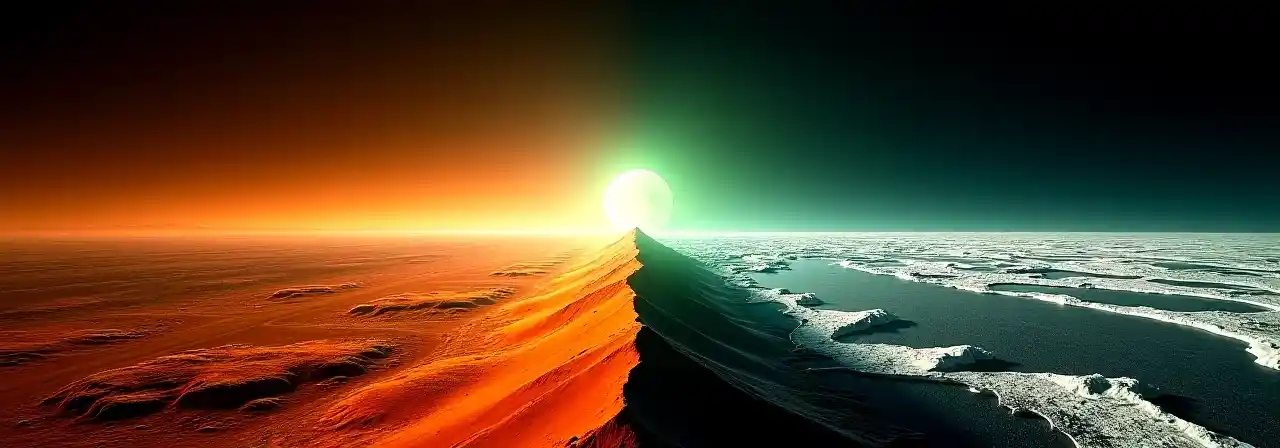
The Moon shows Earth the same face all the time. It rotates, but at exactly the rate it orbits, so one hemisphere permanently faces us and the other permanently faces away. This is tidal locking, and it's common in the solar system. Mercury is nearly locked. Most large moons are fully locked to their planets.
Earth isn't locked to the Sun. We rotate once every 24 hours, giving every point on the surface a regular cycle of light and dark. But if our rotation had slowed over billions of years until one face permanently pointed sunward, the planet would be unrecognisable.
The bright side
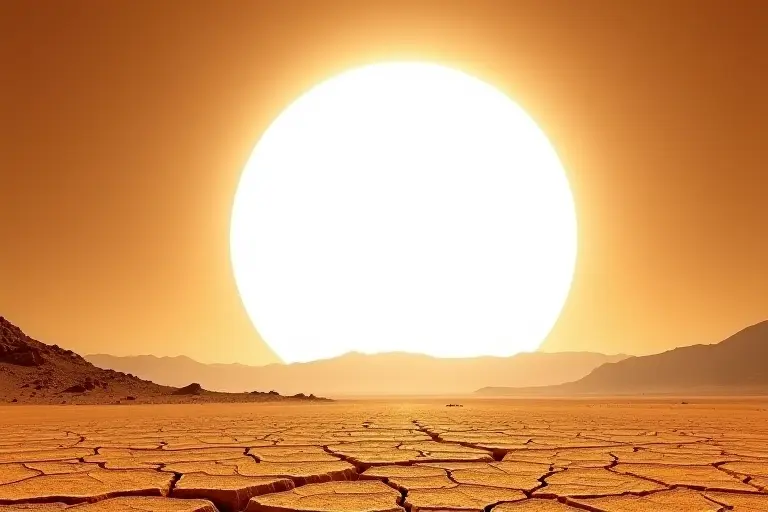
Half the planet bakes in permanent sunlight. The subsolar point, the spot where the Sun sits directly overhead, receives about 1,361 watts per square metre of solar energy, continuously, forever. No night. No clouds building toward a cooling evening. Just unrelenting radiation.
Surface temperatures at the subsolar point climb past 150°C. The rock itself is too hot to touch. Any water evaporated long ago. The landscape is a dry, cracked expanse of overheated stone, closer to Venus than to anything on modern Earth.
Moving outward from the centre, conditions improve gradually. The Sun sits lower on the horizon, spreading its energy across more surface area. Temperatures drop. By the time you reach the terminator (the boundary between the light and dark hemispheres), the Sun sits permanently on the horizon. A never-ending sunrise, or sunset, depending on your temperament.
The dark side
The hemisphere facing away from the Sun never sees it. Not once. Not ever. It's in permanent night.
Without solar input, the dark side radiates its heat into space. Surface temperatures plunge to -70°C or lower. Near the anti-solar point (the spot directly opposite the Sun), temperatures may reach -100°C. This is comparable to Antarctica's interior in winter, except there's no summer coming.
The ground is frozen solid. Any water is ice, locked in glaciers kilometres thick. The atmosphere above the dark side is thinner and drier, because cold air holds less moisture and the density difference drives atmospheric flow toward the light side.
Nothing grows. Nothing moves. It's a continent-sized freezer with the door permanently shut.
The terminator zone
Between the furnace and the freezer sits a band of permanent twilight. The terminator runs in a great circle around the planet, roughly 100 to 200 kilometres wide depending on atmospheric refraction and topography. Here, the Sun hovers at the horizon permanently. The light is golden, angled, like 6pm on a June evening, and it never changes.
This is where life exists, if it exists at all.
Temperatures in the terminator zone average somewhere between 0°C and 30°C, depending on latitude and local conditions. Warm enough for liquid water. Cool enough to not boil it away. The atmospheric circulation patterns that redistribute heat from the bright side to the dark side create persistent wind at the terminator, blowing from the hot hemisphere toward the cold one.
The wind is constant. Not gentle. Models from 2013 research at the University of East Anglia suggest wind speeds of 50 to 100 km/h at the terminator, driven by the enormous temperature gradient between the two hemispheres. Everything in this zone is windswept. Trees, if they evolved here, would grow horizontally, pointing away from the Sun, shaped by a wind that never stops.
Weather, sort of
Earth's weather is driven by differential heating. The Sun warms the equator more than the poles, and the temperature difference drives atmospheric circulation. On a tidally locked Earth, the differential is even more extreme, but it's between the hot and cold hemispheres rather than equator and poles.
The bright side generates a massive low-pressure zone as heated air rises. Cool air flows in from the dark side to replace it, creating a planet-wide circulation cell. Moisture evaporated from any remaining bright-side ocean rises, drifts toward the terminator, and precipitates as rain or snow.
The terminator zone would be wet. Possibly very wet. A permanent band of rainfall where warm moist air from the bright side meets cold air from the dark side. Not seasonal rain. Continuous rain. The kind of drizzle that makes Manchester feel like a desert by comparison.
The dark side receives almost no precipitation. Its air is too cold and dry. Whatever moisture exists there fell as snow millions of years ago and has stayed frozen since.
Could humans live there?
In the terminator zone, yes. Barely. The challenges are significant but not insurmountable.
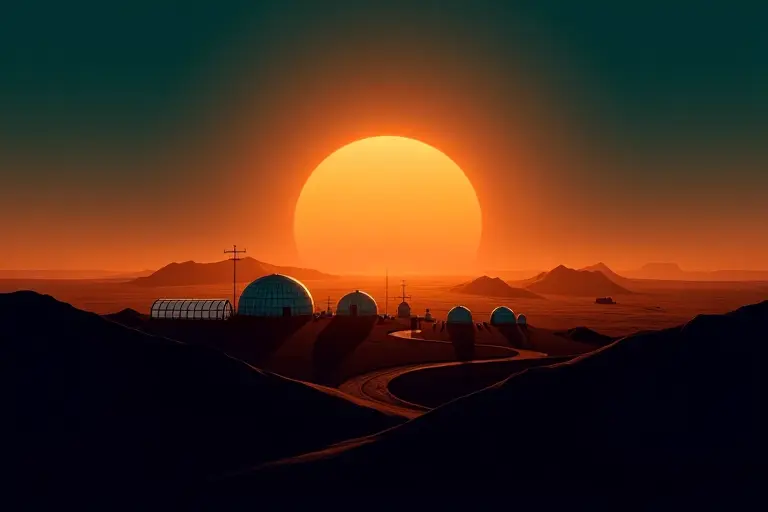
First, the constant wind. Every structure needs to be built for it. Low, heavy buildings oriented parallel to the wind direction. No skyscrapers. No delicate architecture. Think bunkers with windows.
Second, the light. It never changes. There's no day-night cycle to set your circadian rhythm. Your body doesn't know when to sleep. Artificial lighting schedules become a medical necessity, not a convenience. Every building needs blackout capabilities and programmed light cycling. Without them, sleep disorders become universal within weeks.
Third, agriculture. Plants need light, and the terminator zone has it, but it's always low-angle light. Growing crops under permanent golden-hour conditions means long shadows and uneven illumination. Fields would be oriented to face the Sun, terraced on slopes that maximise exposure. The growing season is infinite (there are no seasons), but yields per unit area might be lower than on a rotating Earth.
Fourth, vitamin D. The Sun is always near the horizon, meaning its light passes through more atmosphere and loses more UV. People in the terminator zone might struggle with vitamin D deficiency despite living under permanent sunlight. Supplements or UV lamps indoors. A strange irony in a world where the Sun never sets.
The habitable band
Imagine the population of the entire planet compressed into a ring. A belt of habitable land wrapping around the globe, maybe 200 kilometres wide. Everything outside it is either too hot or too cold for human survival without extreme technology.
The politics of this world are the politics of a corridor. Territory is measured in kilometres of terminator frontage. Wars are fought over the temperate side versus the cold side of the band. Moving 50 kilometres toward the Sun means intolerable heat. Moving 50 kilometres away means lethal cold. The margin for error is measured in tens of kilometres.
Trade routes run along the terminator, not across it. North-south travel (or whatever the equivalent is when your geography is defined by light rather than rotation) follows the habitable band. East-west travel, toward the Sun or away from it, is expedition-level dangerous.
Time
Without day and night, time is arbitrary. The Sun doesn't move. There are no seasons. The concept of a "day" has no astronomical basis. People would invent time divisions based on biological needs (sleep cycles, meal patterns) but there'd be no external cue reinforcing them.
Different cultures along the terminator band would develop different time systems. Some might adopt a 24-hour clock out of tradition. Others might use biological cycles of 20 or 28 hours, whatever matches their sleep patterns. Scheduling a meeting between two settlements 5,000 kilometres apart along the terminator might involve converting between completely incompatible time systems.
There's no midnight. No noon. No dawn, because dawn is a permanent condition, frozen in place. Poets would write about it differently. "Morning" would mean something personal (when you wake up) rather than something the planet does. Every metaphor tied to sunrise, new beginnings, fresh starts, the breaking of a new day, would need replacing.
The planet's most reliable clock would be the stars. The dark side can see them. The bright side can't. And the terminator zone sees a permanent half-sky of stars on one horizon and permanent pale gold on the other. Astronomy happens in one direction only, and every observatory points the same way: away from the Sun, into the dark.