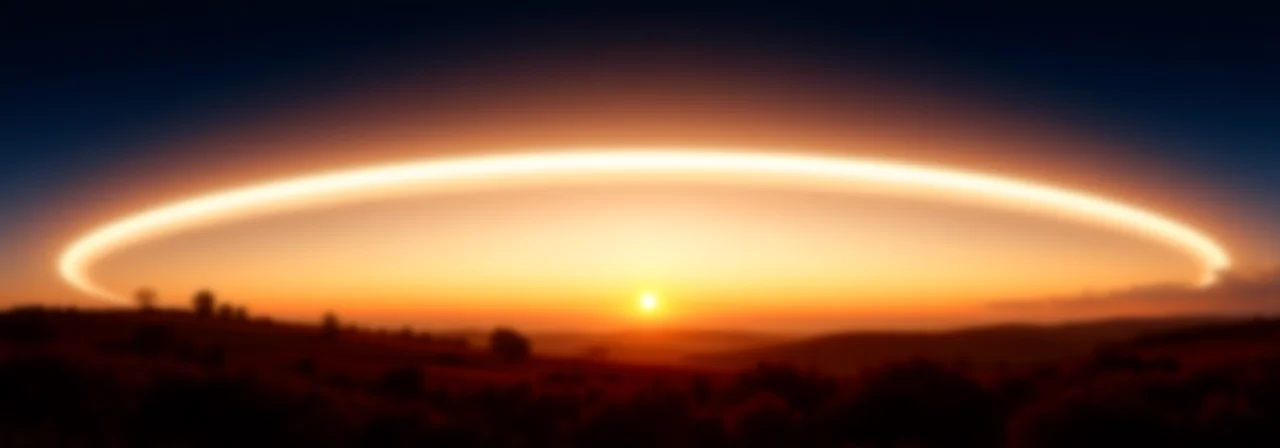
Saturn's rings span roughly 282,000 kilometres from edge to edge but average only about 10 metres thick. They're made of ice particles and rocky debris, ranging from grains of sand to chunks the size of houses. From a distance, they're the most visually striking feature in the solar system. Up close, they're a blizzard of frozen rubble, endlessly orbiting.
Put those rings around Earth, in the same proportional scale, and you change everything from navigation to theology.
What you'd see
Earth's rings would sit along the equatorial plane, extending outward from roughly 12,000 kilometres above the surface (inside the ring of geostationary satellites) to perhaps 80,000 kilometres, depending on their extent. From the ground, what you'd actually see depends entirely on where you are.
Stand on the equator in Quito or Nairobi and look up. The rings appear as a thin, bright line bisecting the sky from horizon to horizon, edge-on. Because you're in the same plane as the rings, you're seeing them from the side. A razor-thin arc of light directly overhead, like someone drew a luminous wire across the sky.
Now travel north to London, at 51° latitude. The rings become a massive, tilted band arcing across the southern sky. During the day, they'd be visible as a pale, milky stripe, brighter than clouds, catching and scattering sunlight. At night, they'd be extraordinary. A wide, glowing arch spanning from southeast to southwest, bright enough to read by, casting ring-light across the landscape the way a full moon does but more diffuse and constant.
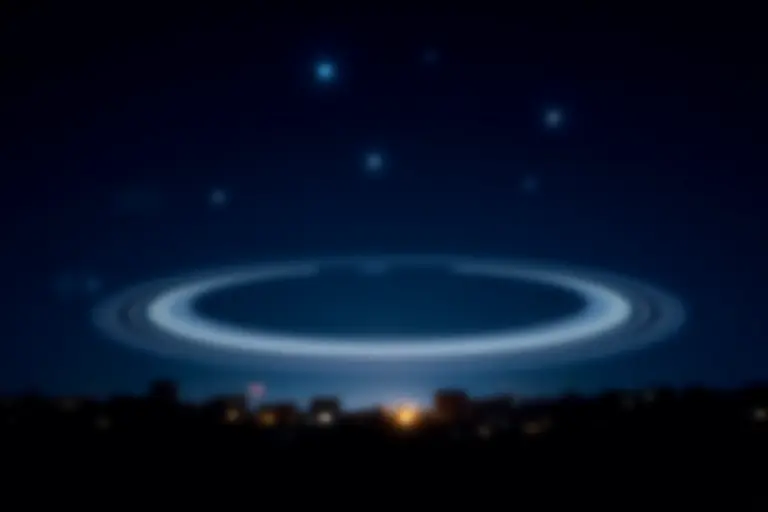
Move further north to Reykjavik at 64° and the rings are lower on the horizon, wider, more dramatic. From the poles, you'd see them as a great circle resting on the horizon all around you, like a luminous wall at the edge of the world.
Shadows
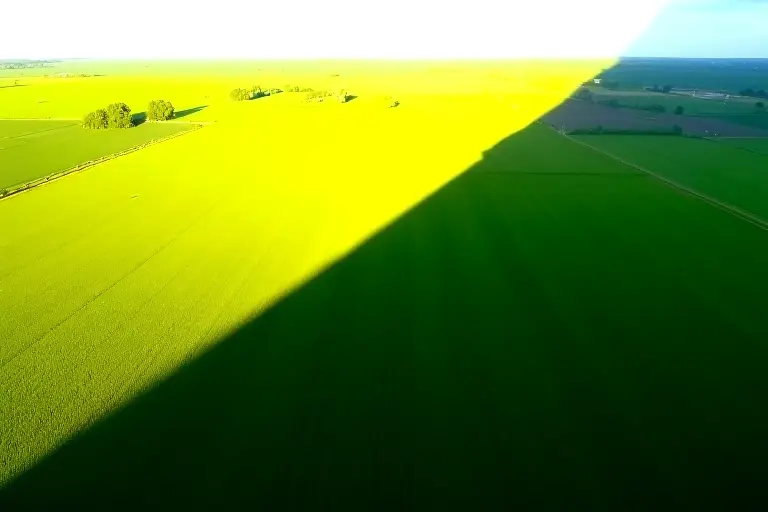
This is where the practical effects begin. The rings would cast shadows on Earth's surface. During equinoxes (when the sun crosses the equatorial plane and is level with the rings), the shadow is minimal. But during solstices, when the sun is highest above or below the ring plane, a substantial shadow band would fall across the Earth.
In the Northern Hemisphere's summer, the rings' shadow would fall across the Southern Hemisphere, and vice versa. The shadow band would be hundreds of kilometres wide, dimming sunlight significantly in the affected region. Equatorial regions would experience the most dramatic shadow effects, with reduced sunlight during certain parts of the year.
This changes agriculture. Crops in shadow-affected zones would receive measurably less solar energy during parts of the growing season. The boundaries of viable farming shift. Some regions currently productive become marginal. Others, previously too hot, become more temperate. The agricultural map of the world redraws according to ring shadow patterns that repeat with clockwork precision every year.
No more dark nights
Light pollution from the rings would be permanent and global. Even on a moonless night, the rings would scatter enough sunlight to keep the sky significantly brighter than it currently is. Depending on the ring density and albedo, ring-light could be several times brighter than a full moon.
Astronomy from the ground becomes much harder. The faint objects that ground-based telescopes currently observe, distant galaxies, nebulae, dim stars, would be washed out by the constant ring glow. Humanity's visual relationship with the cosmos changes. We'd see fewer stars. The Milky Way would be invisible from most latitudes most of the time. The sky would be beautiful, dominated by the spectacular rings, but narrower. Less infinite-feeling.
Whether we'd have developed the same curiosity about space is an open question. The rings might inspire wonder but simultaneously prevent us from seeing what's beyond them.
Navigation before GPS
Celestial navigation, the backbone of exploration and trade for thousands of years, relies on seeing stars. With ring-light washing out fainter stars near the equator and ring structures physically blocking portions of the sky, navigation becomes harder. Polaris is still visible from the Northern Hemisphere (the rings don't reach that high in the sky from mid-latitudes), but many of the reference stars used for latitude and longitude calculations would be intermittently obscured.
The rings themselves would become navigational references. Their precise position in the sky indicates latitude directly: the angle of the rings above the horizon tells you how far from the equator you are, with mathematical precision, no stars needed. Maritime cultures would develop ring-based navigation systems, and they'd work brilliantly. Different from star navigation, but potentially more intuitive.
The Age of Exploration might unfold differently. Or it might not. Humans are persistently good at figuring out how to get from one place to another using whatever the sky provides.
Seasons and climate
The ring shadow effect would create a secondary seasonal pattern layered on top of the existing one. Regular seasons are driven by axial tilt. Ring shadow seasons are driven by the sun's position relative to the ring plane. These two cycles interact, creating more complex patterns of light and temperature throughout the year.
Equatorial regions, currently the most climatically stable on Earth, would become the most affected by ring shadows. The tropics might actually cool slightly on average due to reduced direct sunlight during peak shadow periods. Meanwhile, polar regions, where the rings are near the horizon and cast no overhead shadow, would be relatively unaffected.
Global average temperature might drop by one or two degrees Celsius due to the rings reflecting some sunlight back into space before it reaches the surface. That's enough to shift climate zones, extend glaciation periods, and potentially delay or alter the trajectory of ice ages.
Religion and mythology
Every human culture would have myths about the rings. They're the single most visible feature of the sky after the sun and moon. A permanent, luminous arch that changes apparent width with latitude, casts moving shadows, and glows through the night.
Creation myths would incorporate them. Some cultures would see them as a bridge (the Norse already had Bifrost; a visible ring would make such myths nearly universal). Others might interpret them as a wall, a boundary between the mortal world and something beyond. The shadow cast by the rings would carry religious significance: the "ring shadow" period could become a season of fasting, celebration, or superstition depending on the culture.
Astrology would be more complicated. The rings' position relative to constellations would add another variable to an already overcrowded system. Whether this makes astrology more or less popular is anyone's guess. Probably more. It always seems to be more.
The satellite problem
Modern telecommunications depend on satellites in specific orbits. Geostationary orbit (35,786 km altitude) sits right in the middle of where Earth's rings would be. Every geostationary satellite we've ever launched, the ones that handle television broadcast, weather imaging, and communications, would need to be somewhere else, if "somewhere else" exists that doesn't intersect a field of high-velocity ice and rock.
Low Earth orbit (200-2,000 km) would be below the rings and probably fine. GPS satellites at 20,200 km might be within the ring system or might not, depending on the inner boundary. But the space environment changes dramatically. Any spacecraft passing through the ring plane risks collision with ring particles. Launches from equatorial sites become nearly impossible without navigating through the ring.
We'd have adapted, because we always do. Launch sites would move to high latitudes where the angle through the ring plane is more manageable. Satellite orbits would be redesigned around the ring geometry. But the easy assumption that space is empty and accessible from anywhere on Earth's surface disappears entirely.
Ringed Earth is a more beautiful world and a more complicated one. The sky is never dark, the equator is shadowed, the stars are harder to see, and getting to space means threading a needle through a belt of orbiting debris. But every sunset paints the rings in colour, and every clear night features a glowing arch that no one, in ten thousand years of looking up, would ever get tired of seeing.