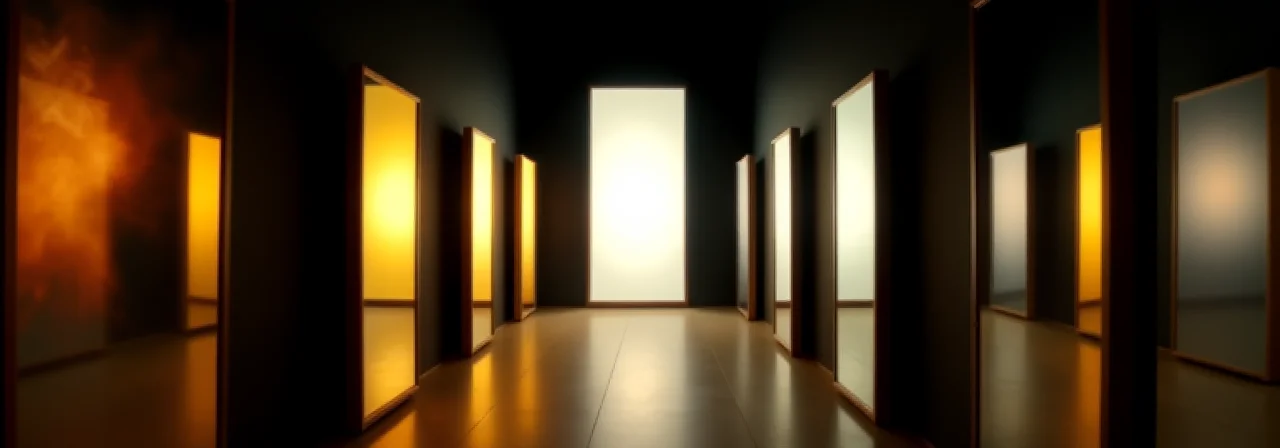
You step out of the shower, towel around your waist, and glance at the bathroom mirror. What looks back isn't your face. There's no face. No body. What you see is a visual representation of who you are inside. Your character, your temperament, the accumulation of every choice you've made, rendered as an image that only you can interpret instinctively.
Everyone sees something different in their own reflection. And nobody can quite describe what they see to anyone else.
What does personality look like?
This is the question that makes or breaks the scenario, so I'm going to spend a moment on it.
Personality isn't a fixed image. It's a state. A generous person in a selfish mood looks different from the same person on a kind day. The mirror shows the current composite: your baseline traits overlaid with your present emotional state, recent actions, and dominant thoughts.
People who've been through something like this describe it in abstract terms. Think about how you feel when you listen to music that matches your mood. There's a recognition, a resonance, a sense that the external thing is expressing your internal state. The personality mirror works similarly. You don't see a literal portrait of your virtues. You see something that feels like you.
For a genuinely kind person, the reflection might be warm. Soft at the edges. Steady. For someone consumed by envy, it might be sharp, acidic, hard to look at for long. The visual language is intuitive and personal. Two kind people don't see the same image. But both recognise warmth when they see it.
The morning routine changes
Physical appearance is gone from the mirror. You can still look down and see your own body, examine your own hands, ask someone else how you look. But the mirror, that daily checkpoint where you assess yourself before leaving the house, now shows something else entirely.
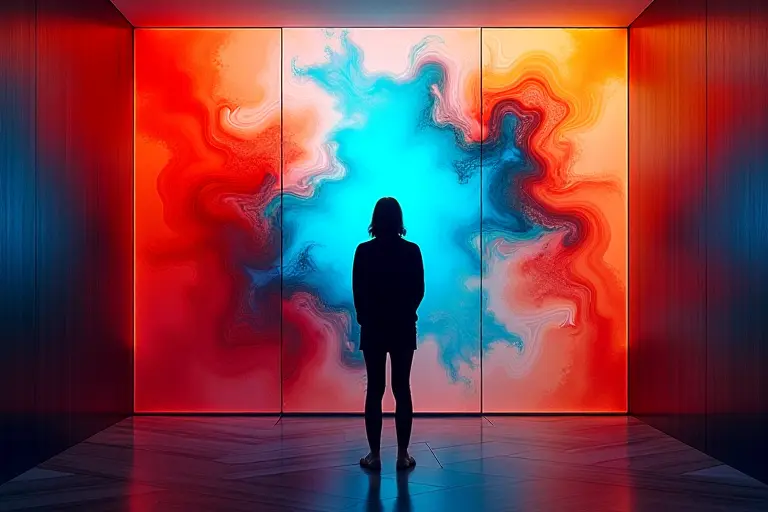
Some mornings, you look and feel good about what's there. You were patient with your kids yesterday. You did honest work. You apologised to someone you'd been short with. The reflection is settled, clear, something you're comfortable facing.
Other mornings, you look and wince. You were petty at work. You gossiped about a friend. You scrolled past something you should have spoken up about. The reflection knows. Not because it's judging you. Because it is you.
People who are fundamentally decent but prone to self-criticism might have a better reflection than they expect. The mirror shows personality, not self-perception. If you're kinder than you think you are (and most anxious people are), the mirror tells you so. This would be genuinely therapeutic for millions of people who spend their lives convinced they're worse than they actually are.
Narcissists and the beautiful reflection
This is where it gets complicated.
A narcissist believes they're extraordinary. If the mirror shows personality, and the narcissist's personality is dominated by grandiosity and self-admiration, do they see something magnificent?
Possibly. If the mirror reflects what you are, and what you are is someone who genuinely believes in their own superiority, then the reflection might indeed look grand. But narcissism also contains insecurity, fragility, and a desperate need for validation. Those would show too. The reflection might be impressive on the surface and unstable underneath, like a building with gilded walls and cracked foundations.
Whether the narcissist notices the cracks depends on whether they can look honestly at their own reflection. Which, given the condition, they probably can't. The personality mirror might be the one mirror a narcissist likes more than a regular one.
Children discovering themselves
Children begin recognising themselves in mirrors at about 18 months old. It's a milestone in developmental psychology. The "mirror test" shows that the child has developed a concept of self.
In this world, the mirror test measures something different. The child doesn't recognise their physical appearance. They recognise their personality. They see something in the glass that feels like them, that matches their inner experience. Developmental psychologists would study the age at which children start reacting to personality mirrors differently from other visual stimuli. It might be earlier than 18 months, or later. Nobody knows, because we've never tested it.
Teenagers would have the hardest time. Adolescence is when personality is most in flux. Identity is under construction. The reflection changes week by week, sometimes day by day. One week it's confident and bright. The next, after a social disaster at school, it's withdrawn and murky. The mirror becomes a source of anxiety for teenagers who are already anxious about everything.
Parents would find themselves having a new kind of conversation. Not "you look fine, stop worrying about your hair" but "your reflection changes because you're growing, and that's normal." School counsellors would keep a mirror in the office. Show me what you see. Tell me what it feels like.
The people who stop looking
Some people would avoid mirrors entirely.
Not because they're bad people. Because they're afraid of what they'd see. Guilt is powerful. Someone carrying unresolved shame, a betrayal they've never confessed, a cruelty they've never acknowledged, might find their reflection unbearable. Not hideous. Just honest in a way they can't face.

Mirror avoidance would become a recognised psychological pattern. Therapists would note it as a symptom. "How often do you look in the mirror?" becomes a standard intake question. The answer reveals more than any questionnaire about self-esteem or moral distress.
Religious communities would have strong opinions. Some would embrace the personality mirror as divine accountability. God shows you who you are. Others would reject it. The reflection is a temptation to vanity or despair. Certain denominations would cover mirrors during Lent. Others would mandate daily mirror meditation as a spiritual practice.
The beauty industry collapses (partially)
If the mirror can't show your face, the daily ritual of checking your appearance before leaving the house disappears. You can still use a camera, of course. Phone selfies still show your physical face. Other people still see your physical face. The mirror is the only thing that's changed.
But mirrors are everywhere. Bathrooms, bedrooms, lifts, shops, gyms, restaurant toilets. Every one of them now shows personality instead of appearance. The casual self-check (is my hair okay? is there spinach in my teeth?) is gone. You'd need to pull out your phone camera for that.
Cosmetics don't disappear. People still care what they look like to others. But the psychological relationship with appearance shifts. The mirror, which for centuries has been the primary tool for self-surveillance and body image anxiety, now measures something different. Eating disorders driven by mirror-checking might decrease. Body dysmorphia loses one of its main reinforcement mechanisms.
New anxieties replace them. Personality dysmorphia. The conviction that your reflection looks worse than it should. That the mirror is lying, or that you're failing some internal standard. Humans are remarkably talented at finding new things to hate about themselves.
Honesty becomes visible
Over time, people who spend a lot of time together start noticing patterns. Your partner's reflection looks different after they've had a bad day. Your colleague's looks different the week they're considering quitting. The personality mirror is private (only you see your own reflection in its personality form), but the emotional residue leaks. People who've just looked in a mirror carry whatever they saw on their face, the real one, for the next few minutes.
You'd learn to read post-mirror expressions. The slight frown of someone who didn't like what they saw. The quiet satisfaction of someone who did. The blank mask of someone who's learned not to react at all.
We already do this with physical mirrors. You can tell when someone has just checked their reflection and been pleased versus disappointed. In this world, the tells carry different information. Not "I look tired" but "I'm not who I want to be today."
Whether that makes the world kinder or crueller depends entirely on what people do with that knowledge. I'd like to think most of us would be gentle about it. But I've met people, so I'm not placing any bets.