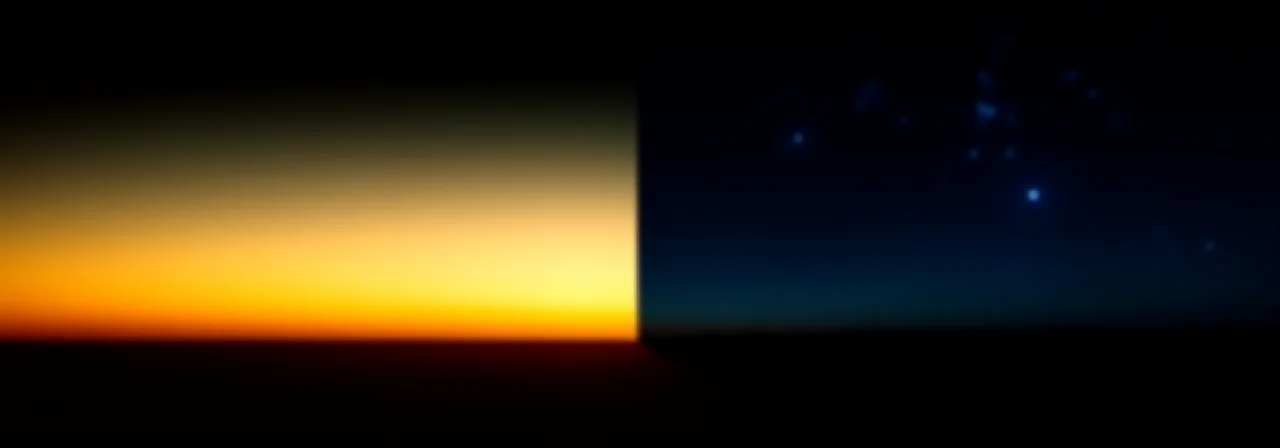
Twice a year, around 20 March and 22 September, the Earth hits a sweet spot in its orbit where day and night are roughly equal everywhere. Roughly. Not perfectly. The spring and autumn equinoxes get close, but atmospheric refraction, the bending of sunlight through the atmosphere, means the sun appears above the horizon slightly longer than geometry says it should. True equal day and night, twelve hours precisely, doesn't actually occur on the equinox. It happens a few days either side, depending on your latitude.
But what if it were permanent? What if Earth's axial tilt were zero, its orbit perfectly circular, and every location on the planet received exactly twelve hours of daylight and twelve hours of darkness, every single day, for ever?
No tilt, no seasons
Earth's current axial tilt of 23.4 degrees is the entire reason seasons exist. It's why London gets sixteen hours of daylight in June and barely eight in December. It's why Australia has Christmas on the beach. It's why the Arctic has midnight sun and polar night.
Remove the tilt and all of that vanishes. No summer. No winter. No spring, no autumn. Every day is the same length. The sun rises at the same time, follows the same arc across the sky, and sets at the same time, every day of the year.
The temperature at any given latitude stays roughly constant year-round. London doesn't swing between 5°C in January and 23°C in July. It sits at something like a perpetual 13-14°C. Cool, grey, and unchanging. So, not entirely unfamiliar.
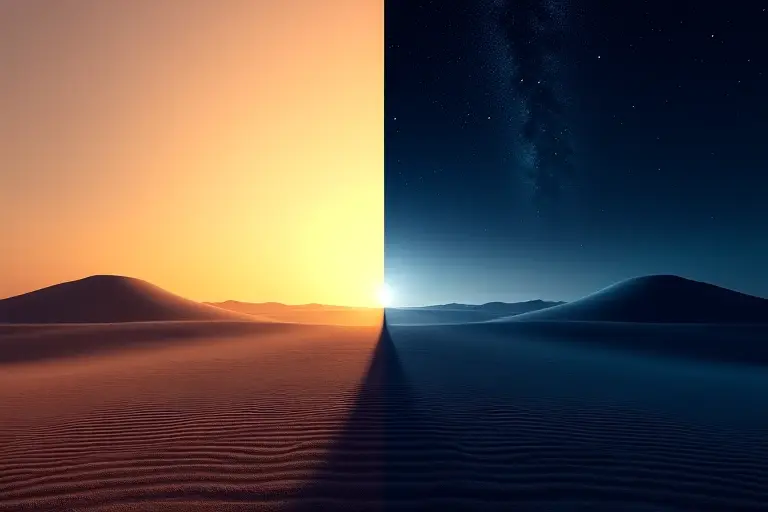
The tropics barely notice. Countries near the equator already experience roughly twelve hours of day and night throughout the year, with minimal seasonal temperature variation. Singapore, Quito, Nairobi: their climates wouldn't change much. The further you get from the equator, the bigger the difference.
Agriculture without seasons
Farming as we know it is built on seasons. You plough in spring, plant after the last frost, grow through summer, harvest in autumn, and let the fields rest through winter. The entire calendar of agriculture, developed over ten thousand years, depends on temperature and daylight varying predictably across the year.
With permanent equinox, there's no frost cycle. No warm growing season followed by cold dormancy. Temperate regions sit at their annual average temperature permanently. That average isn't warm enough for many crops that currently thrive in summer and would be too warm for crops that need a cold period to germinate properly.
Wheat, for instance, comes in two types: winter wheat and spring wheat. Winter wheat needs a period of cold (called vernalisation) to trigger flowering. Without winter, it never flowers. Spring wheat needs warming soil and lengthening days as a growth signal. Without those signals, its development stalls. You'd need to breed entirely new varieties adapted to static conditions.
Fruit trees would struggle. Apples, cherries, plums, and pears all require a certain number of "chill hours" below 7°C to break dormancy and produce fruit. No winter means no chill hours means no fruit. The English apple orchard, already under pressure from warming winters in reality, would be gone entirely.
Tropical crops would be fine. Rice, cassava, bananas, sugarcane. These grow year-round in equatorial regions already. The agricultural balance of power shifts toward the tropics and away from the temperate breadbaskets that currently feed the world.
Weather patterns
Seasons drive weather. The temperature difference between summer and winter creates the large-scale atmospheric circulation patterns that distribute heat around the planet. The jet stream, the polar vortex, monsoon cycles, the annual hurricane season: all of these depend on seasonal variation.
Without seasons, the jet stream weakens and stabilises. It stops meandering north and south. Weather patterns become more static. Wherever it's raining, it keeps raining. Wherever it's dry, it stays dry. The dynamic, shifting weather that temperate regions experience gets replaced by something more permanent.
Britain, which is famously obsessed with weather precisely because it changes so often, would have nothing to talk about. Every day would be overcast with a chance of drizzle. The forecast would be the same forecast. The weather section of the news would last three seconds. Some might consider this an improvement.
Monsoons, which depend on the seasonal heating and cooling of landmasses, would weaken or disappear. South Asia's entire agricultural system runs on the monsoon. India's summer monsoon delivers about 70% of the country's annual rainfall between June and September. Without seasonal forcing, that rainfall would distribute more evenly across the year but with less total volume. Crop yields would drop. Water reservoirs designed around a wet season and a dry season would need complete redesign.
The ecology
Migration ends. Birds migrate because conditions change. Arctic terns fly 70,000 kilometres per year, pole to pole, chasing an endless summer. In a world without seasons, there's no summer to chase. The terns stay put. Wildebeest on the Serengeti stop their annual circuit. Salmon lose the temperature cues that trigger their spawning runs.
Deciduous trees stop being deciduous. Trees drop their leaves in autumn to survive winter. No winter, no need to drop leaves. Forests in temperate regions either remain permanently in leaf (becoming functionally evergreen) or die out and get replaced by species better suited to static conditions. The blazing reds and golds of a New England autumn, the conker season in English parks, gone.
Hibernation stops. Bears, hedgehogs, dormice, bats, all the animals that sleep through winter would remain active year-round. They'd need to eat year-round too, putting more pressure on food sources that no longer have a seasonal cycle of abundance and scarcity.
Insect populations would change dramatically. Many pest species are kept in check by winter die-offs. Without winter, mosquito seasons become mosquito permanence. Tick populations expand. Agricultural pests that currently have one or two generations per year might manage four or five. The pesticide industry would boom, which is a grim sentence to write but an honest one.
Human psychology
We mark time by seasons. The school year starts in autumn. Holidays cluster in summer. Christmas falls in winter, deliberately, because early Christians needed something to get people through the darkest part of the year. New Year works as a psychological reset partly because it comes at the turning point between shortening and lengthening days.
Without seasons, the calendar becomes arbitrary. Why does the year start on 1 January? No reason. It's the same as any other day. Months lose their character. June without long evenings is just another block of thirty days. December without early darkness and fairy lights is indistinguishable from July.
Seasonal Affective Disorder disappears, which is genuinely good news for the estimated 2 million people in the UK who suffer from it. But something else might take its place: a kind of temporal flatness. Every week is the same. Every month is the same. The psychological rhythm of anticipation (summer's coming, the nights are getting longer, spring is just around the corner) doesn't exist.
Humans are pattern-seekers and change-noticers. A world where nothing changes, where the light is the same and the temperature is the same and the trees look the same and the sunrise is at the same time every single morning, might be comfortable. It would also be profoundly monotonous.
The equinox is special precisely because it's temporary. Two days a year when the world balances perfectly between light and dark, and then tips, slowly, inevitably, toward one extreme or the other. That tipping is what makes it beautiful. Take it away and you're left with balance, permanently, which sounds ideal until you realise that perfect balance is just another word for nothing ever changing at all.