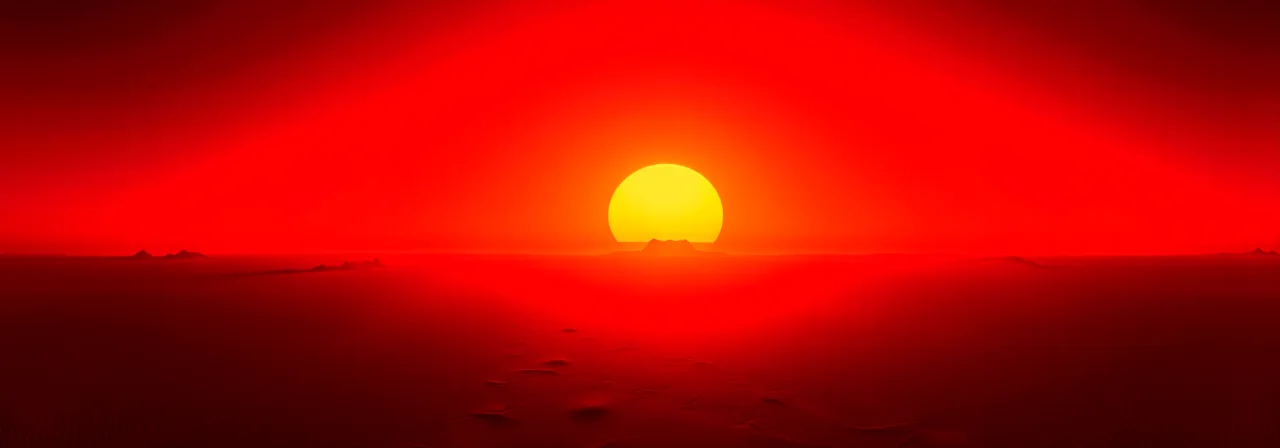
The planet Tatooine has a lot to answer for. Two suns setting over the desert while Luke Skywalker broods about his future. Very cinematic. Very romantic. Very much a death sentence for anything living on the surface.
Binary star systems aren't science fiction. They're actually more common than single-star systems like ours. Roughly half the stars in the Milky Way exist in pairs or groups. So the question isn't whether a planet could orbit two suns. The question is what happens to a planet like Earth when you swap in a second one.
Pick your orbit
There are two stable configurations for a planet in a binary system, and both come with problems.
In a circumbinary orbit, the planet goes around both stars at a great distance. Think of the two suns as a single blurry light source in the middle, and the planet tracing a wide loop around the pair. Kepler-16b does this. It orbits two stars every 229 days at a distance similar to Venus's orbit around our sun. Stable, but cold. The planet is a frozen gas giant.
The other option is an S-type orbit, where the planet circles one star closely and the second star orbits much further out. This is more likely to give us habitable temperatures. But that distant second sun would tug on the planet's orbit over centuries, slowly warping it from circular to elliptical and back again.
Neither option gives you the neat twin-sunset Tatooine scene. Physics is inconsiderate that way.
What the sky looks like
Assume we've got the S-type setup. Earth orbits Sun A at its current distance, and Sun B is a smaller orange dwarf circling the pair at about 50 AU (roughly Pluto's distance). From Earth, Sun B would look like a very bright star. Bright enough to read by on a clear night. Bright enough to cast faint shadows. But not a second blazing disc in the sky.
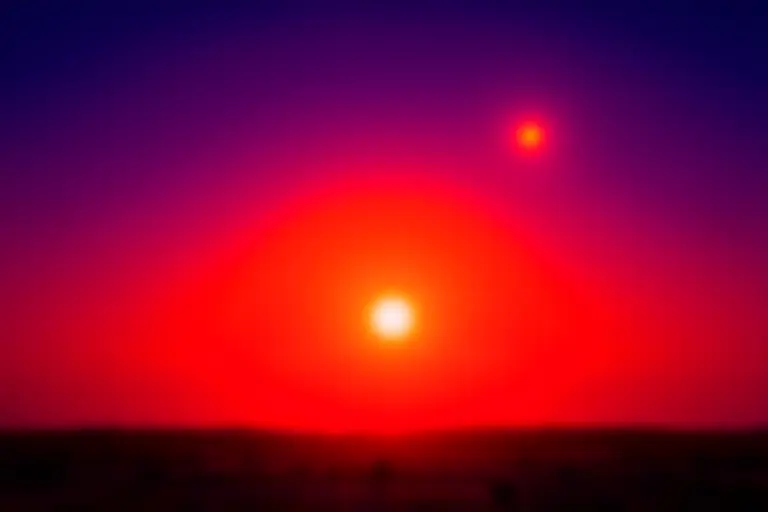
If both stars were closer together and Earth orbited the pair in a circumbinary arrangement, you'd get something stranger. Two discs in the sky, sometimes close together, sometimes on opposite sides. The "day" would vary in brightness depending on whether both suns were above the horizon or just one. You'd have periods of double-shadow, where every object casts two slightly offset shadows in different colour temperatures.
And you'd have something we have no word for: a night when one sun has set but the other hasn't. Not quite day, not quite night. A permanent dim twilight for part of every cycle.
Seasons from hell
Earth's seasons are already caused by a 23.4-degree axial tilt. Adding a second gravitational pull doesn't just add a second summer. It makes the entire seasonal pattern unstable over long timescales.
The second star's gravity would cause Earth's orbital eccentricity to oscillate. Some centuries, our orbit would be nearly circular. Others, it would stretch into an ellipse that brings us 15% closer to Sun A at perihelion and 15% further at aphelion. That's the difference between a mild English summer and temperatures that kill cereal crops across Europe.
Axial tilt would wander too. Earth's tilt is currently stabilised by the Moon (one of the Moon's most underrated jobs). A second star would fight that stabilisation. Over tens of thousands of years, the tilt could swing between 10 and 60 degrees. At 60 degrees, the poles receive more total annual sunlight than the equator. Arctic conditions in the tropics. Permanent daylight at the poles for months.
Agriculture would be nearly impossible to develop. You can't plan a planting season when the climate drifts unpredictably across generations.
No true darkness
This is the part people find romantic. No real night sky. Always some light from somewhere.
But darkness matters. A lot of Earth's biology depends on the day-night cycle. Melatonin production, pollination timing, predator-prey dynamics, coral spawning, bird migration. All keyed to light and dark rhythms.
Remove true darkness and you don't just lose stargazing. You lose the evolutionary pressure that created the entire category of nocturnal animals. No owls. No bats. No moths. No foxes hunting at dusk. The entire ecological niche of "things that come out at night" either never evolves or evolves around a dimmer, warmer twilight instead of proper darkness.
Astronomy would develop centuries later than it did for us. The ancient Greeks mapped the stars because they could see them clearly. With a permanent twilight glow washing out all but the brightest stars, early civilisations would have a much poorer understanding of the universe. Copernicus has nothing to work with if you can't see the planets moving against a background of fixed stars.
The radiation budget
Two stars means more total energy hitting the planet, even if one is distant. The bolometric flux (total energy from all wavelengths) would be higher. Not necessarily enough to boil the oceans, but enough to shift climate zones substantially.
The UV budget is the real concern. If Sun B is a hotter star (say, an F-type), it would contribute significant ultraviolet radiation even from 50 AU away. Earth's ozone layer handles our current UV load reasonably well, but it evolved for one star's output. A second UV source, especially one with a different spectral profile, might overwhelm it during periods when both suns are above the horizon simultaneously.
Skin cancer rates on a twin-sun Earth would be a civilisation-shaping problem. Cultures might develop around avoiding dual-sun hours the way desert cultures organise around midday heat.
Could life exist at all?
Probably. Life is stubborn. Extremophiles on Earth survive in boiling acid, frozen Antarctic rock, and the vacuum of space (tardigrades, the smug little survivalists). A binary system with the right spacing could provide a habitable zone, and life would adapt to the light conditions it grew up with.
But complex multicellular life? That's harder. Complex life needs stable conditions over hundreds of millions of years. Stable climate, stable ocean chemistry, stable day-night cycles. A second sun makes all of those variables wobble. Not necessarily outside liveable range, but never settling into the kind of long, boring stability that let evolution on Earth spend three billion years tinkering with single-celled organisms before finally bothering with anything more ambitious.
The Cambrian explosion happened during a period of relatively stable climate. Give Earth a second sun and that window of stability might never open.
What we'd lose
No constellation myths. No navigation by the North Star. No Galileo staring at Jupiter's moons because he couldn't see them. No discovery that the Earth goes round the Sun, because the sky is too bright to prove it for another thousand years.
Romance wouldn't change, though. People would still find the twilight beautiful. They'd write poetry about the double shadows, the way objects glow with two-toned light, the warm nights when Sun B hangs orange above the western hills and Sun A is just below the eastern horizon.
They just wouldn't know what they were missing.