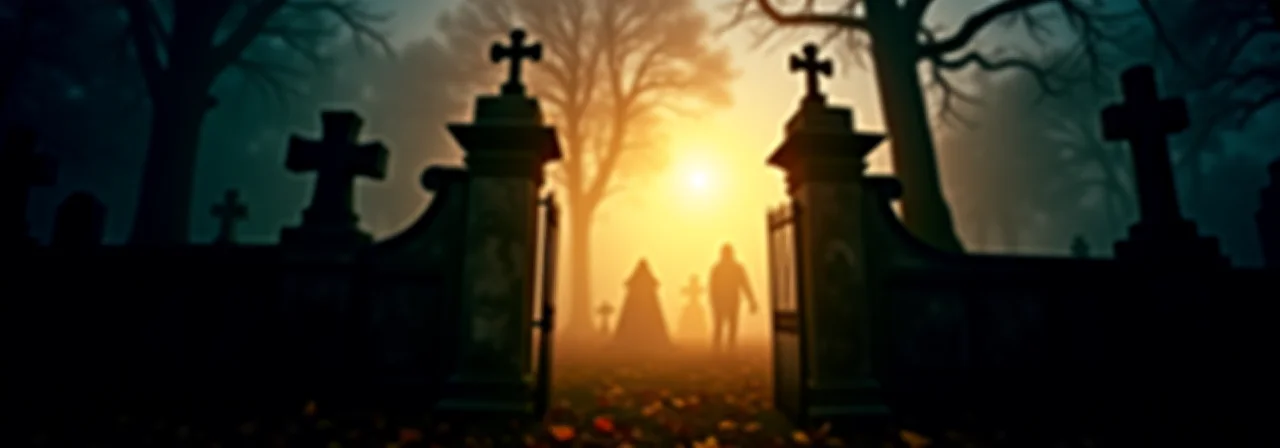
The sun sets on 31 October at 4:28pm. By 4:29pm, the ground starts moving.
Not violently. Not like the films. There's no clawing up through six feet of earth. The dead simply appear where they were buried, standing on the grass above their graves, blinking in the last grey light of an autumn afternoon. They look the way they did when they were well. Not how they looked at the end. Whatever force brings them back has the decency to restore them to a version of themselves they'd recognise.
They have until sunrise. About 14 hours, depending on where in the world they are. Then they go back. One night. No extensions. No negotiations.
The scale of it
Roughly 109 billion humans have ever lived and died. If every single one of them returns, the living are outnumbered thirteen to one. The planet's surface would be standing room only. So let's narrow it. Only the dead who have living relatives return. People with someone still here who remembers them.
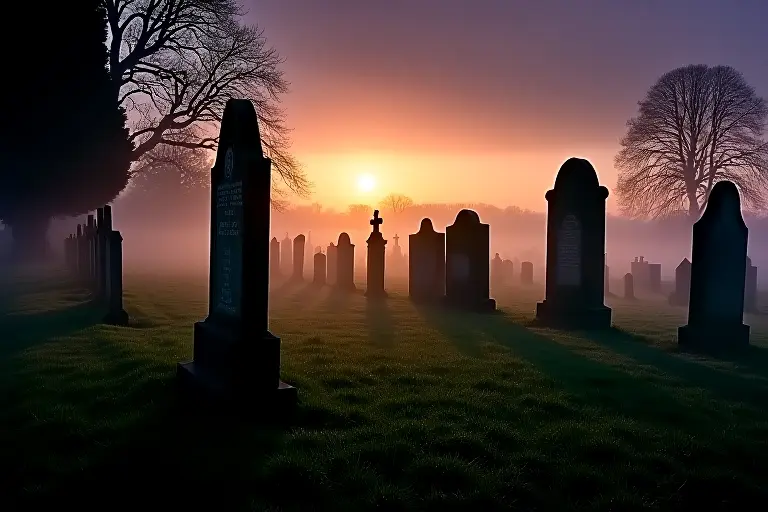
That's still an enormous number. In the UK alone, approximately 600,000 people die each year. Go back five generations and you're looking at tens of millions of returning dead, just for one country. Cemeteries would be packed. Streets near churchyards would fill. The recently dead would have people waiting for them. The long dead would stand in their graveyards wondering why everything looks so different.
The first meetings
Some of these reunions would be exactly what you'd imagine. A widow meets her husband at the cemetery gates. They hold each other. Fourteen hours suddenly feels like nothing. Everything they didn't get to say, everything interrupted by the heart attack or the car accident or the slow fade of the hospital bed, all of it compressed into a single autumn night.
Children would meet grandparents who died before they were born. They'd recognise the face from photographs but the voice would be new. The mannerisms. The way they laugh. Photographs don't capture the way someone stands, or how they smell, or the specific warmth of being held by someone who shares your blood.
Parents would meet children they outlived. And this is where it stops being sentimental and starts being unbearable. A mother who lost a seven-year-old to leukaemia fifteen years ago is now standing in front of a seven-year-old who hasn't aged. Who doesn't understand where he's been. Who asks why mummy looks different. Who wants to go home to a bedroom that was dismantled a decade ago.
I don't know how you survive that twice.
Not everyone wants to be found
The dead don't get to choose whether they come back. They just appear. Which means every abusive parent, every violent partner, every person someone spent years recovering from in therapy is standing in a graveyard somewhere, able to walk to your front door.
Restraining orders expire when the respondent dies. There's no legal mechanism for keeping a dead person away from you, because the scenario was never meant to arise. The returned dead have no legal status. They're not citizens. They can't be arrested, because what do you do, detain them until sunrise when they disappear anyway?
Some people would barricade their doors. Others would leave town entirely, driving as far from the cemetery as they can before sunset. The assumption that everyone would welcome the return of their dead is the assumption of someone whose dead were all kind.
The recently dead and the long dead
Someone who died last month returns to a world they recognise. Their phone is where they left it. Their side of the bed hasn't been changed yet. The milk in the fridge might still be within date. They slot back in, briefly, as though the last few weeks were an interruption.
Someone who died in 1940 returns to a world that's alien. The street they lived on might still exist but every building is different. Their family's terraced house is a block of flats. The corner shop is a Costa. Everyone speaks too quickly and looks at small glowing rectangles constantly.
Someone who died in 1750 can't read the signs, doesn't recognise the language (English has shifted), and finds themselves standing in what was once a rural churchyard and is now a suburban housing estate. They have no one waiting for them. Anyone who knew them personally has been dead for two centuries. They're here, on this night, because a distant descendant vaguely knows their name from an Ancestry.co.uk account.
The long dead would be confused and frightened. The night that's a gift for some is a bewildering exile for others.
What do the dead know?
This question changes everything and nobody would get a straight answer.
If the dead remember nothing between death and return, they're just themselves, picked up from the moment they died and put down in a cemetery on a cold October evening. They don't know what death is like. They can't tell you whether there's anything after. The fourteen hours are a continuation of life, not a dispatch from the beyond.
If they remember everything, then 109 billion people have just returned with knowledge of what happens when you die. And every one of them might say something different. Some might describe peace. Others might describe nothing. Others might refuse to talk about it at all, with an expression that makes you wish you hadn't asked.
The religious implications would shatter or confirm every faith on Earth, depending on what the dead report. And if different dead people give contradictory accounts, the theological fallout would be worse than the return itself.
The night wears on
Midnight passes. The streets are full. Pubs that were closed for the night have reopened because the dead want a drink and the landlord isn't going to say no to his dead father. Restaurants are packed with impossible dinner parties. Hospitals are overwhelmed, not with injuries, but with people bringing the returned dead to A&E demanding that someone explain what's happening and make it permanent.
Nobody can make it permanent. The doctors know that. The families know that. The dead probably know it too, though some of them won't say.
Arguments happen. Of course they do. You don't stop being angry at someone just because they died. The wife who discovers her husband's affair is still furious, even if he's been dead for three years. The father who was never there is still not forgiven, even now he's standing in the kitchen looking like he hasn't aged a day. Some conversations that needed to happen finally happen. Some shouldn't have.
By 2am, the initial euphoria has faded and what remains is something heavier. The awareness that this is temporary. Every minute that passes is a minute closer to the second goodbye, and the second goodbye is worse than the first because this time you know it's coming and you know there won't be a third.
Sunrise
At 6:47am on 1 November, the sun breaks the horizon. The dead don't fade slowly. They're there, and then they're not. Mid-sentence in some cases. A hand holding yours that is suddenly holding nothing. A chair at the table that is suddenly empty again.
The silence that follows is specific and total. It's not the silence of a quiet morning. It's the silence of absence reinstated. The house is exactly as empty as it was yesterday, but now you know what it sounded like with them in it.
Grief counselling services would be overwhelmed for months. The original bereavement was bad enough. This re-bereavement, having to lose someone a second time, with full knowledge and no ambiguity, is something the human psyche is not designed for. Therapists would call it retraumatisation. They'd be right.
And next October, as the days shorten and the 31st approaches, the question that keeps people awake at night: will it happen again? Will the ground move at 4:29pm? Will the dead return for another fourteen hours?
Or was it only the once?
Nobody sleeps well in October any more.