
You're running late for work. You grab socks from the drawer without looking, yank them on, pull your shoes over them. Same as every morning. Except this morning, and every morning from now on, the socks change colour the moment they touch your skin. Bright canary yellow. You're in a good mood. Coffee's on, sun's out, Fridays feel like this.
You get on the train and look down the carriage. A sea of feet. Lots of mid-grey. Some navy blue. One person near the doors is wearing what can only be described as the colour of a headache: a sort of throbbing magenta-brown. Nobody sits next to them.
Welcome to life with mood socks.
The colour chart
For this to work, the socks would need a consistent, universal colour mapping. Let's say it runs roughly like this. Yellow for happy. Warm amber for content. Soft blue for calm. Grey for anxious. Dark navy for sad. Red for angry. Green for envious. Bright orange for excited. A sort of washed-out beige for bored. White for nothing in particular. Black for grief.
And because human emotions are messy, the socks blend. Anxious but hopeful? Grey with amber streaks. Sad but resigned? Navy fading to beige at the toe. Furious and heartbroken simultaneously? A horrible swirl of red and black that looks like something a goth teenager would choose on purpose.
Within a week, everyone would know the chart. Within a month, sock-reading would be a casual social skill, like reading body language but lower.
The office
Monday morning all-hands meeting. The CEO walks in wearing electric orange socks. Excited about something. Probably the quarterly numbers. The finance team is in various shades of grey. The design team has one person in bright yellow and everyone else in the colour of someone who spent the weekend answering Slack messages. Beige with grey undertones.
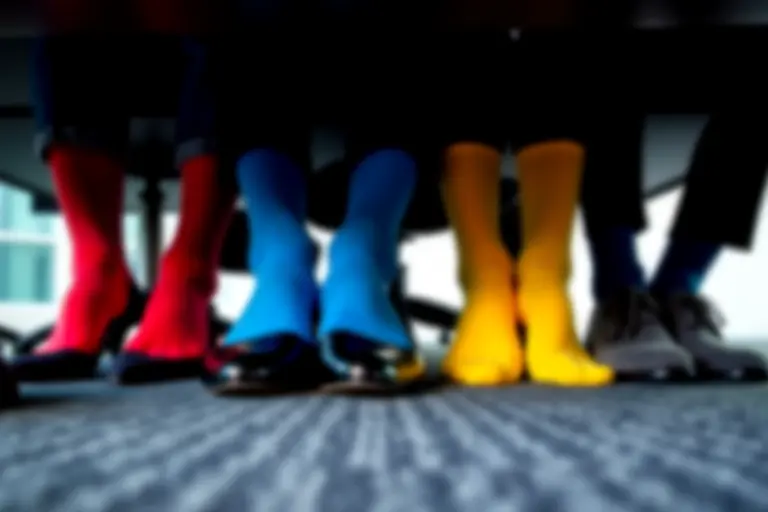
Performance reviews would become an ordeal. Your manager says "We're really pleased with your work this quarter" while their socks cycle through three shades of uncomfortable olive. You'd learn to read the socks, not the words. "I'm not angry, I'm disappointed" loses its ambiguity when Dad's socks confirm, beyond doubt, that he is in fact both.
Job interviews. You walk in, shake hands, sit down. The interviewer's socks are the blue-grey of mild dread. They've done six of these today. Your socks are the nauseating chartreuse of someone pretending to be confident while quietly falling apart. You both know. You both pretend you don't. The interview proceeds exactly as before, just with more mutual pity.
Dating
First dates would become sock-management exercises. You'd choose trousers that sit low over your shoes. Boot-cut jeans would make a comeback. Tall boots. Anything to cover the socks.
But you can't cover them forever. At some point, the shoes come off. And there it is. Your socks are the soft amber of genuine attraction mixed with nervous green (you really hope they like you) and a flicker of grey (what if they don't). Theirs are... polite blue. Calm. Unexcited. You now have emotional information you didn't want and can't unknow.
Long-term relationships would develop their own sock literacy. Partners would learn each other's colour patterns. "Your socks went grey when I mentioned my mother visiting" is a conversation nobody wants to have but everybody would.
Couples therapy would involve a lot of looking at feet.
Children and schools
Children's emotions are already more visible than adults'. With mood socks, a primary school classroom would look like a bag of pick-and-mix sweets. Constant colour shifts. A child struggling with a maths problem flickers through frustration-red to confused-purple to defeated-grey in the space of thirty seconds.
Teachers would find this useful and heartbreaking in equal measure. A child sitting quietly in the back row wearing black socks tells you something no report card captures. A child whose socks go grey every time a particular classmate walks past tells you something about bullying that no conversation would reveal.
The safeguarding implications would be serious. A child arriving at school every morning in dark, distressed colours raises questions. Mood socks would become, whether anyone intended it or not, a welfare monitoring system for every school-age child in the country.
The pub
Friday night, eight o'clock. The pub is a warm glow of amber and yellow feet. Two pints in and the whole room shifts toward soft orange. Someone's telling a funny story and the table erupts in brief yellow flashes. The bloke at the bar who came alone is in steady navy, two drinks ahead of everyone else, and nobody asks him how he's doing because his socks have already answered.
Stag dos would be a colour riot. Hen parties the same. Any event involving alcohol and social performance would produce chaotic, rapidly shifting sock displays that would be genuinely distracting if you looked at them too long.
Funerals, on the other hand. An entire room of black socks, occasionally flickering to grey or navy, with one person in the corner whose socks are a guilty, confusing amber because they inherited the house and can't help feeling slightly pleased about it. Everyone sees. Nobody mentions it. British politeness finds its ultimate test.
Privacy and resistance
Some people wouldn't accept this. Mood socks are a privacy violation made of cotton. Within the first year, you'd see opaque sock covers, deliberately oversized shoes, ankle-length trousers designed to eliminate any gap. A cottage industry in mood-sock concealment.
And then the backlash to the backlash. "What are you hiding?" becomes a reasonable question when someone goes to elaborate lengths to cover their socks. Covering your mood becomes suspicious, like refusing to make eye contact or answering every question with another question.
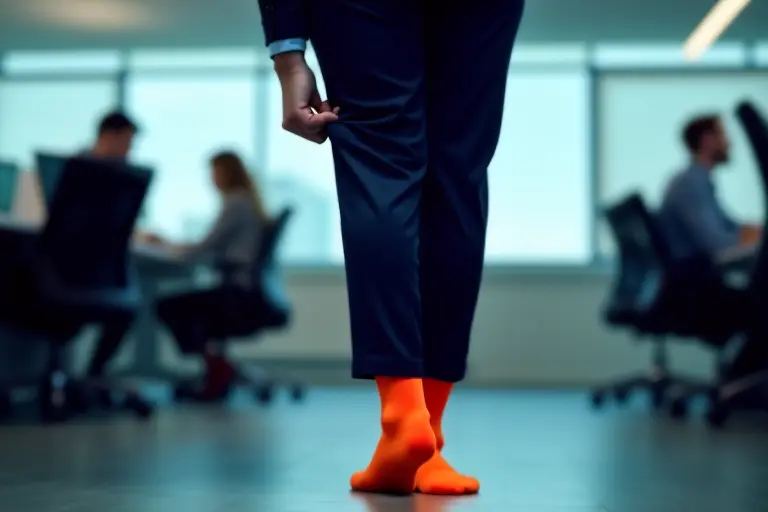
Workplaces would split. Some would mandate visible socks as part of a "transparency culture" initiative, run by the sort of HR department that thinks trust falls build real trust. Others would ban sock-reading as a form of discrimination. Could you fire someone because their socks showed they hated their job? Could you deny a promotion because the candidate's socks turned anxious-grey in every leadership meeting?
Employment lawyers would have the best decade of their careers.
The deeper problem
We think we want to know what other people are feeling. We say it all the time. "I wish I knew what was going on in their head." But we don't, not really. We want selective access. We want to know when our partner is happy. We don't want to know when our colleague finds us boring.
Mood socks would give us total access and no filter. Every fleeting irritation, every momentary sadness, every flash of jealousy or boredom or inappropriate attraction, broadcast from your ankles to anyone who looks down.
Mismatched socks, by the way, would mean a breakdown. Not a fashion choice. An actual emotional breakdown, where your left foot is feeling something your right foot isn't, which doesn't make any physiological sense but would somehow become the universally recognised sign that someone is not coping. "Are you alright? Your socks don't match." The most devastating sentence in the English language.