
Walk across your kitchen floor right now. Notice how solid it is. How your heel strikes and stops dead. That firmness is something you've never once thought about, because you've never known anything different.
Now imagine it gives. Just a little. Every surface on Earth has the springiness of a good gymnastics mat. Pavement, grass, marble, concrete, wooden floorboards. All of it returns about 15% of your downward force as upward bounce.
Your entire relationship with the ground just changed.
Walking is the first thing to go wrong
Walking is a controlled fall. Your body tips forward, your foot catches you, and the rigid ground provides the stable platform your balance system expects. Remove that rigidity and every step becomes a negotiation.
With 15% energy return, each footfall produces a slight upward kick. Not enough to launch you, but enough to make your ankle work overtime stabilising the rebound. Think about walking on a bouncy castle, but dialled down to maybe a third of that intensity. You can do it. It's just annoying.
Running, though. Running is where things get interesting.
Running becomes absurd
Runners already generate ground reaction forces of about 2.5 times their body weight with each stride. On bouncy ground, that energy comes back. Your stride length increases by something like 30-40%, and the sensation is halfway between running and skipping.
Sprinters would be a spectacle. Usain Bolt's 10.4 m/s peak speed came from slamming force into rigid track surface and getting nothing back except Newton's third law on a solid plane. Give him 15% energy return and he's covering ground in enormous loping bounds. The 100m record drops. Probably into the seven-second range. The event looks less like athletics and more like watching someone flee a crime scene on the Moon.

Marathon runners face a different problem. The constant micro-bouncing means your calf muscles never fully rest during the stance phase. They're absorbing and redirecting rebound energy with every step. Marathon times might actually get worse, because the metabolic cost of stabilisation eats into the energy savings from the bounce.
Cars
This is where civil society starts to fray.
Car tyres work by maintaining a contact patch with rigid road surface. Friction depends on that contact being stable and predictable. On a bouncy road, the contact patch fluctuates with every irregularity. Hit a pothole and the car doesn't just jolt. It bounces. Then bounces again, smaller. Then again.
Speed bumps become launch ramps.
The suspension systems in modern cars are designed to absorb shock and maintain tyre contact on rigid surfaces. On a bouncy surface, your suspension and the road are both springy, which creates a compound oscillation problem. Engineers call this resonance coupling, and it's the reason soldiers break step when crossing a bridge. If the car's suspension frequency matches the road's bounce frequency, the oscillations amplify each other.
At 70 mph on a motorway, this is lethal. The car starts porpoising, the tyres lose contact in rhythmic pulses, and braking becomes a suggestion rather than a command.
Speed limits drop to something like 30 mph everywhere. The M25 goes from Britain's most frustrating road to Britain's most terrifying one, which is saying something.
Architecture needs a rethink
Buildings sit on foundations that transfer load into rigid ground. On bouncy ground, the foundation itself moves. Not much. But enough.
A ten-storey building weighs roughly 15,000 tonnes. That's a lot of downward force, and on a springy surface, the building settles deeper than it would on rigid ground, then partially rebounds when the load shifts (say, 2,000 people leave for lunch). The building rises a few millimetres, then settles again when they return at 2pm.
Skyscrapers become impractical. The taller the building, the more it sways at the top, and the swaying is now amplified by the foundation bouncing at the base. The Burj Khalifa already sways up to 2 metres at its peak in high winds. Add a bouncy foundation and that figure doubles or triples.
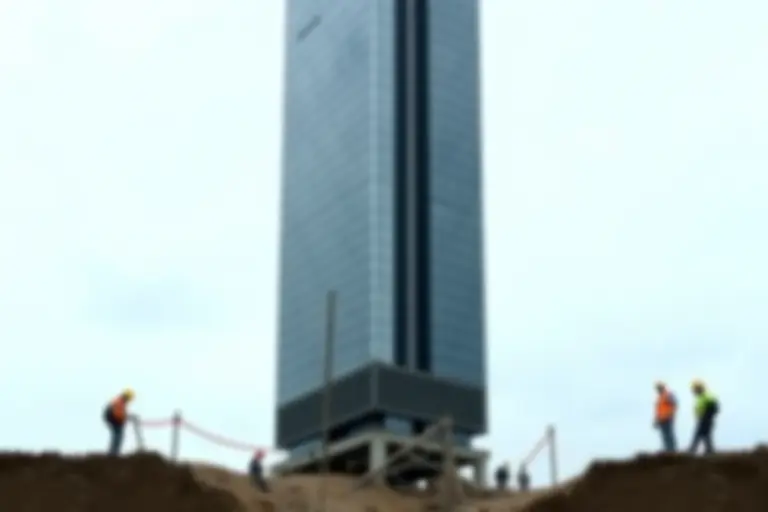
Most construction shifts to low, wide structures. Three storeys maximum, broad footprints, heavy base plates to dampen oscillation. Cities look more like sprawling military bases than vertical skylines.
Sport transforms completely
Basketball players can already touch the rim at 3.05 metres. Add bouncy ground and a decent vertical leap puts you well above the backboard. The game moves upward. Slam dunks become routine. Blocking a shot means getting your hand above the 4-metre mark.
Football (the real kind, with a round ball) becomes chaotic. Players bouncing slightly with every step means ball control suffers. The beautiful passing triangles of Barcelona's tiki-taka era dissolve into something closer to pinball. Goalkeepers, on the other hand, love it. Diving becomes easier when the ground throws you sideways.
Tennis rallies get longer. The ball already bounces. Now the players bounce too. Everyone is slightly higher when they make contact, angles change, and the net seems lower than it used to be. Serve speeds drop because your toss platform isn't stable.
Golf dies. You can't swing a club properly when your feet shift mid-backswing. The sport retreats indoors to specially dampened platforms and never recovers its outdoor prestige.
The small things nobody thinks about
Pouring a cup of tea when your hand gently oscillates with each micro-bounce of the floor. Surgeons operating on patients who are both, very slightly, bouncing at different frequencies. Sleeping on a bed that sits on a floor that won't quite hold still.
Old people falling over. This is a genuine concern. Hip fractures kill about 1,800 people a year in the UK. On bouncy ground, the fall itself is softer (good), but the loss of balance is more frequent (very bad). The net effect depends on whether the reduced impact force outweighs the increased fall rate. My guess is more falls but fewer fatal ones.
Cats would adapt within days. They're already sprung-loaded animals with shock-absorbing spines. A slightly bouncy world is just more interesting for a cat. Dogs, built for endurance running on hard surfaces, would take longer to adjust. Picture a Labrador bounding across a park, each stride launching it a foot higher than expected, tongue streaming behind like a windsock, absolutely delighted.
Humanity would cope. We'd engineer around it, like we engineer around everything. But nobody would ever pour a pint of beer quite as neatly again.