
We tend to define intelligence by what we've done with it. Tools, writing, cities, the internet. By that measure, we're the only game in town. But the measure is rigged. Every item on that list requires hands, fire, and dry land. Take those away and intelligence doesn't disappear. It just builds something completely different.
So imagine a world where cetacean brains developed the way ours did, roughly 300,000 years ago. Sperm whales already have the largest brains of any animal that has ever lived, at about 7.8 kilograms. They already have complex social structures, regional dialects, and what appear to be individual names (specific click patterns called codas used to identify themselves). Give them another few million years of cognitive development. What do they build?
The fire problem
They don't. That's the short answer. Fire is the foundation of human technological civilisation. Cooking food gave us more caloric energy per meal, which fuelled larger brains. Smelting ore gave us metals. Burning fuel gave us engines. Every major leap in human technology either required fire or was made possible by something that required fire.
Whales live in water. Water doesn't burn.
This seems like a dead end, and by our standards it is. No fire means no metallurgy, no ceramics, no glass, no electronics. No writing either, at least not in any form we'd recognise, because writing requires a durable medium and a marking tool, and the ocean offers neither.
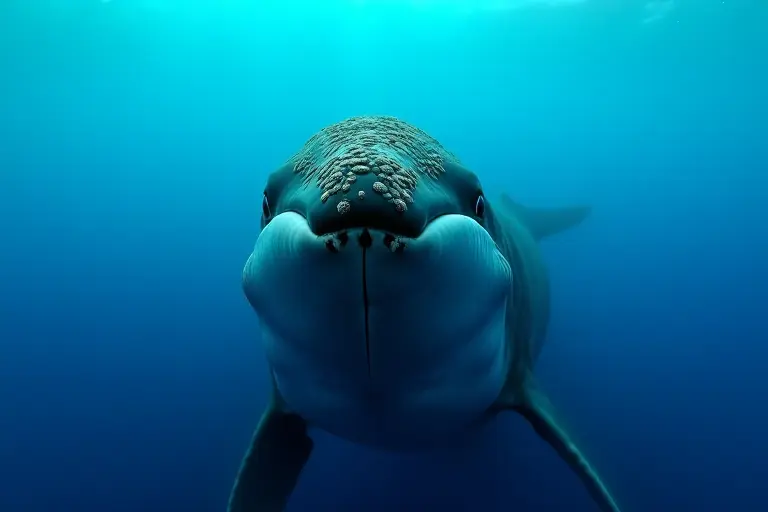
But declaring whale civilisation impossible because they can't smelt iron is like declaring human civilisation impossible because we can't echolocate. We didn't need echolocation. We had eyes and light. They wouldn't need fire. They'd have something else.
A civilisation built on sound
Sound travels 4.3 times faster in water than in air, and much further. A blue whale's call can be detected over 1,600 kilometres away. Sperm whale clicks, used for echolocation, are the loudest sounds produced by any animal: up to 230 decibels, louder than a jet engine at close range.
If whale intelligence developed the way human intelligence did, their civilisation would be acoustic. Not visual, not written, not material. Sound-based.
Consider what they could do with it. Echolocation already lets sperm whales construct three-dimensional maps of their environment in real time, including the internal structure of objects. A sufficiently advanced whale could, in theory, develop echolocation precise enough to function as imaging. You wouldn't need X-ray machines if your voice could see through things.
Communication would be their primary technology. Where we developed writing to store information externally, whales might develop something closer to oral tradition on an extraordinary scale. Multi-generational songs carrying the accumulated knowledge of a species. Humpback whale songs already change from year to year and spread across ocean basins. Imagine that process refined over millennia, with whale brains sophisticated enough to encode and recall vast stores of information acoustically.
Social architecture instead of physical architecture
Humans build structures. Houses, roads, walls, cities. We reshape the physical environment to suit us. Whales in an ocean don't need shelter from weather. They don't need roads because they can move in three dimensions. They don't need walls because there's nothing to wall off in open water.
Their equivalent of architecture would be social. Complex, layered, possibly rigid social structures governing who occupies which territory, how disputes are resolved, how knowledge is transmitted. Orca pods already show this in miniature: each pod has its own dialect, its own hunting techniques passed from mother to calf, its own cultural identity distinct from neighbouring pods even when they share the same waters.
Scale that up. Whale nations, essentially, defined not by borders on a map but by acoustic signatures, shared songs, recognised lineages. A whale from the North Atlantic pod would be identifiable by its dialect the moment it entered South Pacific waters, the same way a Glaswegian accent identifies someone in London.
Medicine without surgery
Whales can't perform surgery. No hands, no tools, no sterile environment. But they might develop medical knowledge through echolocation. If a whale's sonar could image the internal organs of a sick pod member (and sperm whale echolocation can already detect the internal structure of squid inside the squid), diagnosis becomes possible even without intervention.
Treatment might rely on acoustic therapy. This sounds like pseudoscience by human standards, but cetacean sonar produces focused sound energy at intensities that, in a medical context, could theoretically be directed with precision. Humans already use focused ultrasound to treat tumours. Whales might develop something analogous, powered by their own bodies rather than machines.
Or they might develop herbal medicine, after a fashion. Dolphins have been observed rubbing against specific coral species that have antibacterial properties. A whale civilisation might formalise this into pharmacology: knowledge of which sponges, corals, algae and jellyfish treat which conditions, maintained and transmitted acoustically across generations.
War, or the lack of it
Human civilisation is shaped by conflict. Cities have walls because armies exist. Technology accelerates during wartime. Our greatest engineering achievements (the internet, GPS, jet engines, nuclear power) all began as military projects.
Whale civilisation might skip this entirely. Not because whales are peaceful (orca pods coordinate attacks on blue whales, and sperm whale bulls compete violently for mates) but because the ocean doesn't create the conditions that produce sustained territorial warfare. You can't stockpile resources in open water. You can't fortify a position. You can't lay siege to an underwater city because there are no underwater cities to besiege.
Without the pressure of war, technological development looks completely different. No arms races. No space programme driven by Cold War competition. No industrial revolution powered by imperial ambition. The entire arc of development shifts from exploitation and control toward something harder to imagine from our vantage point.
What they'd think of us
If whale civilisation and human civilisation existed simultaneously, contact would be extraordinarily difficult. We'd probably dismiss their songs as animal behaviour for centuries. They'd probably experience our ships as enormous, deafening intrusions, which they already do. Commercial shipping generates low-frequency noise that interferes with whale communication across entire ocean basins. The global shipping fleet has effectively been shouting over their conversations since the 1950s.
From a whale's perspective, humanity wouldn't look like a civilisation. We'd look like a natural disaster. A species that poisons the water, fills it with noise, strips it of fish, and occasionally drops exploding metal cylinders into it for reasons that could not possibly be rational.
They'd have a point.
The thought experiment is worth running because it challenges the unexamined assumption that intelligence necessarily produces technology, and that technology necessarily looks like ours. We score ourselves top of the class because we designed the test. An acoustic civilisation with no tools, no fire, no writing, and a 50-million-year cultural memory encoded in song would score itself top too. The difference is, they'd be quieter about it.