On the evening of 9 November 1989, a confused East German spokesman named Günter Schabowski accidentally announced that new travel regulations were effective "immediately, without delay." He'd misread his briefing notes. Within hours, thousands of Berliners were chipping at the Wall with hammers and chisels, and the Cold War was functionally over.
One man's botched press conference changed the century. But what if he'd read the notes correctly?
The wall holds
The German Democratic Republic had been haemorrhaging citizens all year. Over 13,000 East Germans had fled through Hungary to Austria by September 1989. Protests were growing in Leipzig and Dresden. The regime was cracking.
But cracking is not collapsing. For the wall to survive, two things need to happen: Schabowski's announcement goes as planned (a limited, bureaucratic travel permit process), and the Politburo's hardliners reassert control. Replace Egon Krenz with someone less wobbly. Bring in more Stasi. Crack down on the Monday demonstrations in Leipzig before they snowball.
It's not far-fetched. China managed exactly this five months earlier at Tiananmen Square. Protests, momentum, international attention, then tanks. The Chinese Communist Party is still in power. East Germany's regime had the same tools. The question is whether they'd have used them.
A Tiananmen in Leipzig
On 9 October 1989, a month before the wall fell, 70,000 people marched in Leipzig. The Stasi and riot police had orders to be ready. Hospitals had been told to prepare for mass casualties. Live ammunition was distributed.
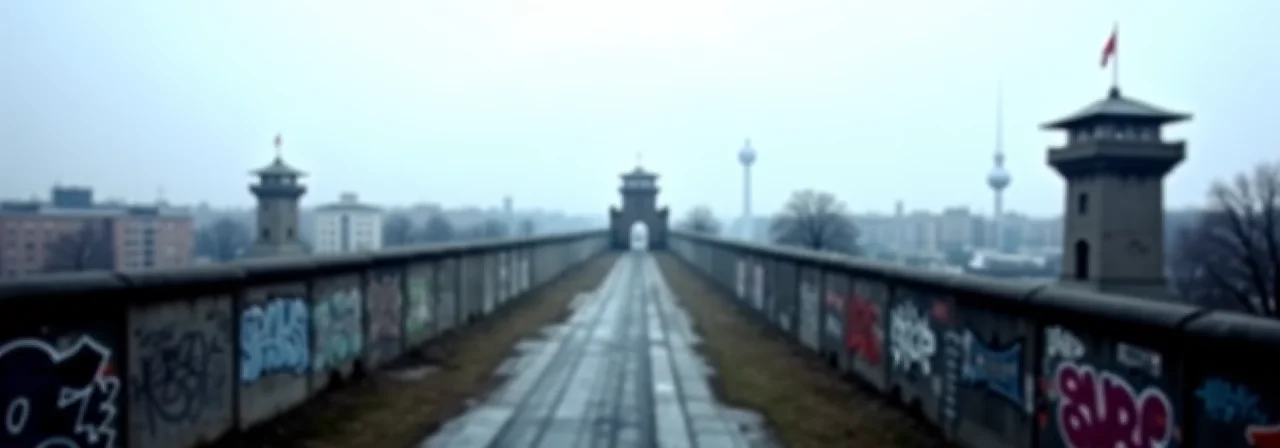
Cold War era divided street with barriers" src="/images/berlin-wall-never-fell.webp">
In our timeline, local officials blinked. They negotiated. The march passed peacefully and became the turning point. But in an alternate history where the hardliners hold firm? 9 October becomes East Germany's Tiananmen. A few hundred dead. Martial law declared. Western media erupts in outrage. And the wall stands for another decade, at least.
This is where the timeline gets interesting.
The Soviet Union stumbles on
The fall of the Berlin Wall didn't cause the Soviet collapse. But it accelerated it enormously. It proved that Moscow wouldn't intervene, that satellite states could break free without Soviet tanks rolling in. It emboldened every independence movement from Tallinn to Tbilisi.
Without that proof of concept, the dominoes fall differently. The Baltic states still push for independence (they were already well organised), but the Central Asian republics, Belarus, and Ukraine move far more cautiously. Gorbachev's reforms continue. The August 1991 coup might still happen, might still fail, but without the psychological shock of a reunited Germany next door, the Soviet Union doesn't dissolve on Christmas Day 1991.
Instead, you get a slow, grinding decline. The economy still rots. Consumer goods remain scarce. But the security apparatus stays intact enough to hold things together. Think of it as a larger, colder version of what happened to Cuba: the ideology dies but the state endures.
By 2000, you might have a reformed USSR, something between the Soviet Union and modern Russia. Still authoritarian, still centralised, but with a market economy bolted awkwardly onto the side, like China did. A country of 280 million people with nuclear weapons and a permanent seat on the Security Council, stretching from Kaliningrad to Vladivostok. NATO exists as more than a formality. The Cold War never technically ends. It just becomes room temperature.
Divided Germany in the internet age
This is the part that fascinates me most. East Germany, the DDR, surviving into the era of the World Wide Web.
The DDR was a surveillance state. The Stasi employed one informer for every 63 citizens, the densest spy network in human history. They opened mail, tapped phones, catalogued the smell of dissidents in jars (seriously, they kept cloth samples of people's body odour in sealed containers for tracking dogs). Now give that apparatus the internet.
East Germany wouldn't have built an open internet. It would have built something like China's Great Firewall, probably earlier and more aggressively. A closed network, DDR-Net or whatever they'd call it, with state-approved sites, heavy filtering, and the Stasi monitoring every packet.
West Germans would email relatives in the East and get no reply. Or get a reply that had clearly been read and edited. East German youth would find ways to tunnel through, the same way Chinese citizens use VPNs today. But the average citizen in Rostock or Chemnitz would live in an information environment entirely controlled by the state, well into the 2020s.
Europe stays divided
No reunification means no expansion of the EU into Eastern Europe, or at least not as we know it. Poland, Czechoslovakia, and Hungary might still edge toward the West (they were already doing so economically), but the process would be glacial rather than revolutionary. NATO doesn't expand eastward. The EU remains a Western European club of 15 or so members.
Brussels is smaller, less powerful, less bureaucratic. There's no eurozone crisis because there's no euro, or at least not one that extends beyond France, Germany, and the Benelux countries. Britain probably still joins and possibly even stays, since the EU without 27 members is a far less threatening institution to the Eurosceptic crowd.
The geopolitics of energy look completely different. Russian gas still flows to Western Europe, but the pipeline politics are between the USSR and NATO, not between Russia and individual EU member states. There's no Nord Stream debate because the Cold War framework makes energy dependency a strategic question, not just an economic one.
The people
Angela Merkel, a physicist working at the Central Institute for Physical Chemistry in East Berlin in 1989, never enters politics. She remains a scientist. Germany never gets its first female chancellor, or its most powerful European leader since Bismarck.
Vladimir Putin, a KGB officer stationed in Dresden when the wall fell, doesn't return to a chaotic post-Soviet Russia to reinvent himself as a politician. In a surviving Soviet system, he remains an intelligence officer, rising through the ranks of a still-functional KGB. Perhaps he reaches general. He doesn't invade Ukraine, because Ukraine is still part of the union.
Seventeen million East Germans continue living under a system they didn't choose. Their grandchildren grow up behind the wall, learning about the West the way North Koreans learn about the South: through smuggled media, whispered stories, and state propaganda insisting they have it better.
Would it eventually fall anyway?
Probably. The economics of central planning don't improve just because you shot some protesters. East Germany's GDP per capita in 1989 was roughly a third of West Germany's, and the gap was widening. The DDR ran on Soviet subsidies. A declining Soviet Union means declining subsidies.
The wall falls eventually. Maybe in 1995. Maybe 2003. Maybe it comes down the way the Soviet Union might have, gradually and bureaucratically, taken apart by technocrats rather than torn down by citizens with hammers.
But those extra years matter. Every year the wall stands is another year of families separated, careers stunted, lives constrained. An estimated 140 people died trying to cross the Berlin Wall between 1961 and 1989. Add another decade and that number climbs. Each one a person who decided the risk of being shot was better than another day on the wrong side.
Schabowski misread his notes, and millions of people got their lives back a few years early. History occasionally turns on someone not doing their homework.