
The average British household has about three days' worth of food in the house at any given time. Some have more. Some have a bag of pasta, half a jar of pesto and a tin of chickpeas they bought in 2019 with good intentions. The point is, we don't stockpile. We rely on the supermarket being there tomorrow.
The modern food supply chain is a spectacularly efficient system that most people never think about until it stops working. Tesco alone shifts about 2.4 billion items per year through its UK supply chain. Food travels from farms and processing plants to regional distribution centres to stores, usually within 24 to 48 hours. The lettuce you bought today was probably still growing four days ago.
Now empty the shelves. All of them. Every supermarket, corner shop, petrol station and vending machine in the country. Nothing coming in. No restocking date announced. What happens next depends on how quickly people realise this isn't temporary.
Day one
Most people don't notice until the evening. You get home from work, open the fridge, start cooking with whatever's in there. Maybe you pop out for milk and find the Co-op has bare shelves. That's happened before. Supply chain hiccup. Storm disrupted deliveries. It'll sort itself out.
Social media is the first alarm. Photos of empty shelves spread before the news catches up. Twitter (or whatever it's called this week) fills with jokes. "Tesco's run out of everything except the gluten-free aisle. Figures." Everyone's a comedian on day one.
The government issues a statement. "Supply disruption." "Temporary." "No need to panic." These words have the same effect they always do: immediate, widespread panic.
Day two to three
People who stockpile are already fine. The prepper community, roughly 3 to 4 million people in the UK according to surveys that probably overcount because people like saying they're prepared, have weeks or months of supplies. They close their curtains and say nothing.
Everyone else starts taking inventory. What's actually in the cupboards? Two tins of soup. A packet of rice. Some biscuits. A tin of tuna. Half a loaf of bread that's going stale. A freezer with a week's worth of meals if you ration.
Freezers become the most valuable appliance in the house. Anyone with a chest freezer full of batch-cooked meals is suddenly wealthy in the only currency that matters. But freezers need electricity. If the power grid stays up (and it should, since power stations have their own fuel supplies for weeks), frozen food buys time. If the grid fails too, you've got 24 hours before everything defrosts and a race to eat it all begins.
Petrol stations are still selling fuel, because fuel and food are different supply chains. But for how long? Fuel delivery drivers need to eat too.
Day four to seven
The polite phase ends somewhere around here. The exact timing depends on the neighbourhood.
In areas with strong community ties (villages, close-knit estates, religious communities), people start sharing. Someone's got a chest freezer full of meat and their neighbour's got a gas barbecue. Another household has fifty tins of beans and no tin opener. Allotment holders suddenly have status. That retired bloke who grows runner beans and courgettes and always has too many? He's the most popular person on the street.
In areas without those ties (much of suburban and urban Britain, where people don't know their neighbours' names), the calculation is different. You're on your own. Your family is on your own. The food in your kitchen is the only food you're sure of.
Theft starts on day four or five. Not dramatic looting, not yet. Sheds broken into for tinned goods. Allotments raided overnight. The 24-hour garage with the locked stockroom becomes a target. It's opportunistic, quiet, driven by genuine hunger rather than greed.
Restaurants and takeaways, which closed when their suppliers ran out, get broken into for their commercial food stocks. A single restaurant kitchen typically holds more food than ten domestic kitchens combined.
The rationing question
Britain has done this before. Food rationing during the Second World War ran from 1940 to 1954. It worked, broadly, because there was still food coming into the country. Rations were small but consistent. The system was backed by law, enforced by local authorities, and accepted by a population that understood why it was necessary.
Rationing an empty supply chain is different. You can't ration what you don't have. The government could requisition remaining stocks from warehouses, cold stores and military supplies, but the logistics of distributing those stocks to 67 million people without a functioning retail network are nightmarish.
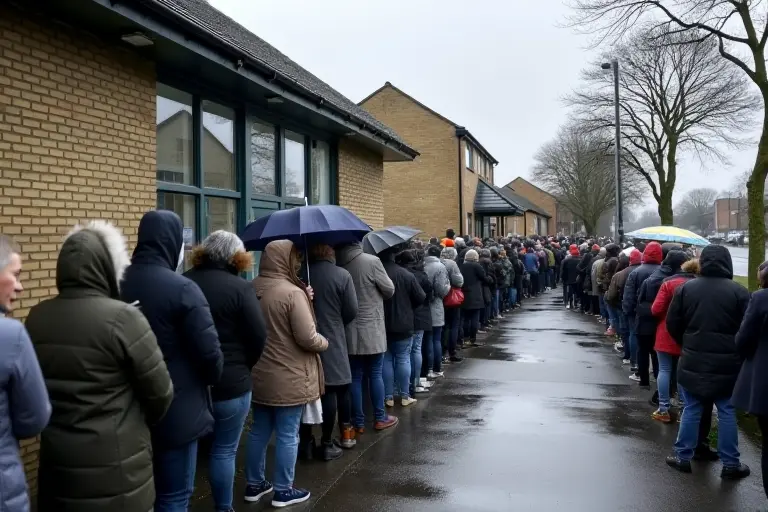
The military would be deployed. Not for crowd control initially, but for distribution. Setting up feeding stations in schools, community centres, sports halls. One hot meal a day per person. Queues around the block. It's manageable for a week, maybe two, if the emergency stocks hold.
After that? International aid. Britain, a G7 nation, receiving food parcels from abroad. It's not a scenario anyone in Whitehall wants to plan for. Which is probably why the planning is patchy.
Week two onwards
Gardens get dug up. Every lawn, every flower bed, every bit of decorative planting gets ripped out and replaced with anything edible. The problem is that most vegetables take weeks to months to grow. You can't plant a potato today and eat it this Friday. Radishes are about the fastest crop going and even those take three to four weeks.
Fishing becomes a survival activity. Britain has roughly 19,000 miles of coastline. Anyone near the coast with a rod, a net or even a bucket is pulling food from the sea. Inland rivers and canals get fished hard. Within a month, fish stocks near populated areas would be visibly depleted.
Foraging, which was a middle-class hobby six months ago, becomes a genuine skill. People who can identify edible plants, mushrooms and berries have knowledge that suddenly matters. People who can't are eating things they shouldn't. A&E departments see a spike in poisoning cases from misidentified mushrooms and berries. Foxglove looks a bit like comfrey if you're hungry and hopeful.
What this actually tests
Food supply disruptions have happened at smaller scales, and they're instructive. The 2000 fuel protests in the UK, when hauliers blockaded fuel depots for about a week, caused visible food shortages within three days. Shelves thinned. Rationing appeared informally (shops limiting purchases). Panic buying wiped out staples. And that was just a fuel disruption. Food was still being produced, it just couldn't be delivered.
During the early weeks of COVID-19 in March 2020, panic buying stripped supermarkets of specific items for days. Flour, pasta, tinned goods, toilet paper. Supply chains caught up within a week or two because production hadn't stopped. The shelves refilled. But for those few days, the thin line between abundance and shortage was visible to everyone.
The UK's food self-sufficiency rate is about 60%. We produce 60% of what we eat domestically, importing the rest. That 60% figure assumes functioning supply chains, fuel, fertiliser, animal feed (much of it imported) and seasonal labour. Remove the supermarket and you also remove the demand signal that tells farmers what to produce and where to send it. The food is still being grown. It just has nowhere to go.
The distance between a full fridge and genuine hunger is about four days, a supermarket delivery slot, and the assumption that someone else has sorted out the logistics. We've built a system that feeds 67 million people with extraordinary efficiency and almost zero redundancy. It works perfectly right up until the moment it doesn't.