
On 12 January 2010, a magnitude 7.0 earthquake struck Haiti. The epicentre was 25 kilometres west of Port-au-Prince. Between 100,000 and 316,000 people died, depending on which estimate you trust (the Haitian government says 316,000; seismologists who studied the building damage say closer to 100,000). Either way, a staggering number. Most of them killed not by the earthquake itself but by collapsing buildings that were never designed to withstand one.
If someone had told Port-au-Prince, with absolute certainty, "a magnitude 7.0 earthquake will hit at 4:53 p.m. on 12 January," the evacuation could have saved nearly every one of those people.
So why can't we do that?
Why prediction is so hard
Earthquakes originate from faults deep underground, where tectonic plates grind against each other. The stress builds over decades or centuries, then releases in seconds. Seismologists can identify which faults are likely to rupture. They can estimate rough probabilities over 30-year windows. What they can't do is tell you the day.
The problem is that the Earth's crust doesn't give reliable warning signals. Various precursors have been proposed over the years: changes in groundwater levels, radon gas emissions, unusual animal behaviour, foreshock patterns. None of them work consistently. The 1975 Haicheng earthquake in China was famously predicted based on foreshocks and animal behaviour, and the city was evacuated hours before a magnitude 7.3 struck. It's the only successful prediction in modern seismology. A year later, the Tangshan earthquake killed 242,000 people with no warning at all.
One success out of thousands. That's the current state of the art.
Perfect prediction arrives
Assume a breakthrough. Some combination of deep-earth sensors, satellite measurements and computational modelling gives us the ability to predict any earthquake above magnitude 5.0 with perfect accuracy: location, depth, magnitude and timing, at least 72 hours in advance.
The first prediction saves a city. A magnitude 7.8 is coming to Istanbul in three days. The Turkish government orders an evacuation. Sixteen million people leave. The earthquake hits an empty city. Buildings collapse onto empty streets. The death toll is zero.
The world celebrates. This is the greatest advance in public safety since vaccines. Then the second prediction comes, and the problems start.
The evacuation problem
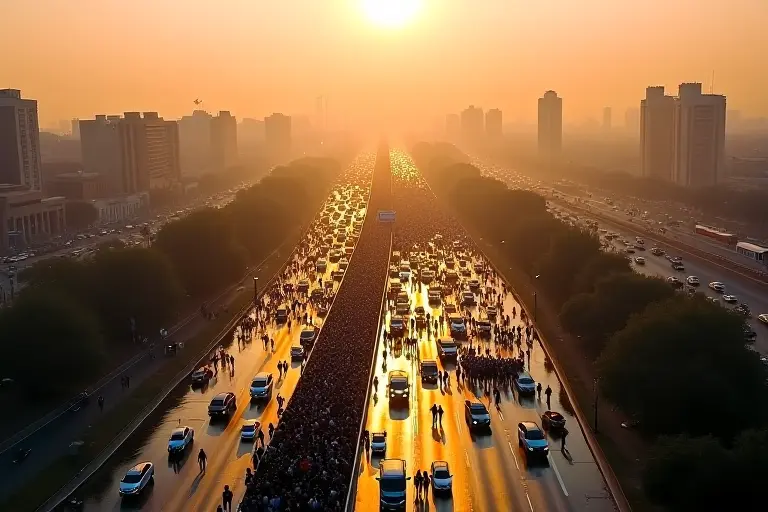
Moving sixteen million people out of Istanbul in 72 hours is logistically brutal but achievable once. People are terrified. They cooperate. Every vehicle moves in one direction. The military helps. International aid pours in.
Now do it four times a year.
Turkey sits on the North Anatolian Fault, one of the most active fault zones on the planet. Istanbul has experienced major earthquakes roughly every 50 to 100 years historically, but moderate earthquakes (magnitude 5 to 6) occur far more frequently along the fault. If we're predicting everything above 5.0 with perfect accuracy, Istanbul might receive multiple evacuation orders annually.
Each evacuation costs billions. People miss work. Hospitals relocate patients. Businesses shut down. Schools close. Traffic accidents during the exodus kill people (Hurricane Rita's evacuation from Houston in 2005 killed more people in traffic than the hurricane itself killed in the city). The psychological toll of repeatedly leaving your home, not knowing what state it'll be in when you return, accumulates.
And that's just one city. Globally, there are about 20,000 earthquakes per year above magnitude 4.0. If prediction triggers mandatory evacuations for anything above 5.0, that's roughly 1,500 evacuations annually, worldwide.
Who pays?
The economics of perfect prediction are genuinely awful.
Property values in earthquake zones would collapse overnight. Not because the risk has changed (it hasn't) but because the risk is now visible. Right now, people buy homes in San Francisco and think "probably not in my lifetime." Perfect prediction turns "probably not" into "definitely, on 14 March 2029, at 2:17 a.m." Nobody buys a house with a confirmed destruction date.
Insurance becomes impossible to price. Actuarial science works on probability. Remove uncertainty and you don't have insurance, you have a scheduled payment plan. "Your house will be destroyed on this date. The repairs will cost this much. Pay upfront." That's not insurance. That's a subscription to disaster.
Governments in seismically active regions face a choice: absorb the costs of repeated evacuations from public funds, or accept that some earthquakes will hit occupied cities because the evacuation isn't worth the expense. The first option bankrupts the state. The second option means someone, some committee, some minister, decides that this particular magnitude 5.5 isn't bad enough to evacuate for, and then three hundred people die in a school that collapsed because the concrete was substandard.
Perfect information doesn't eliminate hard choices. It just makes them explicit.
Prediction fatigue
Humans are bad at sustained vigilance. We're built for acute threats, not chronic ones. The first earthquake prediction would trigger mass compliance. The tenth would see 80% compliance. By the fiftieth, people in moderate-risk zones would shrug and stay home.
"It's only a 5.2. We rode out a 5.4 last March."
This already happens with hurricane warnings. Floridians who've survived a few storms develop a dangerous familiarity with them. "We don't evacuate for Category 2." Earthquake prediction would produce the same calculus: personal risk assessment overriding official guidance, usually based on the fact that last time wasn't that bad.

Then a 5.2 hits a city with poor building codes and kills thousands, because a 5.2 in Tokyo (built to withstand 8.0+) is a non-event, and a 5.2 in Kathmandu is a catastrophe. Magnitude isn't the only variable. Depth, soil type, building quality and time of day all matter. A 6.0 at 3 a.m. when everyone's in bed is different from a 6.0 at 2 p.m. when everyone's in poorly constructed concrete office buildings.
Perfect prediction of the earthquake doesn't mean perfect prediction of the damage. You know what's coming. You don't necessarily know how bad it'll be.
The geopolitics
Who controls the prediction system? If it's a single country or institution, they have leverage over every nation on a fault line. Sharing earthquake predictions becomes a geopolitical tool. Withholding them becomes an act of war.
If it's an international body, funding it becomes a permanent negotiation. Countries that rarely experience earthquakes (looking at you, most of northern Europe) would resent paying for a system that primarily benefits Japan, Indonesia, Turkey and California. The politics of the UN Security Council applied to seismology.
And what about induced seismicity? Fracking, geothermal drilling and wastewater injection cause small earthquakes. Oklahoma went from two earthquakes per year above magnitude 3.0 to over 900 per year after widespread fracking began. If a prediction system identifies that a damaging earthquake was caused by industrial activity, the legal liability is immediate and enormous. Energy companies would fight the prediction system's existence harder than the tobacco industry fought cancer research.
What actually saves lives
We fantasise about predicting earthquakes because prediction feels like control. But prediction isn't prevention. The earthquake still happens. The buildings still fall. The ground still breaks open. Prediction just changes who's standing underneath when it does.
The less exciting, more effective answer has always been building codes. Japan proves this every year. A magnitude 7.0 in Japan kills dozens. The same earthquake in Haiti kills hundreds of thousands. The difference isn't prediction. It's engineering.
Prediction would save lives. Thousands, probably millions over decades. That alone makes it worth pursuing. But it wouldn't make earthquakes safe. It would give us a three-day head start on the same damage, and a bill that nobody wants to pay.