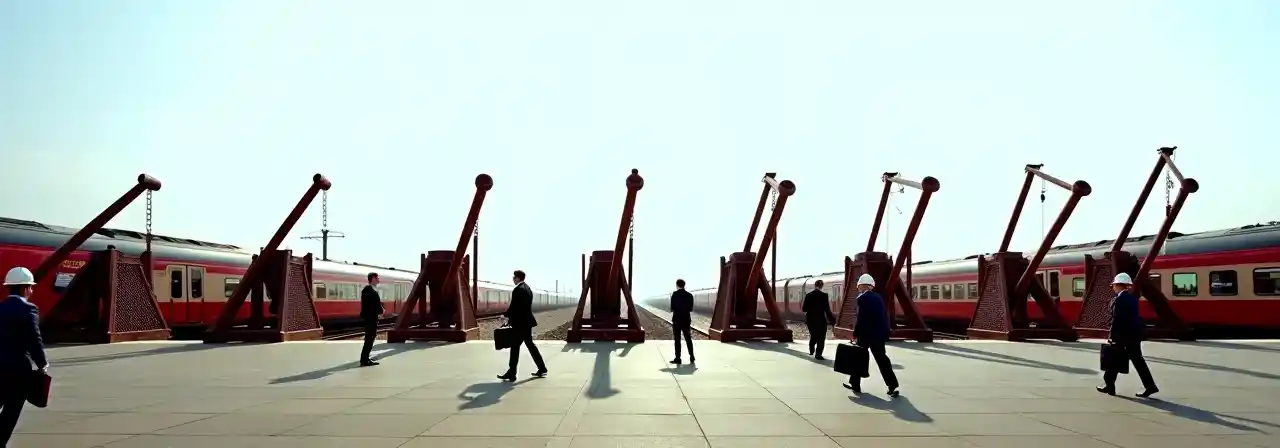
The alarm goes off at 7:15. You shower, dress, eat toast over the sink, check your phone for the launch weather forecast. Clear skies. Light crosswind from the south-east, 8 km/h. Within acceptable parameters. You grab your briefcase (padded, reinforced, with a quick-release strap) and walk to the neighbourhood catapult station.
The queue is short today. Four people ahead of you in the business lane. The catapult operator, a man named Dave who's done this job for eleven years, checks your weight on the platform scale (83.2 kg with briefcase) and adjusts the tension accordingly.
You climb into the launch cradle. Buckle the five-point harness. Bite down on the mouth guard. Dave gives the thumbs up.
Three. Two. One.
The physics of getting to work
A standard trebuchet-style catapult can launch a 90 kg projectile approximately 300 metres. That's medieval siege engine technology. For commuting purposes, we need considerably more range.
To cover 10 kilometres (a typical urban commute), a human-sized payload needs to reach a launch velocity of about 313 m/s, or roughly 1,127 km/h. That's just under the speed of sound. At a 45-degree launch angle, which gives maximum range, you'd experience about 15g of acceleration during the launch phase if the catapult arm is 20 metres long.
Fighter pilots black out at around 9g. You're experiencing nearly double that. For about 0.2 seconds. The world goes grey. Then you're airborne.
Peak altitude on a 10km trajectory is roughly 2.5 kilometres. At that height, the air temperature is about 10°C colder than ground level. The wind is stronger. You are, briefly, higher than Ben Nevis.
Total flight time: 44 seconds.
Landing
This is the part nobody wants to discuss at the planning meetings.
You're arriving at your destination at approximately the same speed you left. The landing system needs to decelerate you from 313 m/s to zero without killing you. This is the same problem rocket engineers solve when landing capsules, and they use a combination of parachutes, retro-rockets, and splashdown in water.

The commuter catapult system uses a staged approach. At peak altitude, a drogue chute deploys automatically, slowing your descent and stabilising your orientation (you've been tumbling slightly since launch, because aerodynamics and the human body are not natural partners). At 500 metres altitude, the main canopy opens, dropping your speed to about 25 km/h. At 50 metres, the landing airbag inflates around you like a full-body jacket.
You hit the receiving field at walking speed, bounce twice, and come to rest on an inflated mat the size of a tennis court. A ground crew member helps you out of the harness, checks for concussion (standard protocol, takes 30 seconds), and points you toward the exit.
It's 7:19. You're at work. Your hair looks like you've been through a wind tunnel, because you have. Your coffee, sealed in a g-rated thermos, is still warm. Your dignity is not.
The wardrobe problem
Business attire is not designed for ballistic travel. A standard wool suit at 300 m/s acts as a sail. Jacket flaps catch the air and rip backward. Ties become weapons. Shirt buttons pop under aerodynamic stress. Anyone who launches in a traditional suit arrives in something closer to rags.
The clothing industry adapts. "Launch-ready" becomes a fashion category. Tight-fitting, aerodynamic, with reinforced seams and no loose components. Imagine a motorcycle suit that's trying to pass as business casual. Zip-front instead of buttons. Integrated collar that seals against wind noise. Trousers with built-in compression to help with the g-forces.
Ties vanish from professional dress codes within a year. Nobody mourns them.
Skirts are technically possible if you don't mind arriving at the office having given a 2.5-kilometre-high presentation to the entire borough. Most people mind. Trouser suits become universal regardless of gender. HR departments update the dress code: "All employees must wear launch-compatible attire. Loose accessories are prohibited in the flight zone. The company is not responsible for items lost during transit."
Rush hour
A typical catapult station handles one launch every 90 seconds. Longer than that and the queue backs up. Shorter and you risk a mid-air collision with the previous commuter, which is exactly as bad as it sounds.
A station serving 500 morning commuters needs roughly 12.5 hours of continuous operation, which doesn't work. So stations have multiple launch pads. A large suburban station might have eight catapults firing in parallel, staggered by 10 seconds, each aimed at slightly different trajectories to separate the flight paths.

The sound is something else. Eight catapults releasing at subsonic velocities every 10 seconds produces a rhythmic series of concussive thuds, like someone beating a drum the size of a house. Residents near catapult stations wear earplugs. Property values within 200 metres of a launch site crater. Estate agents list proximity to a catapult station as a negative feature, right after "located on a flood plain."
Noise complaints to the council run at about 4,000 per month per station. Nobody does anything about them, because the alternative is everyone driving, and the ring road can't take it.
Weather
Rain isn't a problem. At 300 m/s, raindrops hit your flight suit like tiny ball bearings, but the suit handles it. Wind is the real enemy.
A 30 km/h crosswind shifts your landing point by roughly 400 metres over a 10km flight. That's the difference between hitting the receiving field and hitting the Tesco car park next to it. Launch operators calculate wind compensation and adjust the catapult angle, but gusts are unpredictable. Every morning commute has a margin of error.
On high-wind days (above 50 km/h), the catapult service is suspended. These are called "ground days." People drive, cycle, or take the bus. Ground days feel oddly nostalgic and unbearably slow. Ten kilometres by car, in traffic, takes 40 minutes. By catapult, including queue time, launch, flight, landing, and concussion check, it takes four.
Fog is the real disrupter. Landing crews need to see you coming. GPS landing guidance exists, but regulations require visual confirmation below 100 metres. A foggy morning means delays, diversions to alternate landing fields, and the occasional commuter touching down in a farmer's field near Slough, sheepishly asking for directions to the office.
The health effects
Two catapult flights per day (one each way) subjects your body to about 30g of acceleration daily, in short bursts. Over a year, that's roughly 7,300 g-events. Spinal compression becomes an occupational health concern. Catapult commuters are, on average, 2 to 3 millimetres shorter by retirement than non-catapult users. The NHS publishes guidelines on maximum recommended launches per week (10) and mandatory rest days (weekends, obviously, but some people ignore this).
Dental work suffers. The bite guard protects your teeth during launch, but the repeated clenching causes TMJ issues in about 15% of regular commuters. Dentists near business districts specialise in "launch jaw." It's not a glamorous subspecialty, but it pays well.
The psychological effects are more varied. Some people love it. The 44 seconds of flight, the silence at peak altitude, the view of the city laid out below you, it becomes addictive. "Launch junkies" choose longer commutes just for the flight time. A 30km commute gives you nearly two minutes of airtime and a peak altitude of over 7 kilometres. You can see the curvature of the Earth. You arrive at work euphoric and slightly hypoxic.
Others never get used to it. The launch anxiety, the loss of control, the knowledge that your safe arrival depends on a parachute packed by someone earning minimum wage. These people move closer to work or switch to ground transport. They're teased gently by colleagues. "Taking the bus again, Karen?" Karen doesn't care. Karen has an intact spine and dry hair.
Insurance
Life insurance premiums for catapult commuters are 340% higher than for ground commuters. The actuarial tables don't lie. The system is safer than driving, statistically (0.3 fatalities per 100 million passenger-launches versus 2.5 per 100 million car journeys), but the insurance industry hasn't caught up with the statistics. Something about the mental image of being flung through the air by a machine makes underwriters nervous.
The catapult operators carry liability insurance that costs more than the equipment. Every landing field has a team of paramedics on standby. The safety record is genuinely good. But when something goes wrong, it goes very, very wrong, and the footage ends up on the news for a week.
Still. Four minutes to work. No traffic. No parking. You'd take the catapult. Everyone takes the catapult. You just try not to think about it too carefully while Dave is adjusting the tension.