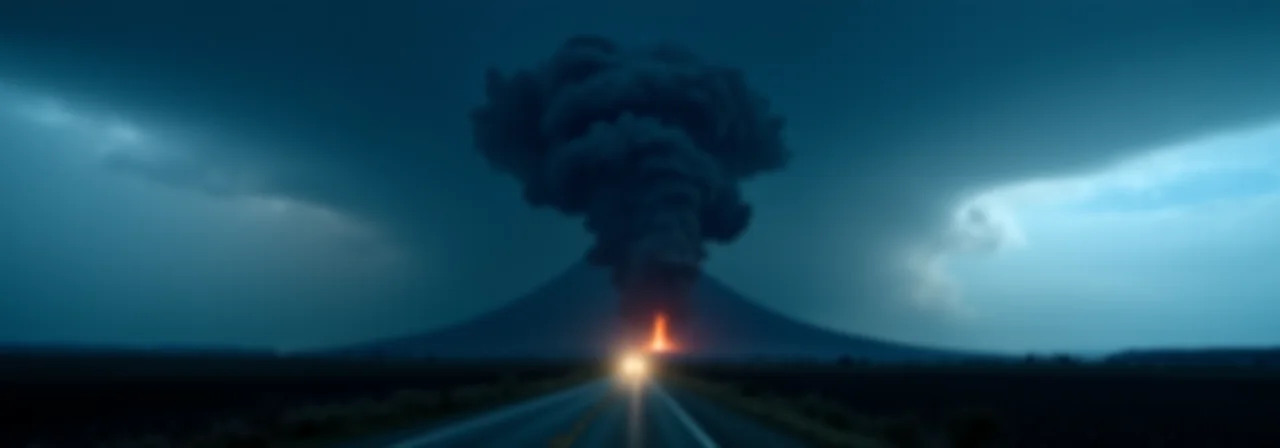
Beneath Yellowstone National Park, about eight kilometres down, sits a magma chamber roughly 90 kilometres long, 40 kilometres wide, and 10 kilometres deep. It contains enough molten rock to fill the Grand Canyon eleven times over. It has erupted three times in the last 2.1 million years. The last eruption, 640,000 years ago, ejected over 1,000 cubic kilometres of rock and ash into the atmosphere.
It will erupt again. The question is when, and what happens to the rest of us when it does.
The kill zone
Within roughly 60 kilometres of the eruption, everything dies. Not from lava. Yellowstone doesn't produce the sort of gentle lava flows you see in Hawaii. It produces pyroclastic flows: superheated clouds of gas, rock, and ash moving at 700 kilometres per hour at temperatures above 800°C.
Nothing outrunns a pyroclastic flow. You don't get a warning siren and twenty minutes to evacuate. You get a wall of incandescent gas travelling faster than a commercial airliner, and then you don't get anything ever again.
The towns of West Yellowstone, Gardiner, and Cody cease to exist. Jackson, Wyoming, roughly 100 kilometres south, is likely buried. The zone of total destruction extends across most of the park and well into surrounding counties. Depending on the eruption column's behaviour, pyroclastic flows could reach 150 kilometres from the vent.
Ash buries three states
The eruption column punches through the troposphere and into the stratosphere, reaching perhaps 25 kilometres in altitude. From there, wind takes over.
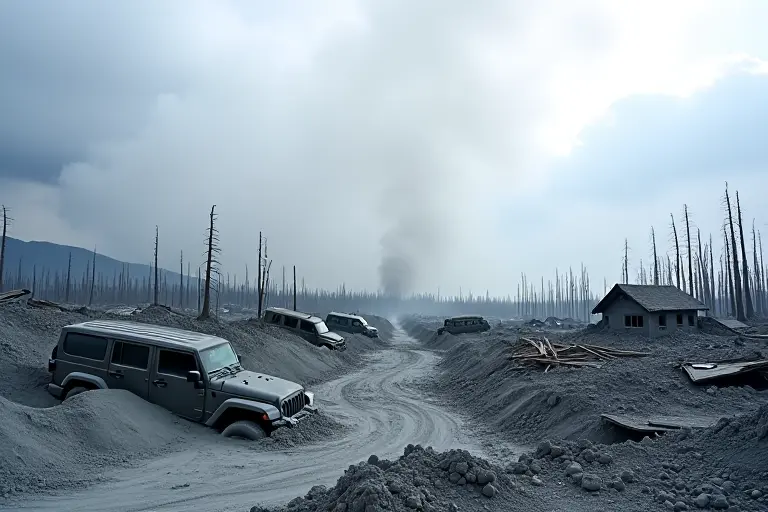
Wyoming, Montana, and Idaho would receive the worst of it. USGS models suggest ash deposits of a metre or more across a wide swathe of these three states. A metre of volcanic ash doesn't sound dramatic until you consider that it's not like snow. Volcanic ash is powdered rock and glass. It's dense, abrasive, and when wet, it sets like concrete. Ten centimetres of ash will collapse most residential roofs. A metre will flatten anything short of a reinforced steel building.
The ash cloud spreads east with the prevailing winds. Denver, 900 kilometres away, receives maybe 10-30 centimetres. Minneapolis, 1,500 kilometres away, gets several centimetres. Measurable ashfall reaches the East Coast. Satellite imagery would show a grey plume crossing the entire continental United States.
Airports close. Every single one within a thousand kilometres, certainly, but realistically most of North America's airspace shuts down. Volcanic ash destroys jet engines. It melts inside the turbine, reforms as glass, and coats the engine components. The 2010 Eyjafjallajokull eruption in Iceland, a comparatively tiny event, grounded European air traffic for six days. Yellowstone would ground North American aviation for weeks. Possibly months.
The agricultural collapse
The three states buried in deep ash contain some of America's most productive agricultural land. Montana alone produces over 200 million bushels of wheat annually. Wyoming's ranching industry supports millions of cattle. Idaho grows roughly a third of the country's potatoes.
All of that production stops. Not for a season. For years. Volcanic ash doesn't wash away with the next rain. It compacts, it suffocates soil biology, it poisons waterways with fluorine and sulphur compounds. Land recovery after major volcanic events takes anywhere from five to fifty years depending on ash depth.
But the local agricultural damage is minor compared to what happens globally.
Volcanic winter
The eruption injects massive quantities of sulphur dioxide into the stratosphere. Up there, it converts to sulphuric acid aerosols that reflect incoming sunlight back into space. The planet cools.
The 1815 eruption of Mount Tambora in Indonesia ejected roughly 60 cubic kilometres of material and lowered global temperatures by about 0.4-0.7°C. The following year, 1816, became known as the Year Without a Summer. Crops failed across Europe and North America. Famine killed tens of thousands.
Yellowstone would eject fifteen to twenty times the volume of Tambora. Climate models suggest global temperature drops of 5-10°C sustained over several years, with partial recovery taking a decade or more. Growing seasons shorten dramatically. Monsoons weaken. The jet stream shifts.
Think about what a 5°C temperature drop means in practice. Average global temperature during the last ice age was only about 6°C cooler than today. Yellowstone wouldn't cause a full ice age (the cooling is temporary, not sustained over millennia) but it would simulate one for long enough to matter.
Global food crisis
Rice yields in Southeast Asia drop because weakened monsoons reduce rainfall during growing season. Wheat production in Europe and Russia falls as shortened summers prevent crops from maturing. Maize in sub-Saharan Africa, already marginal in many regions, fails outright.
The world currently produces enough food to feed about 8 billion people, with very little margin. Lose 20-30% of global agricultural output for three consecutive years and you have a famine that dwarfs anything in recorded history. Not in one country. Everywhere.
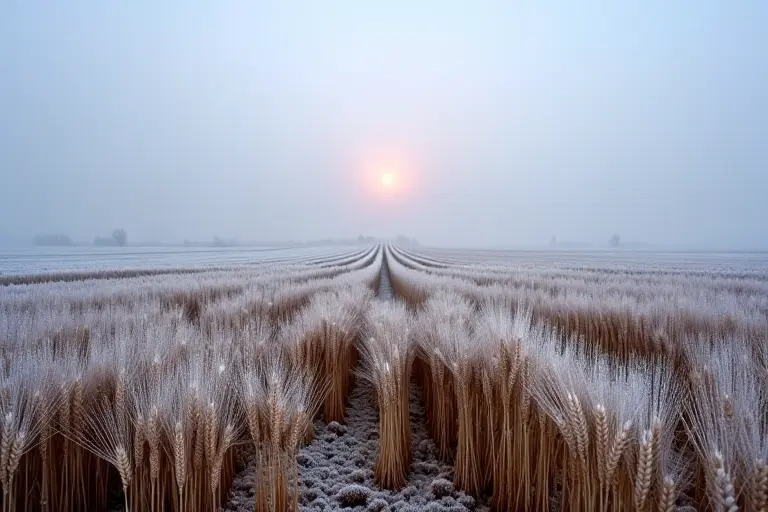
The countries that suffer most won't be the ones closest to Yellowstone. They'll be the ones with the least capacity to import food, store reserves, and distribute what they have. The same countries that suffer most from everything, basically.
What doesn't happen
Yellowstone doesn't crack the Earth open. It doesn't trigger a chain reaction of volcanoes worldwide. It doesn't end human civilisation permanently. These are popular apocalyptic fantasies, but the geology doesn't support them.
Humans survived the Toba eruption 74,000 years ago, which may have been even larger than Yellowstone's worst. The genetic evidence suggests human population crashed to perhaps 10,000 individuals, which is alarming, but we did survive. We had stone tools and animal hides. We now have industrial agriculture, global logistics, seed banks, and the Svalbard Global Seed Vault buried in a Norwegian mountainside specifically for this kind of scenario.
The species would survive. The question is how many of us, and at what cost. A decade of agricultural disruption in a world of 8 billion people with just-in-time food supply chains would be catastrophic even with modern technology. The political consequences, mass migration, resource wars, collapsed governments, would likely cause more death than the eruption itself.
Should you worry?
The USGS estimates the annual probability of a Yellowstone supereruption at roughly 1 in 730,000. You're far more likely to be struck by lightning (about 1 in 15,000 lifetime odds) or killed in a car accident on the way to read about Yellowstone.
The park isn't overdue, either. That's a myth based on averaging three eruptions over 2.1 million years and concluding we're "due" for another. Volcanoes don't work on schedules. The magma chamber is monitored continuously, and current data shows no signs of an imminent eruption. Ground deformation, seismic activity, and gas emissions are all within normal ranges.
So sleep well tonight. But maybe keep a few extra tins in the cupboard. Not because Yellowstone is about to blow. Just because, well, it can't hurt.