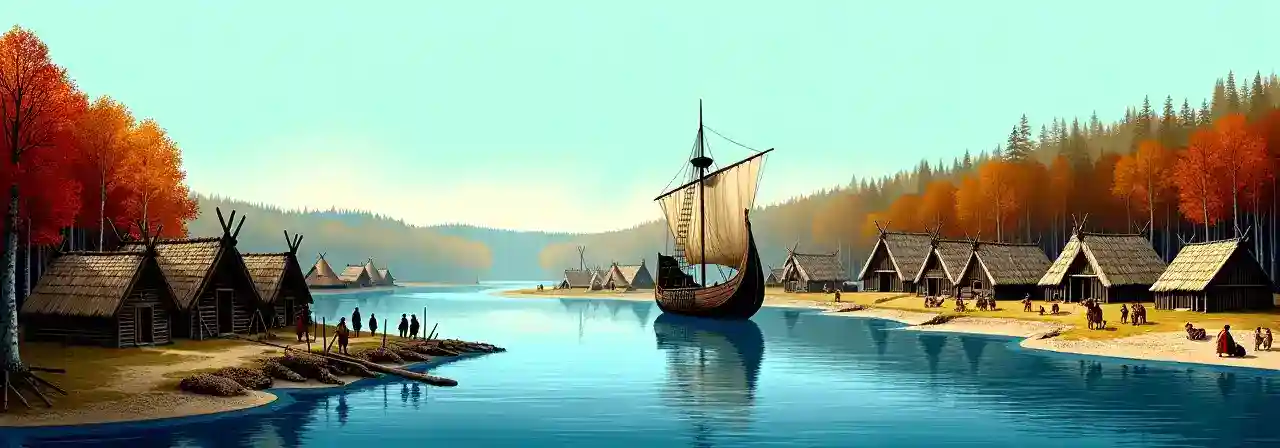
Around 1000 AD, a Norse expedition led by Leif Erikson landed on the coast of what is now Newfoundland. They called it Vinland. They built houses, felled trees, and harvested wild grapes. Archaeological evidence at L'Anse aux Meadows confirms they stayed for at least a few years.
Then they left.
The sagas blame conflicts with the local Skraelings (Indigenous peoples), internal disputes, and the sheer difficulty of maintaining a settlement 3,000 kilometres from the nearest Norse supply line. Vinland was abandoned within a decade, and Europe forgot about it for five centuries.
But what if they'd stayed?
Why it nearly worked
The Norse weren't casual visitors. They were experienced colonists. By 1000 AD, they'd already established permanent settlements in Iceland (874 AD) and Greenland (985 AD), both of which succeeded for centuries. Erik the Red's Greenland colony survived until the mid-1400s despite conditions far harsher than anything Newfoundland could throw at them.
Vinland had timber, which Greenland desperately lacked. It had fertile soil, salmon-rich rivers, and a climate milder than Scandinavia. The raw materials for a successful colony were there. What was missing was numbers. The expeditions brought maybe 60 to 160 people. That's not enough to sustain a settlement against hostile neighbours, disease, and the inevitable bad harvest.
Double that number. Triple it. Give Vinland 500 settlers with a reliable supply route to Greenland and Iceland, and the arithmetic changes.
The first century
A permanent Norse Vinland starts small. A timber-fortified settlement on the Newfoundland coast, probably in the Strait of Belle Isle area where L'Anse aux Meadows sat. Iron-working (they brought bog iron smelting technology), boat-building, fishing, and limited agriculture.
Relations with the Indigenous Mi'kmaq and Beothuk peoples are the critical variable. In real history, the Norse clashed with them almost immediately. But sustained contact doesn't always mean sustained conflict. The Norse in Iceland encountered no prior inhabitants. In Greenland, they coexisted with the Thule Inuit for centuries, sometimes trading, sometimes fighting, sometimes ignoring each other entirely.
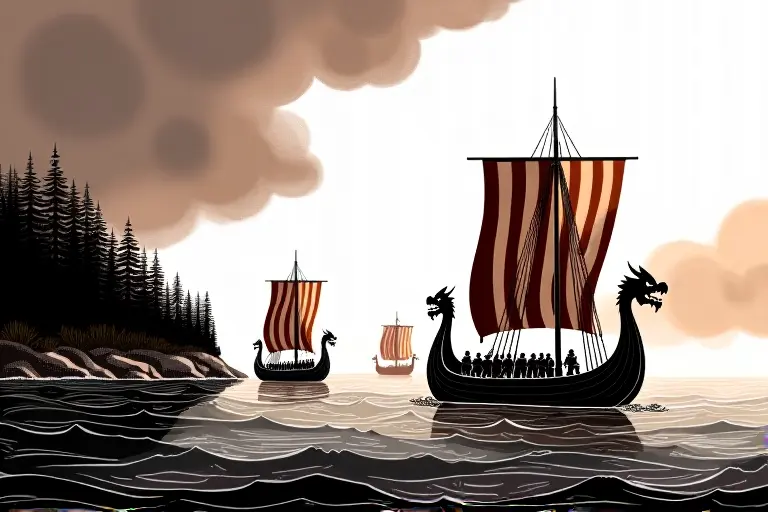
With a larger settlement, trade becomes worthwhile. Norse iron tools and woven cloth for Indigenous furs, dried meat, and local knowledge. The Norse desperately need that local knowledge. They're farming techniques suited to Scandinavian soil and climate. The Beothuk know which rivers run with salmon in which months, where the caribou herds move, which plants are edible and which will kill you.
A trading relationship, fragile and unequal, but functional, is the likeliest path to Norse survival.
Expansion south
By 1100 AD, a successful Vinland colony expands. The Norse never stopped exploring. They'd probe south along the coast, into the Gulf of St Lawrence, possibly down to what we'd now call New England. The sagas mention a place called Hop, described as having wild wheat and grapevines, which historians have tentatively placed somewhere between New Brunswick and Massachusetts.
Each new settlement needs a harbour, timber, and fresh water. The eastern seaboard provides all three in abundance. By 1200 AD, there might be a string of Norse communities from Newfoundland to Cape Cod, totalling perhaps 5,000 to 10,000 people. Not a nation. A loose chain of fishing and farming settlements linked by coastal shipping, much like Norway itself.
They'd bring livestock. Cattle, sheep, goats, and pigs. All of which thrive in the northeastern climate. They'd bring grain crops. Barley and oats at first, then whatever they could cultivate from local species. They'd bring diseases.
Disease, but slower
This is the part that's hard to think about honestly.
European diseases devastated Indigenous populations after 1492 because contact happened suddenly, massively, and across a continent with no prior exposure. An estimated 90% of the pre-contact population died, mostly from smallpox, measles, and influenza.
Norse contact in 1000 AD would still bring European pathogens. But the exposure would be gradual. Small settlements, limited contact radius, slow expansion over centuries. Indigenous communities near Norse settlements would suffer epidemics, but they'd have time to develop partial immunity before the next wave of exposure. Communities further away might not encounter European diseases for another century.
The death toll would still be catastrophic by modern standards. But the slow-burn model, disease spreading across the continent over 500 years rather than 50, likely produces a less total demographic collapse. By the time full-scale European contact arrives in the 1500s, some Indigenous populations have been exposed to European disease for twenty generations. They've been devastated and partially recovered, multiple times.
The population Columbus encounters is not 60 to 100 million people with zero immunity. It's a smaller population, perhaps, but one that's been through the worst already.
What Columbus finds
It's 1492. Columbus sails west with his three ships, expecting Asia. Instead, he finds the Caribbean, then the mainland. And on the eastern seaboard, he encounters something nobody in Spain expected.
European-descended people who've been there for 500 years.
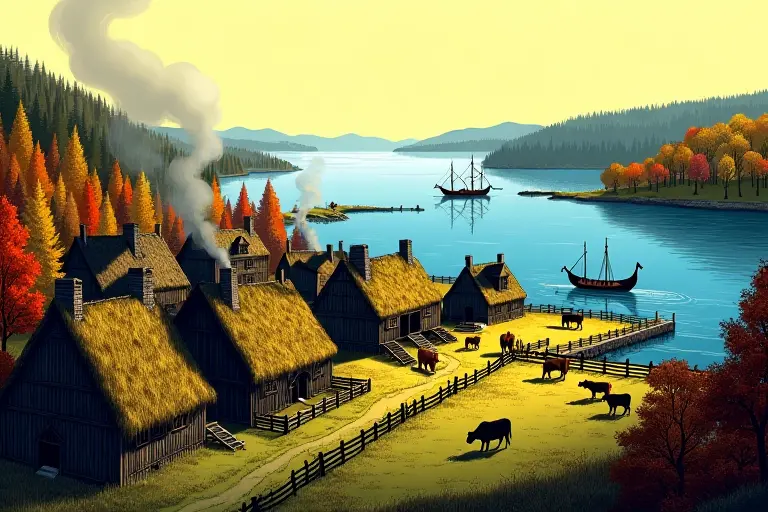
The Vinlanders of 1492 aren't really Norse any more. Five centuries of intermarriage with Indigenous peoples, adaptation to local conditions, and isolation from Scandinavia has produced something new. They speak a creole language blending Old Norse with Algonquian elements. They're Christian, nominally, but their Christianity has drifted over five centuries without regular contact with Rome. They fish with Norse-style boats and hunt with techniques borrowed from their Indigenous neighbours.
Their skin tones vary. Their cultural practices are a mix. They build longhouses in the Norse tradition but use birchbark canoes for river travel. They have iron tools, which has given them a technological edge, but they haven't developed gunpowder (neither had Scandinavia by 1000 AD, and without contact with China or the Islamic world, there's no path to it).
Columbus has no framework for understanding these people. They're not the Asian courts he expected. They're not the "Indians" he was prepared to claim. They're Europeans who don't recognise his authority, speak a language no interpreter can parse, and have been governing themselves for longer than Spain has existed as a unified kingdom.
The scramble changes
Spain, Portugal, England, and France still want the New World. Its resources are too valuable to ignore. But colonising a continent that already has European-descended settlements with established territorial claims is a different proposition from claiming "uninhabited" land under the Doctrine of Discovery.
The Vinlanders are Christian (sort of). They're European (sort of). Papal bulls dividing the New World between Spain and Portugal don't apply cleanly when the land already has white Christians on it, however strange their theology might look to a 15th-century cardinal.
Does this prevent colonisation? No. European powers with guns, ocean-going navies, and state-level organisation will overrun scattered coastal settlements. But it complicates the moral and legal justification, slows the land grab, and creates a population that resists with European-style political organisation rather than solely with guerrilla warfare.
The Indigenous peoples who've spent centuries alongside the Vinlanders have iron weapons, horses (if the Norse brought them, which is uncertain), and some degree of European disease resistance. They're not the technologically outmatched populations of real history. The conquest still happens. But it takes longer, costs more, and produces a colonial map that looks nothing like the one we know.
A different continent
By 1800, North America in this timeline has no neat division between "European settlers" and "Indigenous peoples." It has a 800-year gradient of cultural mixing, running from pure-Norse-descended fishing communities in Newfoundland to uncontacted nations in the deep interior. English and French colonists arrived to find not a wilderness to claim but a continent already complicated.
Whether that produces a better outcome for Indigenous peoples is impossible to say with confidence. It almost certainly produces a different one. The total erasure of pre-contact cultures that happened in our timeline becomes less complete when those cultures have had centuries to absorb, adapt, and push back against European influence on their own terms, at their own pace.
All because a few more longships crossed the Atlantic in 1001 AD and decided to stay through the winter.