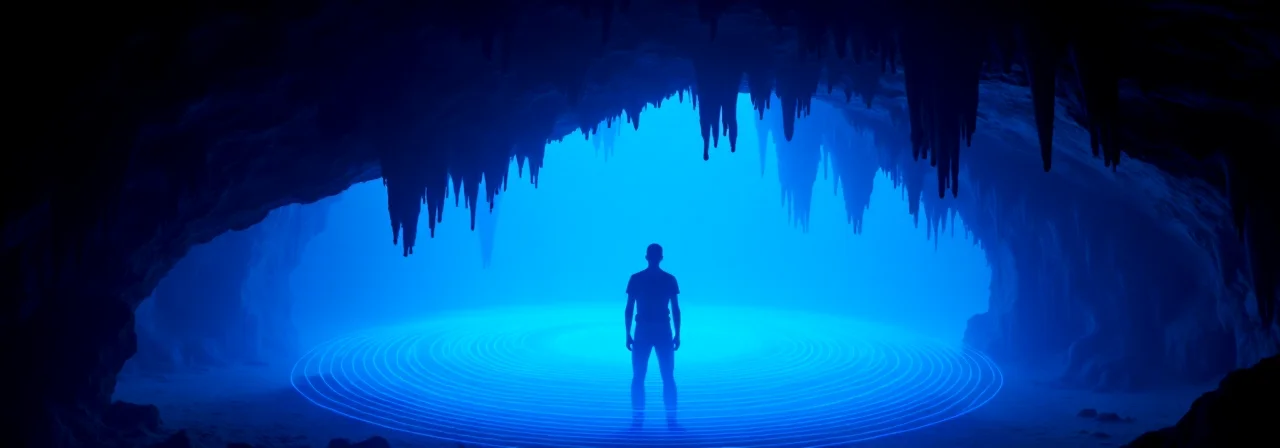
Bats do it. Dolphins do it. A small number of blind humans have taught themselves to do it with surprising accuracy. Ben Underwood, who lost his eyes to retinal cancer at age three, could rollerblade, play basketball, and navigate unfamiliar buildings using tongue clicks. He mapped the world in sound.
What if all 8 billion of us could do that? Not learned. Built in. A biological sonar system wired into the human brain from birth, as natural as sight.
What would it actually involve?
Echolocation works by emitting a sound and interpreting the returning echoes. The brain calculates distance from the delay, size from the echo strength, texture from the frequency shift, and shape from the pattern of reflections across both ears. Bottlenose dolphins process this information with a dedicated region of auditory cortex about the size of a walnut. Humans would need something similar.
The sound itself matters. Bats use ultrasonic frequencies between 20 and 200 kHz, well above human hearing range. Dolphins click at 20 to 130 kHz. For human echolocation to work without driving everyone in the room mad, we'd probably use a frequency band just above our current hearing ceiling. Say 25 to 50 kHz. Inaudible to us, but produced by a new structure in the larynx and picked up by expanded inner ear sensitivity.
You wouldn't hear yourself clicking. But you'd perceive the echoes as spatial information, the way you currently perceive depth from binocular vision without consciously thinking about it.
Darkness stops being scary
For the entire history of our species, darkness has meant vulnerability. Our ancestors huddled around fires because the night was full of things that could eat you, and you couldn't see them coming. We built cities of light because we are, at our core, a species terrified of what we can't see.
With echolocation, you always know what's around you. The dark bedroom at 3am? You can hear the shape of the wardrobe, the chair, the open door. That unlit alley? You're aware of the bins, the wall, the person standing thirty metres ahead of you. The fear doesn't vanish entirely. But the helplessness does.
Streetlights become less critical for safety. Not unnecessary (you still need light to read a sign or recognise a face), but the bone-deep fear of an unlit path fades. Councils save money. Energy consumption for outdoor lighting, which accounts for about 19% of global electricity use, drops meaningfully.
Every room has a sound
Here's where it gets strange. Echolocating humans would perceive rooms the way musicians perceive concert halls. Each space has an acoustic signature. A tiled bathroom reads differently from a carpeted bedroom. A cathedral reads differently from a lift.
You'd walk into a restaurant and instantly know the layout, the ceiling height, how many people are sitting at tables, which tables are empty. Not from looking around. From the shape of the sound.
Interior design gains a new dimension. Architects already think about acoustics for music venues. Now they think about it for everything. Hard surfaces give cleaner echoes, better spatial definition. Soft furnishings absorb sound and create dead zones where your echolocation goes fuzzy. A room full of thick curtains and plush carpet feels, to your sonar sense, like trying to see through fog.
Minimalist interior design becomes genuinely functional, not just an aesthetic choice. The sparse Scandinavian living room with wooden floors and bare walls? That's a room you can read perfectly.
The noise problem
There's a catch. A big one.
If every human is emitting ultrasonic clicks, then every crowded space fills with overlapping signals. A busy train platform with 200 people all clicking at slightly different frequencies. A football stadium with 60,000. The pub on a Friday night.
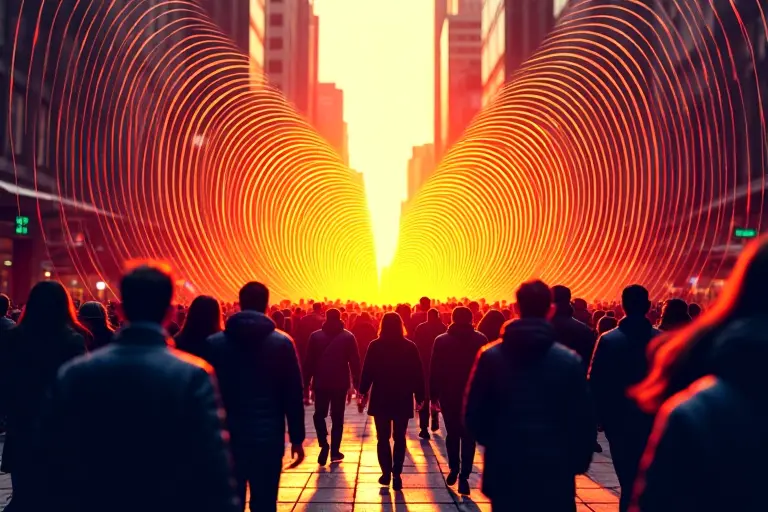
Dolphins solve this by varying their click frequency and timing, so they can distinguish their own echoes from someone else's. The brain learns which echoes are yours. But dolphins travel in pods of maybe 15 to 30. Not 15,000.
In dense crowds, echolocation likely degrades. Too many signals, too many reflections. Your spatial sense turns to mush. It would feel like trying to have a conversation at a nightclub. The system works brilliantly in quiet environments and fails in precisely the situations where you'd want it most.
Rush hour on the Tube would be an echolocation nightmare. All those bodies packed together, all those clicks bouncing off curved tunnel walls, all those echoes layered on top of each other. People would develop the sonar equivalent of a headache.
Privacy changes
You can close your eyes. You cannot close your echolocation.
If someone is in the next room and the walls are thin, you can hear their shape. Their position. Whether they're standing or lying down. Whether there's one person or two. The outline of someone behind a bathroom door is as clear to your sonar as a shadow under a door is to your eyes.
Building codes change. Walls need acoustic insulation not just for noise reduction but for echolocation blocking. The concept of a "solid" wall takes on new meaning. If your echolocation clicks penetrate it and return useful information, it's not a real wall. It's a curtain.
Office partitions, cubicle dividers, those frosted glass screens in restaurant booths. All useless. You can't block line of sight with a frosted panel when the person next to you can map you in sound.
What happens to blind people?
Blindness still exists in this world. Eyes still fail. But the impact is radically different. A blind person with fully functioning echolocation can navigate, avoid obstacles, identify rooms, estimate crowd density, and detect approaching objects. They can't read printed text, appreciate colour, or recognise faces. But the disability shifts from "cannot safely navigate the world" to "cannot access visual media."
That's a profound change. The white cane becomes rare. Guide dogs less necessary. The built environment needs fewer tactile paving strips and more acoustic clarity.
Deafness, conversely, becomes worse. Lose your hearing in this world and you lose two senses, not one. The deaf community faces a double burden, and sign language can't compensate for missing spatial awareness the way it compensates for missing speech.
Children growing up with it
Babies learn to focus their eyes at about two to three months. Echolocation would follow a similar developmental curve. Infants clicking constantly, learning to parse echoes, building a spatial model of their nursery before they can crawl to the edge of it.
Toddlers playing hide and seek would be terrible at it. You can hide behind the sofa, but your echolocation-equipped three-year-old knows you're there. The game only works if you go out of range, which for a child's developing sonar might be four or five metres.
Schools would teach "sonar literacy" the way they currently teach reading. How to focus your clicks for precision. How to filter crowd noise. How to read a room efficiently. Some children would be naturally gifted, able to identify objects at fifty metres by their echo profile. Others would struggle, the way some children struggle with spatial reasoning now.
Tests would exist. Employers would want to know your echolocation acuity for certain jobs. And, inevitably, someone would found a coaching industry to improve your click technique for a monthly subscription fee.