On the night of 4 November 1605, a man named Guido Fawkes was found crouching in a cellar beneath the House of Lords with 36 barrels of gunpowder. That's roughly 2,500 pounds of the stuff. Enough to reduce the building above to rubble and kill everyone inside.
"Everyone inside" meant King James I, the entire House of Lords, the entire House of Commons, and most of the senior judiciary, all gathered for the State Opening of Parliament on 5 November. The conspirators had planned to decapitate the entire English government in a single explosion.
Fawkes was caught. The plot failed. We burn effigies of him every November to celebrate. But what if nobody had checked the cellar?
The explosion
Modern analysis suggests the gunpowder would have worked. A 2003 study by the Institute of Thermodynamics and Explosion Dynamics at the University of Aberystwyth (a real institution, despite the name sounding like something from a Terry Pratchett novel) concluded that the blast would have destroyed the House of Lords completely, caused serious structural damage to Westminster Abbey, and been lethal to anyone within a 40-metre radius.
King James I is dead. His wife, Queen Anne, is probably dead (she was expected to attend). The Prince of Wales, nine-year-old Henry, might survive if he wasn't in the building. Princess Elizabeth, aged nine, is at Coombe Abbey in Warwickshire. She becomes very important shortly.
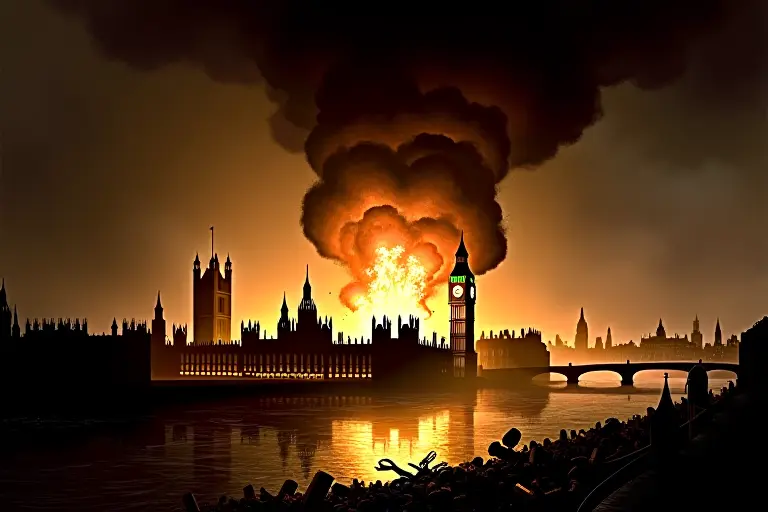
Every senior peer, bishop, judge and member of parliament in attendance is killed instantly. England has no government. No legislature. No king. The line of succession is a child in the Midlands who doesn't know what's happened yet.
The plotters' plan
The Gunpowder Plot wasn't just about the explosion. That was step one. The 13 Catholic conspirators, led by Robert Catesby (not Fawkes, who was essentially the demolition technician), had a second phase planned.
While Fawkes lit the fuse in London, other conspirators would ride to Coombe Abbey, kidnap Princess Elizabeth, and install her as a Catholic puppet queen. She'd be raised Catholic, married to a Catholic nobleman, and England would be steered back toward Rome.
It was a terrible plan, and it probably wouldn't have worked even if the explosion had succeeded. But the explosion succeeding changes everything about the response.
The first 48 hours
News travels slowly in 1605. No telegraph, no telephone, no printing press fast enough to matter. Riders carry the news from London to the major cities over days. The explosion happens on a Tuesday. By Thursday, most of England still doesn't know the details.
London descends into chaos immediately. The governing class has been vaporised. No one has clear authority. The Privy Council, the body that actually ran the country day to day, would have lost most of its members in the blast. Whoever survived (those who skipped the Opening, those who were ill, those who were abroad) has to assemble and take control before panic or opportunism fills the vacuum.
The Lord Mayor of London becomes the de facto authority in the capital. The Tower of London's garrison secures key points. But there's no one to give orders nationally. The country's chain of command has a smoking crater where the top used to be.
Anti-Catholic violence
This is where the scenario turns very dark, very quickly.
England in 1605 was already hostile to Catholics. The Reformation had been in progress for 70 years. Catholics were banned from public office, fined for not attending Protestant services, and periodically arrested for practising their faith. The Gunpowder Plot was born from genuine desperation. Catholics had hoped James I would be more tolerant than Elizabeth I. He wasn't.
If the plot succeeds and the Catholic conspirators are identified (which they would be, because Catesby's circle was riddled with informants and several conspirators would have been captured during the Princess Elizabeth kidnapping), the backlash against English Catholics would be orders of magnitude worse than what actually happened.
In our timeline, the failed plot led to harsher penal laws against Catholics that lasted over 200 years. A successful plot, one that killed the king, would trigger something closer to a pogrom. Catholic homes burned. Catholic priests hunted and killed. Catholic communities attacked across the country. The surviving Protestant establishment would have every incentive to channel public grief into anti-Catholic fury, and no reason to hold back.
English Catholicism might not survive as a functioning community. The faith would go so deep underground that it effectively disappears from English life for generations.
Civil war, twenty years early
England's Civil War happened in 1642, nearly four decades after our hypothetical explosion. It was fought over the balance of power between Crown and Parliament. Remove both Crown and Parliament simultaneously in 1605 and you get a succession crisis that could easily become an armed conflict much sooner.
Prince Henry, if he survived, was nine. A regency would be required. But who leads it? The Privy Councillors who survived? Regional magnates with private armies? Scotland, where James was also king, would have its own crisis. James was James VI of Scotland before he became James I of England. His death leaves Scotland leaderless too.
Multiple factions would claim authority. Protestant hardliners. Moderate establishment figures. Scottish lords with claims through the Stuart line. Perhaps even Catholic sympathisers in the north of England, where Catholicism was strongest, hoping to take advantage of the chaos.
Armed conflict between these factions becomes likely within months, not decades. And unlike the actual Civil War of the 1640s, which at least had two clear sides (Royalist vs Parliamentary), this conflict would be a multi-sided scramble for power with no legitimate authority to negotiate between the parties.
Scotland breaks away
The Union of the Crowns in 1603, when James inherited both thrones, was a personal union. Scotland and England shared a king but had separate parliaments, separate laws, separate churches. Remove James and there's no constitutional reason for the union to continue. Scotland would almost certainly reassert its independence immediately.
Whether that's good or bad for Scotland depends on what follows. An independent Scotland in the early 1600s is a poor country of about a million people, heavily dependent on trade with France and the Low Countries. Without the eventual Acts of Union in 1707 (which happened partly because Scotland was bankrupt after the Darien Scheme), Scotland goes its own way. The British Empire, built on the combined resources of England and Scotland, either doesn't happen or happens differently.
No British Empire means no British India, no British Africa, no global English language dominance. The consequences cascade outward from a cellar in Westminster.
Guy Fawkes Day
We wouldn't have Bonfire Night, obviously. Or rather, 5 November would be commemorated very differently. Not as a celebration of the plot's failure but as a day of national mourning. The English equivalent of the Gunpowder Treason would be less "let's set off fireworks and eat toffee apples" and more "let's remember the worst day in English history."
Churches would hold memorial services. There'd be a sombre national ceremony at whatever was rebuilt on the Westminster site. Children would learn about it the way American children learn about 9/11.
The nursery rhyme would be different, too. "Remember, remember the fifth of November" works both ways. But there'd be no "penny for the Guy." No stuffed effigy on a bonfire. No Catherine wheels nailed to fence posts while someone's dad tries to light a barbecue in the rain.
We'd have lost one of the strangest national celebrations in the world. Four hundred years of burning a Catholic terrorist in effigy while eating jacket potatoes, and somehow nobody thinks it's weird. That's the most English thing about Bonfire Night. Not the history. The fact that we turned a foiled atrocity into a family-friendly excuse to stand in a cold field and watch things explode.