Before you panic, I should mention that spiders already fly. Sort of. Ballooning spiders release silk threads that catch the wind and carry them into the atmosphere. They've been collected by research aircraft at altitudes above 4,000 metres. In 2018, scientists at the University of Bristol showed that spiders can detect Earth's electric field and use it to launch themselves into the air even when there's no wind at all.
So this isn't quite as far-fetched as it sounds. It's just worse.
What I'm asking is: what if spiders had proper wings? Functional, evolved flight apparatus. The ability to take off, cruise, manoeuvre, and land at will. Every species. All 50,000 of them.
What kind of flight?
Insect flight evolved independently at least four times. Spiders aren't insects (they're arachnids, and if you call them bugs in my presence I will judge you quietly), but there's no biological law against an eight-legged arthropod developing wings.
The most plausible model is something like a beetle's. Two pairs of wings, the outer pair hardened into protective covers, the inner pair membranous and used for actual flight. On a spider, these might sit on the cephalothorax behind the eyes, folding flat against the body when not in use.
Small spiders would be excellent fliers. A common garden spider weighs about 0.5 grams. That's lighter than a housefly. With appropriately sized wings, it could fly with the agility of a mosquito. The larger species are more constrained. A Goliath birdeater weighing 175 grams needs a wingspan proportional to a small bird. Picture that for a moment. A hairy spider the size of a dinner plate with the wingspan of a starling, buzzing past your head in the garden.
I'm going to move on from that image quickly.
Webs in three dimensions
Spiders that can fly don't need to build webs between two fixed anchor points. They can build them anywhere. Between buildings. Across roads. Spanning gaps that ground-bound spiders could never reach.
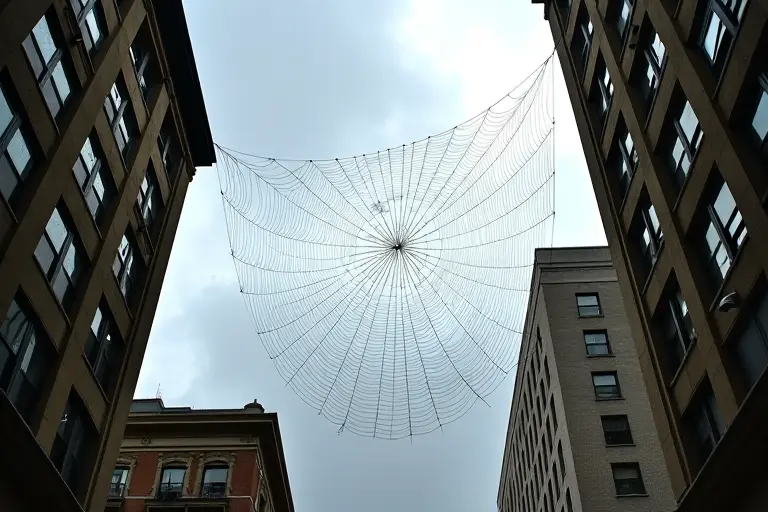
Orb-weaving spiders currently build webs up to about a metre across, limited by the structural anchors they can reach by climbing. A flying orb-weaver could span five metres easily. Ten, if the silk holds. The webs appear overnight, strung between lamp posts, across alleyways, between your car and the tree next to your parking space.
Morning commuters walking to the station would carry sticks in front of them like medieval banner-bearers, sweeping the air to clear webs at face height. This would become normal. Nobody would question it. Umbrella sales would spike, and not because of rain.
Motorways become a problem. Webs strung across carriageways at windscreen height don't stop cars, but they do splatter across the glass in a way that makes the current "bug on windscreen" issue look quaint. Washer fluid consumption triples. Someone patents a heated windscreen that burns through web silk on contact. They become very wealthy.
Indoors changes forever
Currently, spiders get into your house by walking through gaps, hitching rides on objects, or being carried in by the breeze as tiny spiderlings. It's passive. Accidental, mostly.
Flying spiders would enter your house on purpose.
An open window on a summer evening is an invitation. You know those moths that cluster around your bedside lamp? Add spiders. Not clustering around the light (spiders are generally light-averse) but flying in through the opening and immediately looking for a corner to colonise. They'd treat your ceiling like airspace, making short flights from one corner to another, spinning silk anchor lines as they go.
Window screens become standard everywhere, not just in countries with mosquito problems. The UK, where we've traditionally considered window screens a bit American and unnecessary, would adopt them within a single summer. Net curtains, those gauzy things your grandmother had, would experience an unexpected comeback.
Sleeping with the window open becomes a calculated risk. Air conditioning, which barely exists in British homes, suddenly has a purpose beyond the three hot days in August.
Arachnophobia goes airborne
About 3 to 6% of the global population has clinically significant arachnophobia. That's roughly 400 million people who experience genuine panic responses to spiders. Currently, those people cope by avoiding places where spiders congregate. Don't go in the shed. Don't look under the bath. Have someone else deal with it.
When spiders fly, there is nowhere to avoid them.
The psychology of the phobia shifts. Ground spiders are scary because they appear suddenly in unexpected places. Flying spiders are scary because they could be anywhere, at any time, coming from any direction. The terror becomes ambient. Background-level anxiety whenever you're outdoors. Therapy waiting lists for arachnophobia treatment would stretch to months. CBT clinics specialising in exposure therapy would run sessions outdoors, in parks, where flying spiders cruise past at regular intervals. Effective, probably. Pleasant, absolutely not.
The ecological cascade
Spiders already eat an estimated 400 to 800 million tonnes of insects per year. That's more than the weight of the entire human population, consumed annually by spiders. Most of this predation happens on webs or via ambush on the ground.
Flying spiders add aerial predation to the mix. They can now hunt flying insects directly, not just wait for them to blunder into a web. Mosquito populations crash. So do flies, gnats, and midges. In Scotland, the infamous midge clouds of the Highlands thin out. Outdoor weddings become tolerable. The Scottish tourism board sends a quiet thank-you note to evolution.
But cascading effects follow. Insect populations that are already under pressure (bees, butterflies, hoverflies) face a new aerial predator. Pollinators decline further. Crop yields suffer. The very spiders that reduced pest insects also reduce the beneficial ones. There's no editorial control over what a flying spider decides to eat.
Bird populations shift. Many birds eat spiders. A flying spider is more accessible than a hidden one, so some bird species benefit. Others face competition, because flying spiders are now hunting the same aerial insects that swallows, swifts, and flycatchers depend on. The food web reshuffles. Nobody can predict exactly how.
The sound
Nobody mentions this, but it matters. Insect wings produce sound. Mosquitoes whine at around 600 Hz. Bees buzz at about 230 Hz. A spider's wing frequency depends on its size and wingbeat rate. Small spiders might produce a sound similar to a midge: a faint, nearly inaudible hum. Larger species, the ones with real wingspan, would produce something closer to a low-frequency drone.
A garden full of flying spiders on a warm evening would have a sound. Not the pleasant hum of bees visiting flowers. Something less musical. More papery. The rustle of thousands of tiny wings, layered with the occasional thwip of silk being deployed mid-flight.
You'd get used to it. People get used to everything. But on quiet summer nights, lying in bed with the window cracked open (behind your new regulation spider screen), you'd hear them out there. Patrolling. Building. Hunting.
Sweet dreams.