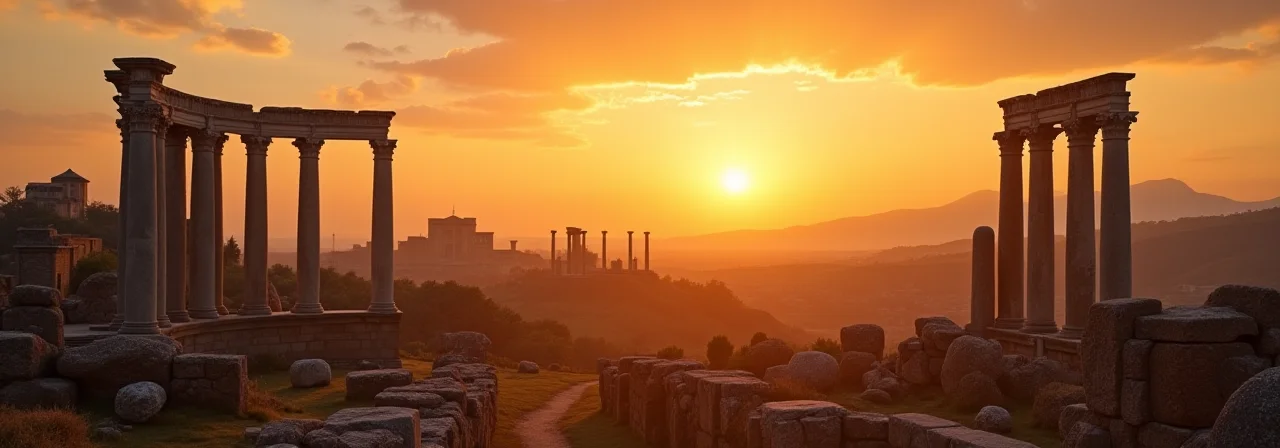
The fall of the Western Roman Empire in 476 AD is one of those historical events that keeps attracting people who feel it shouldn't have happened. It's treated almost as a mistake — an avoidable catastrophe that plunged Europe into centuries of disorder when it could have had continuous Roman administration, Roman engineering, Roman law.
The implicit assumption is that a surviving Rome would have been a better Rome. Probably a progressive Rome, steadily improving, gradually becoming something like what we have now but a thousand years earlier.
This is probably wrong in almost every interesting way.
What we mean by "the fall"
First, some basic housekeeping. The Eastern Roman Empire (which we call Byzantium, though the Byzantines never did) survived until 1453. Constantinople fell to the Ottoman Turks after a siege on 29 May of that year, which is almost exactly a thousand years after the date you're probably thinking of.
So Rome didn't fall. Half of it fell. The eastern half, which had the better harbours, the wealthier cities, and the more defensible geography, kept going and called itself Rome until the Ottomans explained that it wasn't anymore.
The Western Empire's collapse was real and consequential, but the historical record is messier than the clean narrative suggests. Odoacer, the Germanic king who deposed Romulus Augustulus in 476, didn't particularly think he was ending Rome. He sent the imperial regalia to Constantinople and nominally administered Italy under Eastern Roman authority. Many Roman institutions continued. The Senate kept meeting in Rome for another century.
"The fall" was a slow dissolution as much as a collapse, which matters for the hypothetical because it means there's no single fixing point to push against.
The most plausible survival scenario
Most serious alternate history on this question identifies the third century as the real inflection point. The Crisis of the Third Century, from 235 to 284 AD, saw the empire nearly disintegrate: fifty years of military anarchy, plague, economic collapse, and simultaneous invasions on multiple frontiers. Some fifty emperors in that period, most of them dead within two years of taking power.
Diocletian's reforms at the end of that crisis stabilised things, but the damage was lasting. Tax burdens increased sharply. The currency had been debased to the point where soldiers were demanding payment in kind rather than coin. The administrative complexity of running a territory stretching from Scotland to Mesopotamia had outgrown the tools available to manage it.
If you want Rome to survive, you probably need to prevent the Crisis of the Third Century, or at least blunt it. A more stable succession mechanism. Earlier administrative decentralisation. Perhaps a different handling of the Antonine Plague, which killed somewhere between 5 and 10 million people in the 160s and 170s AD, roughly a quarter of the empire's population in the affected regions.
Change any of those things and you get a different Roman Empire. But you don't necessarily get a better one.
The stagnation problem
Here's what the "surviving Rome would have been great" scenario tends to skip over: Rome was not an engine of technological progress. It was very good at building things it already knew how to build, and very thorough about administering territory it already held. But the rate of genuine innovation in the Roman world was low.
The steam engine had a near-miss. Hero of Alexandria, in the first century AD, built a device called the aeolipile, a hollow sphere mounted on an axle that spun when steam was vented through two nozzles. He described it as a novelty. No one industrialised it. This is often cited as evidence that the Romans were close to an industrial revolution and just didn't make the leap. The more honest reading is that they had abundant slave labour, which meant there was no economic pressure to replace it with machines.
A surviving Rome with a stable slave economy had little incentive to mechanise. The intellectual tradition was strong; Roman law remains the foundation of most European legal systems. But it ran alongside a labour market that actively discouraged labour-saving technology. The question isn't whether Rome could have had an industrial revolution. It's whether Rome as constituted would ever have had reason to want one.
What happens to Christianity
This is where alternate history of Rome gets genuinely complicated.
Christianity became the official religion of the Roman Empire under Theodosius I in 380 AD. The Western collapse and the subsequent fragmentation of Europe actually helped Christianity spread, in a somewhat paradoxical way. Local bishops became civic authorities. The Church filled administrative gaps that the empire left behind. The monasteries preserved literacy during periods when centralised education wasn't available.
A surviving Rome might not have needed Christianity to do any of that. A strong centralised empire has less space for religious institutions to accumulate independent power. It might have remained officially Christian, as it probably would have given the political investment by that point, but the relationship between church and state would look very different from the one that shaped medieval Europe.
Alternatively, with a different third-century trajectory, Christianity might never have reached official favour at all. That's not obviously good or bad. It's just a different world, built around different stories and different institutions.
The borders never holding
The other problem is the frontier. The Rhine and the Danube were always more administrative lines than actual barriers. Germanic groups had been crossing, settling, serving in Roman armies, and being absorbed into Roman administrative structures long before the fifth century. The Vandals, Visigoths, and Huns were not simply external forces that arrived and overwhelmed a stable system. They were partly products of a centuries-long border interaction.
A surviving Western Empire would still have had this frontier pressure. The Huns arrived in Europe around 370 AD, pushing Germanic populations westward regardless of what Rome was doing. Any survival scenario has to account for what a Roman Empire does when several hundred thousand armed people are being driven across its northern border by a nomadic confederation out of Central Asia.
The answer might be "handles it better than the historical empire did." It might be "eventually fails anyway, just a century later." The geographical problem (enormous frontier, declining population in some regions, increasingly mercenary army) doesn't disappear because the administration is more stable.
What Europe looks like
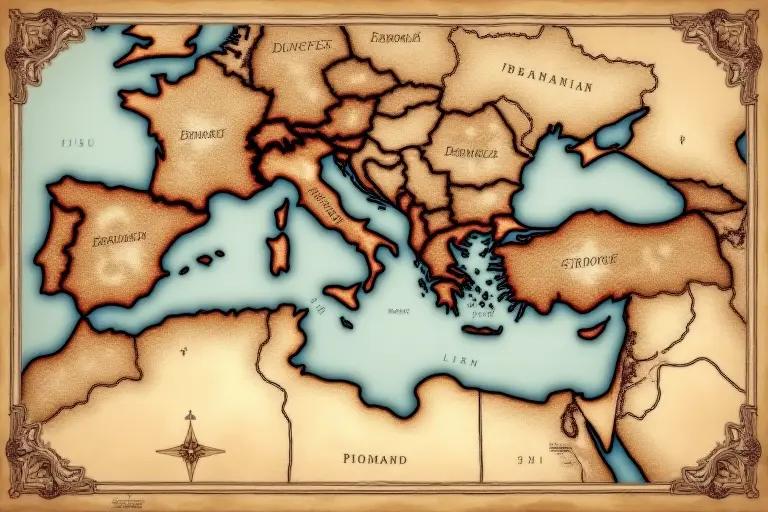
Assume the empire survives, somehow, past the fifth century and into the mediaeval period. No fragmentation into Frankish, Visigothic, and Lombard kingdoms. No Holy Roman Empire as a ghost of a memory. No gradual crystallisation of what would become France, Germany, Spain, England.
Nation-states as we understand them are, in significant part, a product of the post-Roman fragmentation. The idea of France is the idea that the Franks' territory, shaped over centuries of Frankish rule and gradually unified language and administration, constitutes a political unit. Remove the fragmentation and you remove the specific conditions that produced those identities.
You might get something like a Chinese model: a large empire that fractures and reunifies repeatedly, with a shared administrative and cultural tradition that makes reunification imaginable. Or you might get something more like the Ottoman Empire: a very long-lived multi-ethnic imperial structure that successfully absorbed enormous diversity but struggled to adapt when external pressures changed faster than the institution could respond.
What you almost certainly don't get is the particular ferment of competing states that drove European science, trade, and political development from roughly 1400 onward. The competitive state system — where England could lose to France and be forced to innovate, where the Italian city-states could experiment because no single power controlled them, where the Protestant Reformation could survive because there was no unified authority to crush it — that system was a product of fragmentation. Unification removes the competition.
The honest answer
A surviving Roman Empire probably produces a more orderly early mediaeval period and a worse modern one.
The things we value about the contemporary world: scientific method, liberal democracy, the abolition of slavery, religious pluralism. None of it emerged from a unified, stable empire. They emerged from the collision of competing traditions, the pressure of competing states, the upheaval of revolutions that only become possible when existing authority has been thoroughly disrupted.
Rome at its height was an impressive human achievement. It was also a slave state that executed dissidents, exported its culture by military force, and was not especially interested in the wellbeing of anyone outside its citizen classes.
Surviving Rome would have been Rome. Not us, arrived early. Rome, going on.
Whether that's better depends entirely on who, in that world, you'd have been born as.