On 3 September 1928, Alexander Fleming returned from holiday to his laboratory at St Mary's Hospital in London and found a petri dish he'd accidentally left uncovered. A mould had contaminated it, and around the mould, the staphylococcus bacteria he'd been growing were dead. He nearly threw it away.
If he had, or if the spore had landed somewhere else, or if Fleming had cleaned up properly before leaving, the entire trajectory of human medicine changes. Not gradually, not in some subtle academic way. Catastrophically.
The world before penicillin
We don't have to imagine what a world without antibiotics looks like. We can just look at the one that existed before 1928. It was appalling.
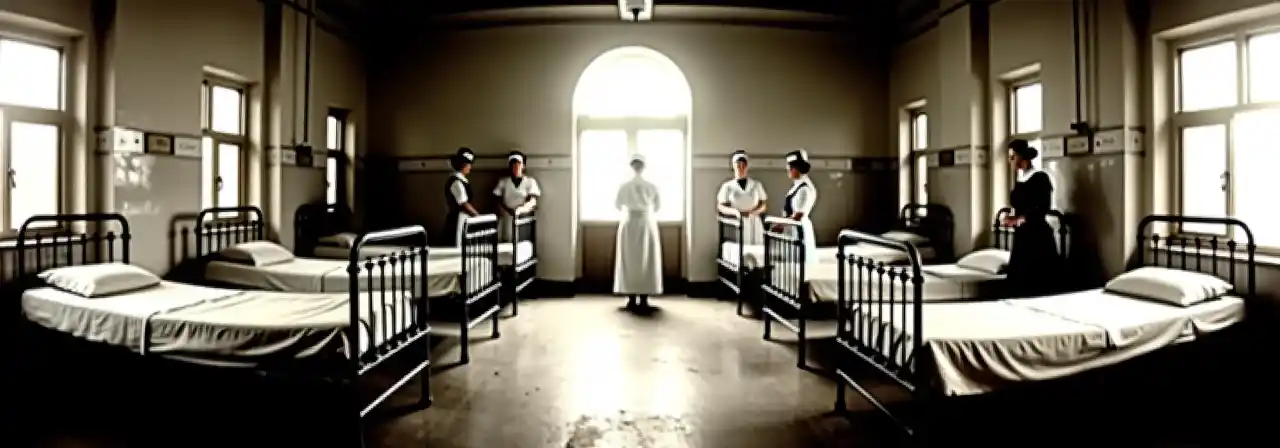
A scratch from a rose thorn could kill you. Not would, not always did, but could, and often enough that people took it seriously. Any break in the skin was an invitation for bacteria, and once infection set in, there was nothing to do but watch. Doctors could clean wounds, amputate limbs, and hope. That was the entire toolkit.
Childbed fever killed roughly one in a hundred women during childbirth in European hospitals during the nineteenth century, though some maternity wards hit rates of 10-35% during outbreaks. Surgeons operated in street clothes. Joseph Lister's antiseptic techniques, introduced in the 1860s, helped enormously, but antisepsis prevents infection from starting. Once bacteria are in your bloodstream, antiseptic on the skin doesn't help.
Pneumonia was called "the old man's friend" because it offered a relatively quick death compared to whatever chronic illness had weakened the patient enough to catch it. Tuberculosis killed roughly one in four Europeans during the nineteenth century. Syphilis was a slow, inevitable, brain-destroying sentence with no reprieve.
This was normal. This was just what life was.
Surgery stays primitive
Without antibiotics, surgery never advances beyond its 1920s capabilities. The problem isn't anaesthesia or technique (both were improving independently). The problem is that cutting someone open exposes their internal tissues to bacteria, and without antibiotics to fight the resulting infection, complex surgery is a coin flip.
Organ transplants don't happen. Not because we can't figure out the immunology, but because post-surgical infection kills patients before rejection even becomes relevant. Heart surgery doesn't happen. Joint replacements don't happen. Inserting foreign material into a human body is an infection risk even with antibiotics; without them, it's essentially a death sentence.
Cancer treatment is crippled. Chemotherapy works by destroying the patient's immune system alongside the cancer, then relying on antibiotics to keep the patient alive while their immune system rebuilds. Without that safety net, chemotherapy kills too many patients to be worth the risk. Cancer survival rates stay pinned at early-twentieth-century levels.
Dental care is more dangerous than it sounds. A tooth abscess, left untreated, can spread to the jaw, then the bloodstream, then the brain. In the pre-antibiotic era, this happened regularly. Dentistry without antibiotics means every extraction carries a small but real chance of fatal sepsis. People pull their own teeth rather than risk it. Or they don't, and they die.
Life expectancy
Global life expectancy in 1920 was approximately 32 years. By 2020, it had reached 72.6 years. Antibiotics aren't solely responsible for that leap. Sanitation, vaccination, nutrition, and public health all contributed. But antibiotics were the safety net beneath everything else. They made it survivable to be wounded, to give birth, to undergo surgery, to be old and frail with a chest infection.
Without them, the other advances still happen. Vaccines still work. Clean water still prevents cholera. Better nutrition still strengthens immune systems. But life expectancy probably plateaus somewhere around 50-55 in developed nations, because the infections that antibiotics routinely cure remain untreatable killers.
Infant mortality stays high. Neonatal sepsis, currently treated with a course of intravenous antibiotics, kills newborns at rates we'd find medieval. Ear infections in children occasionally become mastoiditis, then meningitis, then death. Parents in this world understand, in a way we've forgotten, that children sometimes die of things that seem minor.
The Second World War
Penicillin was mass-produced starting in 1943, primarily to treat wounded Allied soldiers. Before its deployment, roughly 15% of wounded soldiers with compound fractures died of infection. After, that figure dropped to less than 1%.
Without penicillin, the war's casualty figures are significantly higher. Not because more soldiers are hit, but because more of the wounded die. Field hospitals overflow. Recovery times triple. The logistical burden of caring for chronically infected soldiers strains supply lines that were already stretched thin.
D-Day still happens. The Allies still win, probably, because the strategic imbalance was industrial and numerical, not medical. But the human cost is substantially worse. Tens of thousands of soldiers who survived their wounds in our timeline die of infection in this one.
What medicine looks like instead
Medical research, denied its most powerful tool, focuses on prevention with an urgency that our timeline never required. Hygiene becomes an obsession surpassing anything we've seen. Hospitals are designed like clean rooms. Surgeons scrub for thirty minutes. Operating theatres have positive air pressure to prevent bacterial ingress. Every possible measure to stop infection before it starts is pursued with the desperation of people who know there's no plan B.
Phage therapy gets the investment that antibiotics got in our timeline. Bacteriophages are viruses that attack specific bacteria, and they were discovered in 1917, before penicillin. In our world, antibiotics were easier to use and more broadly effective, so phages were largely abandoned outside the Soviet Union. Without antibiotics, phage research becomes the primary weapon against bacterial infection. It works, in some cases, but it's harder to deploy. Each phage targets specific bacteria, so treatment requires identifying the exact infection first. There's no broad-spectrum phage equivalent of amoxicillin.
Immunotherapy research accelerates. If you can't kill bacteria with drugs, perhaps you can train the immune system to kill them more effectively. This line of research, in our timeline mostly applied to cancer, becomes the central focus of infectious disease medicine.
None of these alternatives fully replaces what antibiotics do. They help. They save some lives. But the casual miracle of taking a pill for ten days and curing a life-threatening infection never materialises. Medicine in this world is better than the nineteenth century, but nowhere near what we have.
The world we'd live in
People in this world are more careful. Not as a personality trait but as a survival strategy. Playground injuries are treated with genuine alarm. Cuts are cleaned immediately and watched obsessively for redness and swelling. Children are discouraged from roughhousing. Extreme sports don't exist as a category, because the risk calculus includes "might die of an infected graze."
Sex is more dangerous. Sexually transmitted bacterial infections (gonorrhoea, syphilis, chlamydia) are untreatable. Condom use isn't a choice; it's a medical necessity on par with wearing a seatbelt. The social consequences of this are hard to predict, but the sexual revolution of the 1960s probably doesn't happen in the same way when gonorrhoea can leave you infertile and syphilis eats your brain.
Farming is different. Roughly 73% of the world's antibiotics by weight are used in agriculture, not human medicine. Without them, intensive livestock farming as we know it doesn't work. Animals packed into confined spaces die of bacterial disease at rates that make the operations uneconomic. Farming stays smaller, more dispersed, more expensive. Meat is a luxury item, not a daily staple. This is arguably better for the planet, though the people who can't afford protein might disagree.
We got lucky with penicillin. A contaminated dish, an observant scientist, a war that demanded mass production. Remove any of those links and the chain breaks. The world without antibiotics isn't a dystopia. People lived in it for all of human history. It's just a world where infection is the background hum of existence, where every wound is a negotiation with death, and where the distance between a scraped knee and a funeral is shorter than any of us are comfortable imagining.