Eight hours. That's roughly a third of your life spent unconscious, drooling into a pillow, doing nothing productive. If you live to 80, you'll have slept for about 26 years. Twenty-six years of lying in the dark with your eyes closed.
What if you could skip it?
Not insomnia. Not sleep deprivation. A clean biological switch: you simply don't need sleep any more. No tiredness, no cognitive decline, no health consequences. You're as sharp at 4 a.m. as you are at 10 a.m. Sleep becomes something you can do, like a hobby, but never something you must do.
Most people's first thought is freedom. Eight extra hours a day to learn guitar, write a novel, spend time with family.
Most people's first thought is wrong.
The economy adjusts within weeks
If everyone gains eight usable hours per day, the global labour pool doesn't just increase. It explodes. There are roughly 3.5 billion people in the global workforce. Each one just gained 56 hours per week. That's the equivalent of adding 2.3 billion full-time workers to the planet overnight, without a single new person being born.
Employers notice this immediately. If you don't need sleep, why aren't you working? The question starts as a cultural nudge and hardens into policy within a generation.
The precedent is already there. When electric lighting became widespread in the late 19th century, working hours didn't decrease. They increased. Factory owners realised that if workers could see, workers could work. Night shifts proliferated. The eight-hour workday that labour movements fought for was a response to 14- and 16-hour days that electrification had made possible.
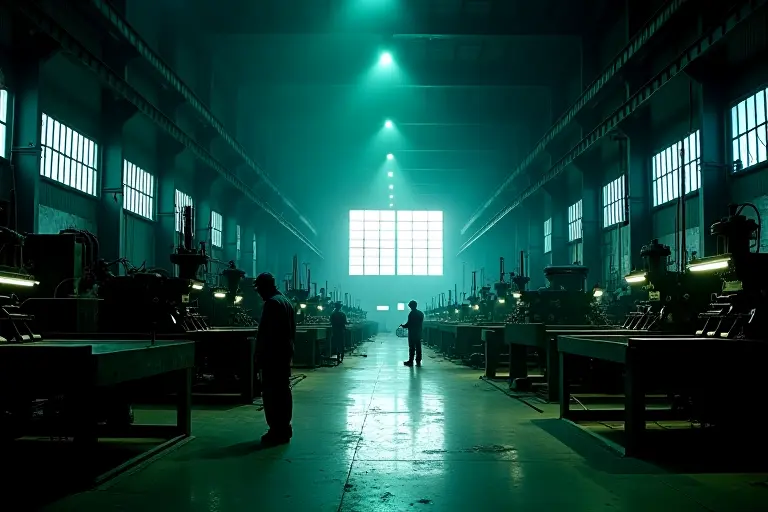
Remove the biological need for sleep and the same logic applies, except this time there's no physical limit to push against. You can't argue that you're exhausted. You're not. You can't claim you need rest. You don't. The only argument left is that you'd prefer not to work those hours, and employers have never found that particularly convincing.
The 16-hour workday
Within a decade, the standard workday settles somewhere around 14 to 16 hours. Not because anyone mandates it formally, but because competitive pressure makes it inevitable. The company that runs 16-hour shifts outproduces the company running 8-hour shifts. The worker willing to do 14 hours gets the promotion over the one doing 10.
Your extra eight hours didn't become free time. They became expected output.
This isn't speculation. It's pattern recognition. Every time human capacity has expanded, economic systems have absorbed the surplus. Agricultural mechanisation was supposed to free people from manual labour. It freed them into factory work. Computers were supposed to reduce working hours. They created the expectation of constant availability. Email was supposed to make communication faster. It made communication permanent.
The pattern has a name in economics: the Jevons paradox, originally about coal consumption but applicable here. When you make a resource more efficient, you don't use less of it. You use more. Human waking time is a resource. Make it 50% more abundant and it will be consumed, not conserved.
Leisure mutates
With 16 waking hours outside of work (assuming even a 16-hour workday leaves eight), the leisure industry would transform. Restaurants that currently close at 11 p.m. stay open until 3 a.m. Gyms are packed at midnight. Cinema showings at 2 a.m. become routine.
The concept of "evening" as a distinct period ceases to exist. There's work, and there's not-work, and not-work happens whenever you're not at your job. Tuesday at 4 a.m. becomes as valid for grocery shopping as Saturday at noon.
Cities never go quiet. The 3 a.m. emptiness of a residential street, that particular silence where you can hear a fox rummaging through bins, vanishes. There's always someone mowing a lawn, always a car on the road, always a light in every window. The world becomes permanently active. Permanent dayshift.
Noise complaints would spike. Or rather, the concept of a "quiet hours" policy becomes meaningless when nobody sleeps. Your neighbour's 2 a.m. drum practice is no longer antisocial. They're simply using their time.
Relationships change shape
Sleep is the one part of the day where couples are guaranteed to be in the same place doing the same thing. Lying next to someone in the dark, even if you're not talking, creates a kind of intimacy that nothing else replicates. It's a shared vulnerability. Remove it and relationships lose their natural pause.
Partners with different interests or social circles would simply drift into parallel lives under the same roof. You're painting at midnight while they're out running. You're watching a film at 3 a.m. while they're at a book club. The sleeping hours that currently force co-presence disappear, and nothing structurally replaces them.
Families with children face a different problem. If adults don't need sleep but children do (their developing brains presumably still require it), parents gain hours of childcare capacity. This sounds positive until you realise that employers know parents are awake all night and adjust expectations accordingly. "You don't need sleep, so the 11 p.m. meeting works for you, right?"
Mental health in a world without rest
Sleep isn't just downtime for the body. It's when the brain processes emotions, consolidates memories, and clears metabolic waste products. During deep sleep, the glymphatic system flushes cerebrospinal fluid through brain tissue, carrying away beta-amyloid proteins and other debris. A 2013 study in Science found that this cleaning process is 60% more active during sleep than during wakefulness.
In this hypothetical, we've assumed sleep becomes biologically unnecessary, so presumably the brain finds another way to handle this. But what sleep also provides is psychological rest. A boundary between days. A reset. You go to bed feeling awful and wake up feeling slightly less awful. Not because anything changed, but because consciousness paused long enough to let the intensity fade.
Without that pause, bad days don't end. They just continue. A terrible Monday stretches into Tuesday without interruption. The argument you had at dinner is still happening in the same unbroken stretch of consciousness when the sun comes up. There's no "sleeping on it." There's no "things will look better in the morning."
Burnout in a sleepless world wouldn't look like exhaustion (you can't be exhausted). It would look like a low-grade, unrelenting emotional flatness. The accumulated weight of experience with no natural discharge point.
Who benefits?
Parents of newborns. There's no contest. The single greatest beneficiary of optional sleep is anyone who currently has a screaming infant at 3 a.m. and has to function at work six hours later. If you don't need sleep, night feeds stop being torture and start being just another part of the day.
Students cramming for exams. Shift workers. Surgeons doing 18-hour operations. Anyone whose work is limited by human endurance rather than skill gains an obvious advantage.
But the gain is temporary. Once everyone has extra hours, the competitive advantage disappears. You're not special for being able to work until 2 a.m. Everyone can. The baseline shifts upward and the relative position stays the same, except now you're working twice as many hours for the same standing.
This is the treadmill. You can't step off because everyone else is on it too.
Be careful what you wish for
There's a reason "I wish I didn't have to sleep" is one of the most common idle fantasies. Sleep feels like wasted time. It feels like something imposed on you, an inefficiency in the human design.
But sleep is also the only part of the day where nobody can reach you. No emails, no notifications, no obligations, no decisions. It's the one socially acceptable excuse for being completely unavailable. "I was asleep" is the universal get-out. Employers accept it. Friends accept it. Society accepts it.
Take that away and you're available 24 hours a day, seven days a week, every week, forever. Not because you chose to be. Because you have no reason not to be.