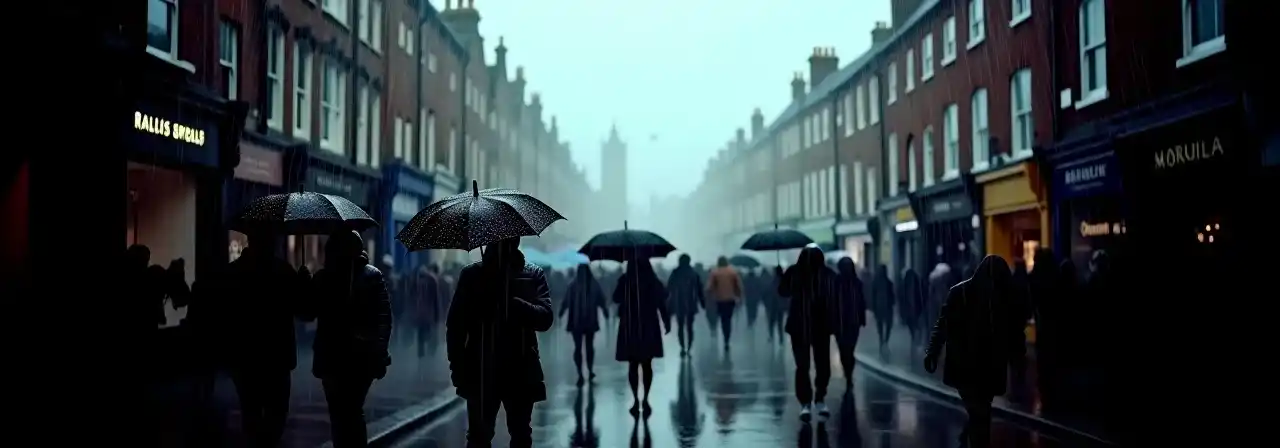
Let's be specific about this. Every raindrop that falls from the sky now has the adhesive properties of honey mixed with PVA glue. It sticks to whatever it touches. It sticks to other raindrops. It sticks to you, your car, your house, your dog, the pavement, the trees, and itself. Once it lands, it doesn't run off. It clings.
Britain receives approximately 1,126 millimetres of rainfall per year. All of it is now sticky.
We are not going to be fine.
The first shower
Nobody notices immediately. The first drops hit the pavement and just sit there, slightly more viscous than expected. People glance at the sky. "Bit thick today," someone in Manchester says, because Manchester has been training for this exact scenario since 1853.
Within ten minutes, everything outdoors has a thin, tacky film. Pavements become flypaper. Shoes stick slightly with each step, making a faint sucking noise. Walking becomes that thing where you step on chewing gum and can't quite shake it off, except it's everywhere and it's getting worse.
Dogs panic. Birds can't fly. A pigeon in Trafalgar Square manages three wingbeats before its feathers glue together and it drops out of the air like a tennis ball dipped in syrup. Within an hour, the square is carpeted in immobile pigeons. For many Londoners, this is the first positive development.
Cars
Windscreen wipers are finished. They make one pass across the glass and stop, permanently bonded to the windscreen in a half-arc of congealed rain. Drivers who were mid-journey find their visibility dropping to zero as the sticky layer accumulates. The M25, already a car park on dry days, becomes one permanently. Vehicles sit in the rain getting slowly encased, like insects in amber but with worse traffic news.
Tyres stick to the road. That sounds helpful, actually, until you realise it means the car can't roll. The friction coefficient is so high that engines stall trying to overcome it. Lorries jackknife. A single rainstorm turns every motorway into a museum exhibit of vehicles frozen in place.
The AA issues a statement advising motorists to "remain indoors during precipitation events." This is indistinguishable from their normal advice for snow, ice, fog, sun, wind, or Tuesday.
Infrastructure
Rain gutters clog immediately. The whole point of a gutter is that water flows through it, and sticky rain doesn't flow anywhere. It accumulates. Rooftops gain weight at an alarming rate. An average UK roof collects about 85,000 litres of rainwater per year. If none of that runs off, the structural load eventually exceeds what the rafters can handle. Houses don't collapse dramatically. The roof just sags over weeks, like a tent in heavy snow, until something gives.
Drains back up. Streets flood, but not with water. With a slowly thickening, honey-like sludge that doesn't drain because it sticks to the inside of every pipe it touches. Civil engineers start drinking.
Power lines accumulate layers of sticky residue. Weight increases. Lines sag, then snap. Transformers short out. The national grid, already running on optimism and deferred maintenance, fails region by region.
Agriculture
Crops are destroyed. Plants need rain to land on leaves, run down to roots, and soak into soil. Sticky rain lands on leaves and stays on leaves. The leaf surface gets coated, blocking sunlight. Photosynthesis stops. The plant suffocates under a layer of organic glue.
Soil can't absorb the rain because it never reaches the soil. The ground beneath a rainstorm stays bone dry while the surface above it gets progressively more adhesive. Farmers can't plough because the plough sticks to the ground. Tractors can't move because the tyres stick to the field. The entire agricultural supply chain halts the first time it rains on a Tuesday in April.
Livestock fare worse. Sheep, already 90% wool by volume, become enormous sticky puffballs. They adhere to fences, to each other, to the ground. A flock caught in a downpour becomes a single collective sheep-mass from which no individual animal can escape. Shearing becomes a rescue operation.
People
Umbrellas become the most important technology on Earth. Not the flimsy folding ones from Primark. Proper engineered umbrellas with drainage channels, non-stick coatings, and structural reinforcement. You'd need something closer to a personal roof than a traditional umbrella. The rain doesn't bounce off it; it sticks and accumulates, so your umbrella gets heavier with every passing minute. Carrying one for a full British drizzle (which can last for seven hours without technically qualifying as "rain" by Met Office standards) would require genuine upper body strength.
Outdoor clothing is reinvented from scratch. Every surface that contacts sticky rain needs a non-stick coating. Gore-Tex is obsolete. We need Gore-Teflon. Waterproof stops being the standard; rain-repellent at a molecular level becomes the minimum spec for stepping outside.
Laundry that was hanging on the line when the rain started is ruined. Not wet-ruined. Permanently-bonded-to-itself ruined. Your favourite shirt is now a solid textile brick. The line it was hanging from is now a suspension bridge for shirts.
The economy
Britain's GDP is approximately £2.27 trillion. Most of this relies on things moving between places. People commuting to offices. Lorries delivering goods. Ships arriving at ports. All of these stop when it rains, which in Britain is between 150 and 200 days per year. You're looking at the economy functioning at roughly half capacity, and that's being generous.
Construction halts every time a cloud appears. Outdoor events become impossible. Tourism collapses. The entire pub garden industry vanishes. Sport, already the nation's collective coping mechanism, becomes indoor-only. Wimbledon finally installs a roof on every court, which it probably should have done decades ago anyway.
House prices in covered areas skyrocket. Anywhere with a permanent roof over public spaces becomes prime real estate. Shopping centres, already dying a slow death to online retail, experience an unexpected renaissance as the only places where you can walk around without being glued to the floor.
Global consequences
Equatorial regions with daily rainfall become virtually uninhabitable. The Amazon basin glues itself shut. Monsoon season in South Asia isn't a weather event any more; it's a civilisation-ending adhesive tsunami. Desert nations, previously disadvantaged by lack of rainfall, become the most functional economies on Earth. Saudi Arabia, receiving a mere 59 millimetres of rain per year, barely notices the change.
There is a mass migration toward dry climates. The Sahara, the Australian outback, the Atacama Desert. Property developers descend on Death Valley. Dubai builds seventeen new indoor cities and nobody even thinks it's unusual.
The British, characteristically, refuse to leave. "It's just a bit of rain," they insist, peeling themselves off the bus shelter with a sound like separating Velcro, already late for work and stuck to a stranger's coat. The national character is, if nothing else, waterproof. Even if nothing else is.