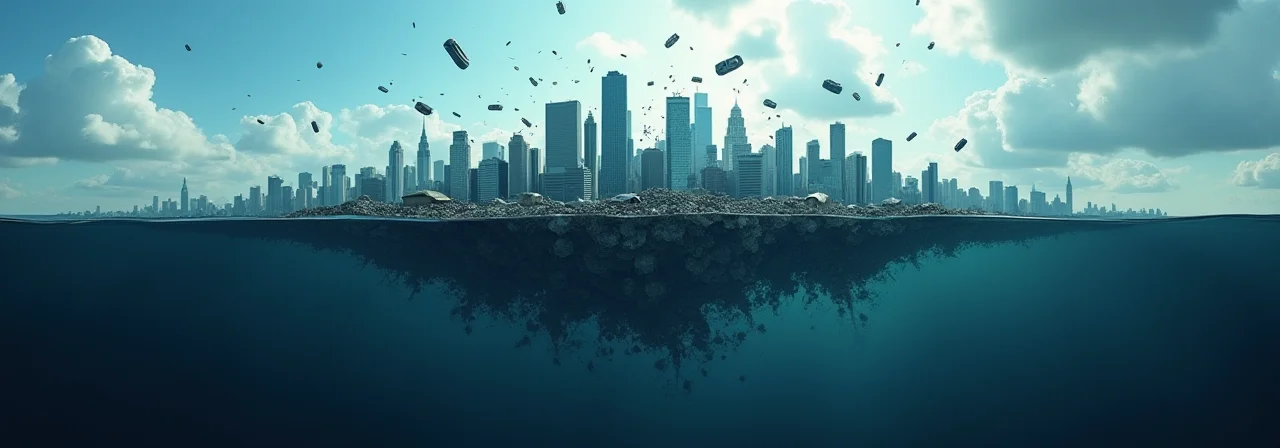
I want you to imagine something. You're sitting in your chair, coffee in hand, scrolling through your phone. Then, without warning, you feel yourself lifting. Your coffee rises from the mug in a perfect sphere. The chair beneath you falls away from you. Or rather, you fall away from it. Upward. Toward the ceiling.
Gravity has reversed.
Not weakened. Not vanished. Reversed. Every object on Earth now falls upward with the same 9.8 m/s² we've always known, just pointed the wrong way.
The first ten seconds
The chaos is immediate and total. Every human, animal, vehicle, and unsecured object on the planet simultaneously launches toward the sky. You hit your ceiling in about 0.45 seconds if you were sitting. The ceiling becomes your floor. Briefly.
But ceilings aren't designed to be floors. Most residential ceilings are plasterboard screwed to joists. Within seconds, the weight of everything in the room tears through. You're now falling upward through your attic, then through your roof tiles, then into open sky.
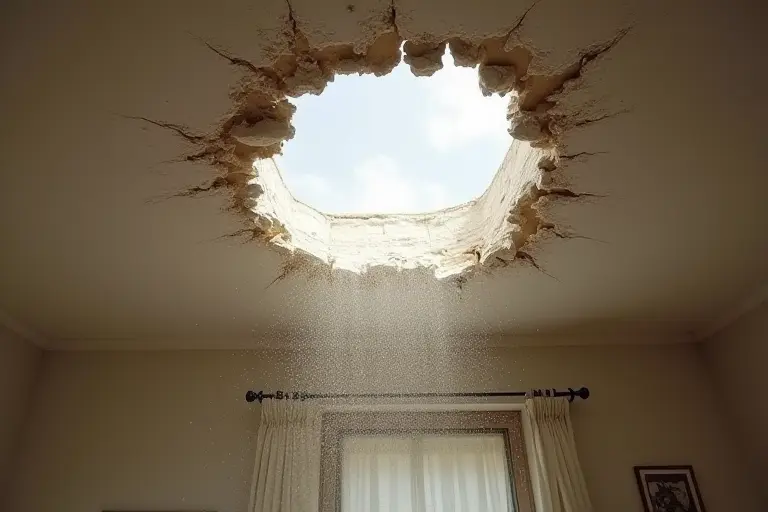
Buildings don't survive this. They were engineered for downward load. Foundations anchor buildings against lateral forces, not against the ground itself rejecting them. Structures rip free and tumble skyward like leaves in a gale.
The oceans
Earth's oceans contain roughly 1.335 billion cubic kilometres of water. All of it is now falling upward. Not slowly rising. Falling, with the same acceleration you feel when you drop a tennis ball off a bridge.
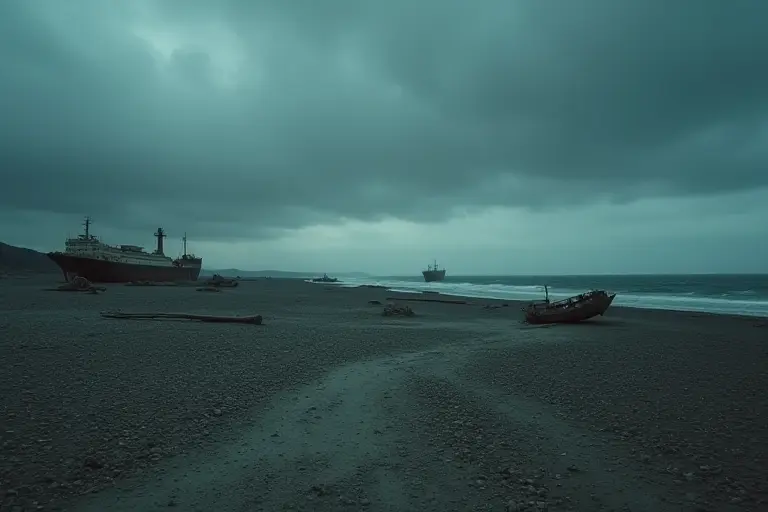
The ocean peels off the seabed in enormous sheets. Marine life, ships, submarines, the lot. Within minutes, a shell of seawater is rising through the atmosphere, spreading, thinning, cooling as it climbs. The mid-Atlantic ridge sits exposed for the first time in four billion years. Nobody is around to see it.
The atmosphere
Air has mass. About 5.15 × 10¹⁸ kilograms of it. The entire atmosphere begins falling away from Earth's surface into space. Air pressure at ground level drops to near-vacuum within five minutes.
If you somehow survived the initial ceiling impact and the building collapse, you now can't breathe. Your lungs are trying to pull in air that isn't there any more.
Could anything survive?
Deep underground, maybe. Miners in a shaft hundreds of metres down would experience the reversal (they'd slam into what was their ceiling) but the rock around them stays put. It's interlocked, compressed, held in place by its own weight pressing sideways against tunnel walls.
Submarines deep underwater might last the initial seconds, but once the ocean lifts away they'd be suspended in thinning air, then falling upward with everything else.
There's a horrible irony here. The people furthest from the sky are the only ones who might live long enough to notice what happened. Everyone else is gone in under a minute.
The planet itself
Earth is held together by its own gravity. Reverse it and the planet doesn't just sit there while surface objects fly off. The Earth expands. Every particle of rock, magma, and iron in the core now repels every other particle. The planet tears itself apart from the inside out.
Within hours, the Earth is an expanding cloud of debris mixed with its oceans and atmosphere, all flying outward into space. The Moon, still attracted to nothing (since the reversed gravity pushes everything apart), drifts away untethered.
So what?
This thought experiment is useful because it shows how much work gravity does that we never think about. It's not just keeping your feet on the ground. It's holding the atmosphere in place. Keeping oceans in their basins. Compressing the planet's core into a solid ball. Allowing the sun to maintain fusion.
Take it away and nothing holds together. Reverse it and nothing holds together faster.
Next time you're annoyed at how heavy your shopping bags feel on the walk home, consider the alternative.